
Adventures in the Archives: Fancy Goods, Fireworks, and Fun
by Ashley Adams Serveiss, Collections Manager & Archivist
Welcome back to another episode of Adventures in the Archives, where this week, we will ponder what fancy goods, fireworks, and fun have to do with each other. You may be asking yourself, what exactly constitutes a fancy good? In 19th century commerce, “fancy goods” stores distinguished themselves from bulk or dry goods purveyors — that’s to say, those stores which sold flour, grain, or other food products that would have been purchased in large quantities. Fancy goods, on the other hand, were not necessarily expensive, though they were in fact fancy. Let me explain.
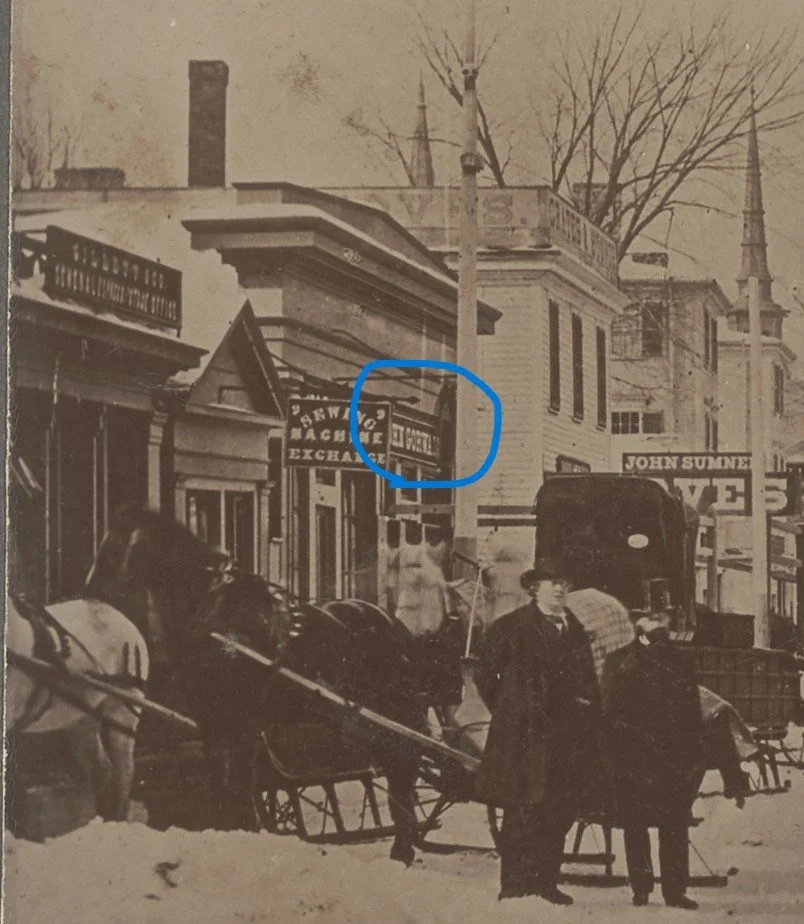
The John Gorwaiz store can be seen in the background in this image in the Snow Photo Collection at the Museum of Old Newbury
In 1870, John Gorwaiz (1833-1912) opened his business, “John Gorwaiz’s Cheap Store,” which specialized in fancy goods. The store, located at 11 Pleasant Street in Newburyport, was part of a growing movement to appeal to a burgeoning middle and upper middle class during the mid-late 19th century. Imported and domestic goods were being produced at a much faster rate than ever before due to rapid industrialization and expanding global markets. As a result of this, the consumer habits of the middle and upper middle classes began to evolve. Those aforementioned middle class groups had disposable income, which could be used to purchase — you guessed it — fancy goods.
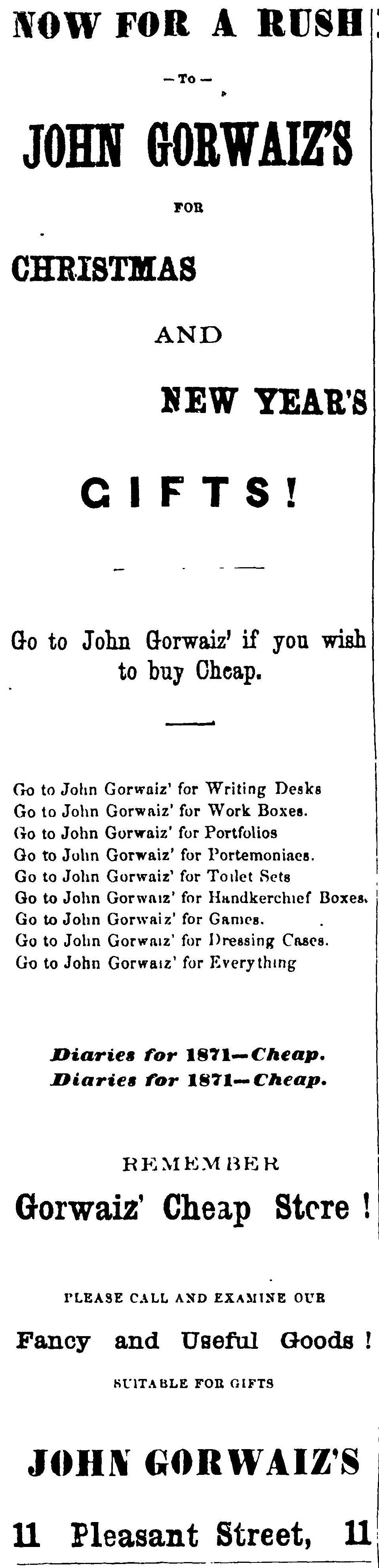
An advertisement for John Gorwaiz’s Cheap Store, published in the Newburyport Daily Herald, Thursday, December 15th, 1870.
So what are fancy goods, exactly? Like I mentioned before, they aren’t basic household staples. Instead, fancy goods can be thought of as readily available goods, usually decorative small wares, toys, accessories, or personal luxuries. Imagine a selection of dainty fans, stationery, scarves, trinket boxes, children’s toys, tableware, and, in the case of John Gorwaiz, all of that, plus fireworks and pharmaceutical medicines! The average customer could certainly accomplish some pretty unorthodox one-stop shopping at Gorwaiz’s. If you put fireworks and the patent medicines of the 1870s together, you’d be looking at one heck of a Saturday night.
Despite a mountain of ads in the local papers, I found very little about John Gorwaiz as an individual. What we do know is that he lived at 207 High Street in Newburyport. He was married to Hannah (nee Wiggin) Gorwaiz until her death in 1881. A few years later, in 1888, John married again, this time to Aroline Lermond of Thomaston, ME, who was a dressmaker and the daughter of Charles and Rebecca Lermond (you can read about their beautiful house in Maine here). Throughout his career as a purveyor of fancy goods, John never faltered in offering a bizarrely attractive range of products, spanning from porte-monnaies (wallets), dressing combs, and handkerchiefs to tinware, patent medicines, and explosives. Whatever the buyer’s taste may have been, it appears that Gorwaiz was willing and ready to accommodate his customers with his expansive selection of unique offerings.
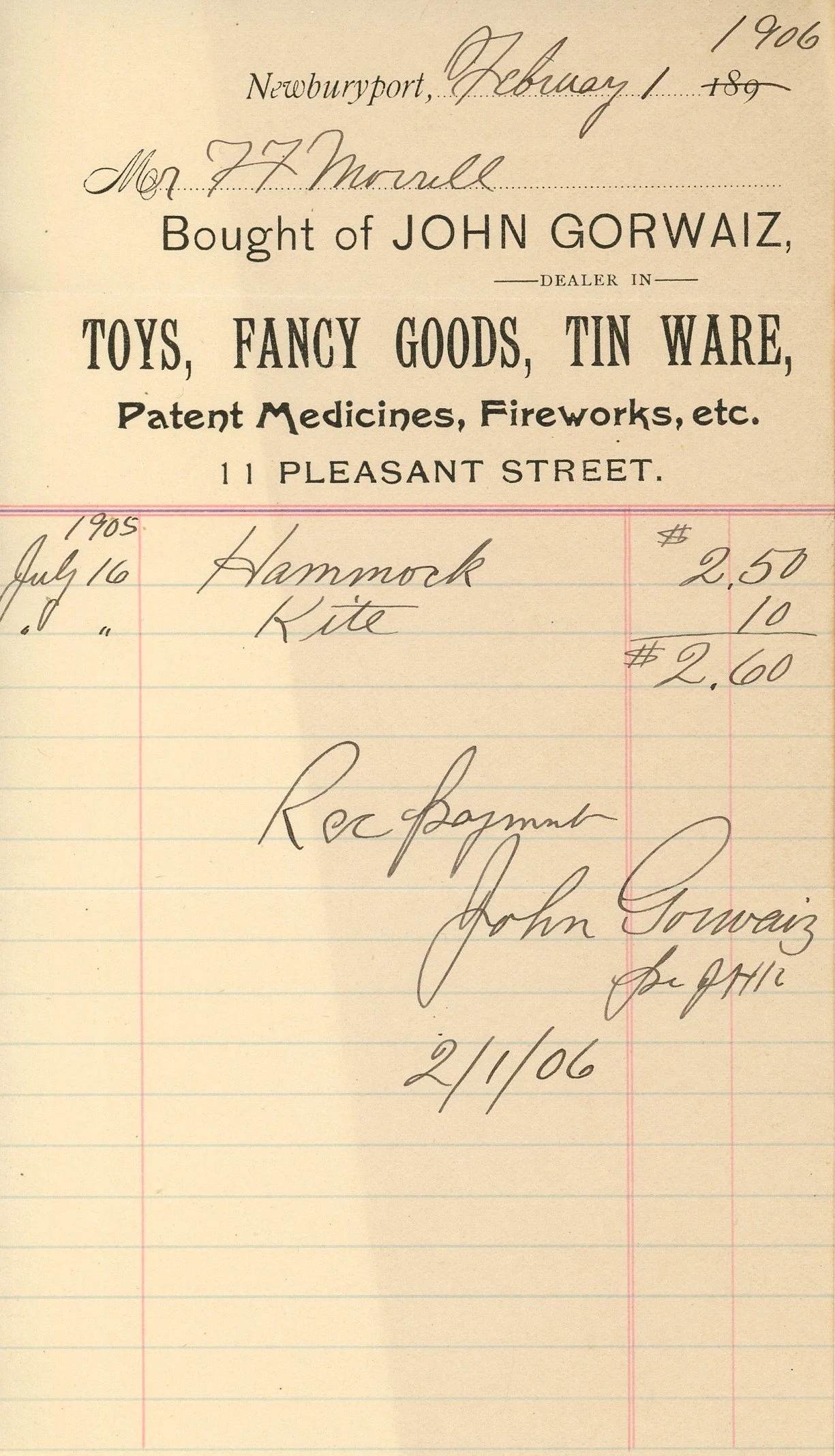
A receipt from our Business & Industry Collection at the Perkins Art & Research Center. Frank Forrest Morrill, the customer, purchased a kite and hammock — perfect for a summer’s day spent outdoors. Object ID: JohnGorwaiz.001