
Shot, Bludgeoned, Drowned, and Stabbed: Dr. Perkins, the Farm Boy, and the Tattooed Man
by Bethany Groff Dorau
Shortly before nine o’clock on Saturday evening, September 15, 1855, John Warren Randall and his friend got off the train on Washington Street, walked downtown to Brown’s store, and then continued up State Street into the countryside. Randall, a Maine farm boy and son of a village minister who had recently died, believed that he was going to meet a shipmaster who needed a cook for a voyage to the East Indies, and could make good money to support his widowed mother. Instead, he was being led toward a thicket next to the Little River where his friend and travelling companion would lead him into a trap. The plan was to rob him, kill him, and leave his body mutilated beyond recognition.
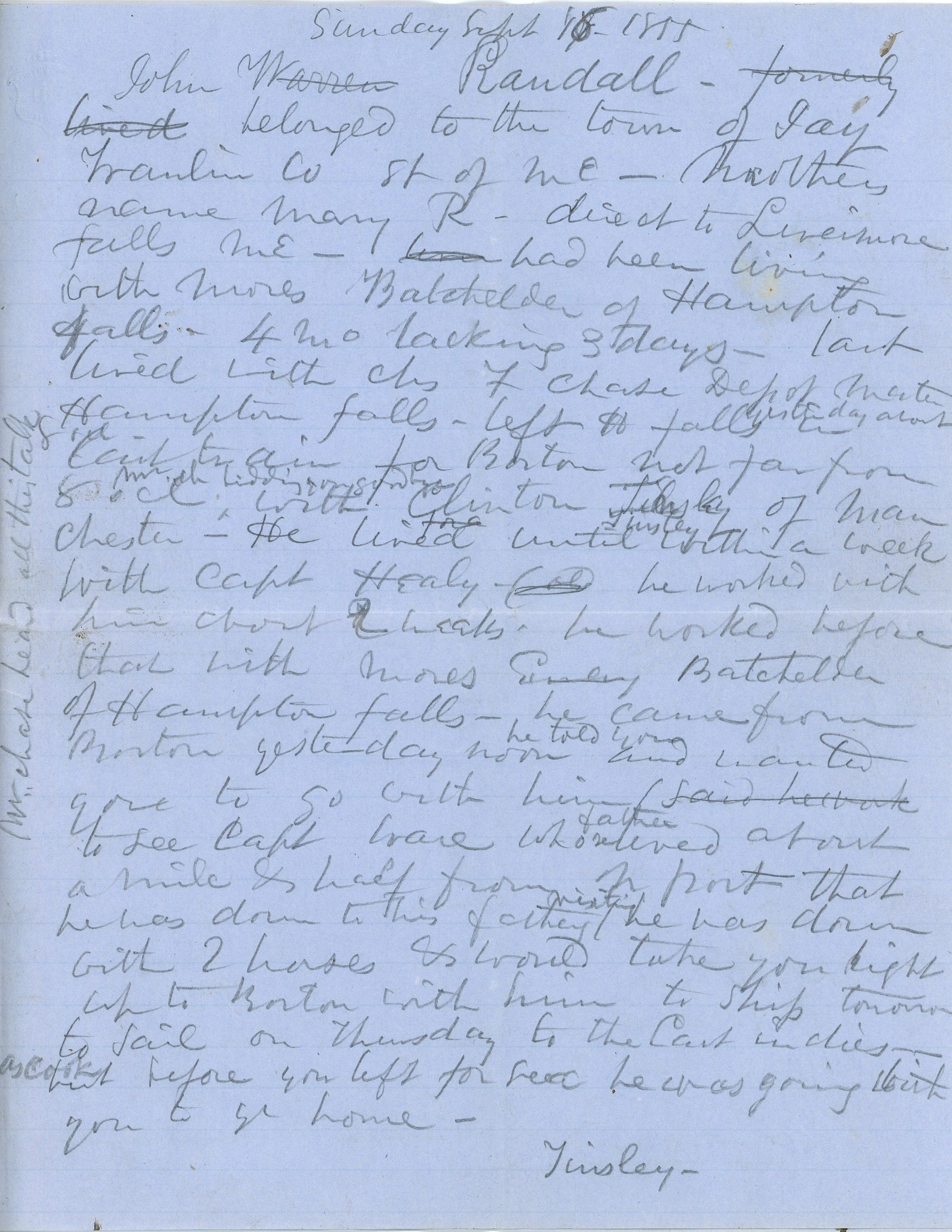
Within hours of the subsequent attack, Dr. Henry Coit Perkins, Newburyport’s most esteemed physician and the de facto medical examiner, rushed to interview Randall with a few others to ascertain the facts of the case. Dr. Perkins, born at the Wolfe Tavern on State Street on November 13, 1804, son of Wolfe Tavern manager Thomas Perkins and Elizabeth Storey, graduated from Harvard in 1824, received his medical degree in 1827, and returned to Newburyport to practice. These pages are Dr. Perkins’ scribbled, crossed-out, notes from what appear to be several conversations with Randall and others. He used the first person and second person for Randall interchangeably, perhaps because someone is speaking for the grievously injured man.
I stumbled across this case while researching a completely different topic - Perkins’ pioneering experiments with photography - and I wrote a short piece about these records last week. I was captivated by Perkins’ descriptions of the tattoos and clothing of one of the assailants. Records like these provide details that rarely surface in the historical record. Sometimes a document catches my eye, I make a note of it, and I put it aside. This one kept coming back to me.
Like a moth to the flame…
I decided I would see what I could find about this case, which required transcribing, genealogy, and old maps, deeds, and wills. Afternoon turned to evening, evening to night. The phone rang. It was my husband, wondering if I was ever coming home. “I can’t talk right now,” I said. “I’m solving crimes!”
I did not solve this crime, and the conclusion of this case is deeply unsatisfying, as I will explain in a moment, but I did meet a young man I will never forget, and found quite a lot to both love and loathe in the Newburyport of the 1850’s.
If you’re still interested, at the end of this story there is a full transcript of Perkins’ notes, as best I can decipher them.
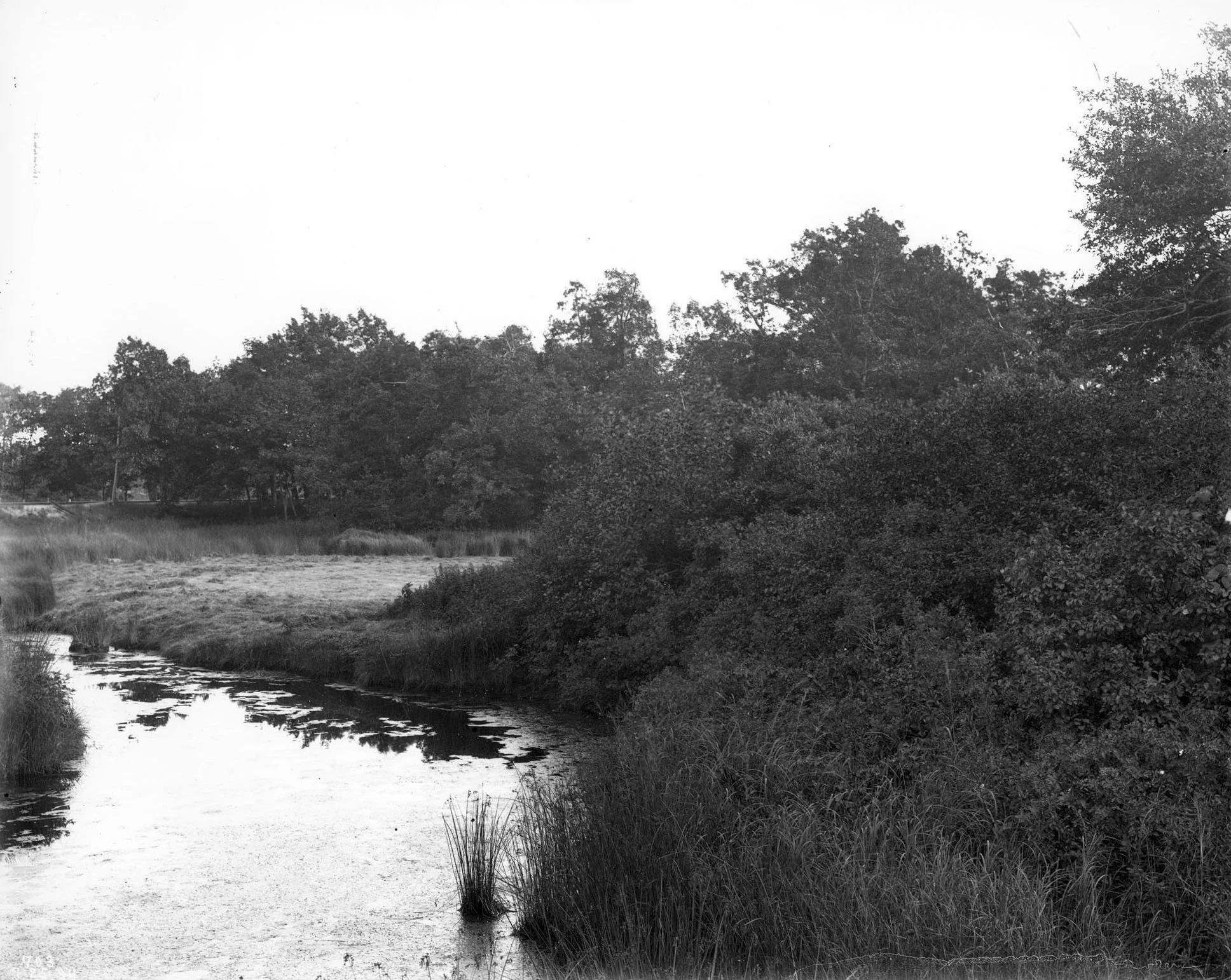
Little River from Floyd’s Lane by John White Winder, 1894. The attack took place along these banks. Collection of the Museum of Old Newbury
John Warren Randall was born in 1833 in Jay, Maine, a town of around 1600 people along the Androscoggin River. His father’s headstone identifies him as Rev. John Randall, though local records are fragmentary. John Randall senior was likely a lay preacher of the Freewill Baptist Church, a revivalist denomination that quickly spread around the area in the early 19th century thanks to the fervent advocacy of Benjamin Randall, a relative. I can find no birth records for either John Randall, father or son. His mother, Mary Ross, was a descendant of Anne Hutchinson and Mary Dyer and so am I, so, as it turns out, the unfortunate John Warren Randall is my 4th cousin (5x removed). But, I digress.
What can be known is that John Warren Randall was 12 years old when his father died in 1845. and he next appears in the record, age 17, living with his mother, brother, and two older sisters. Their farm is valued at $250, the poorest farm on the census page, and life must have been a daily struggle.
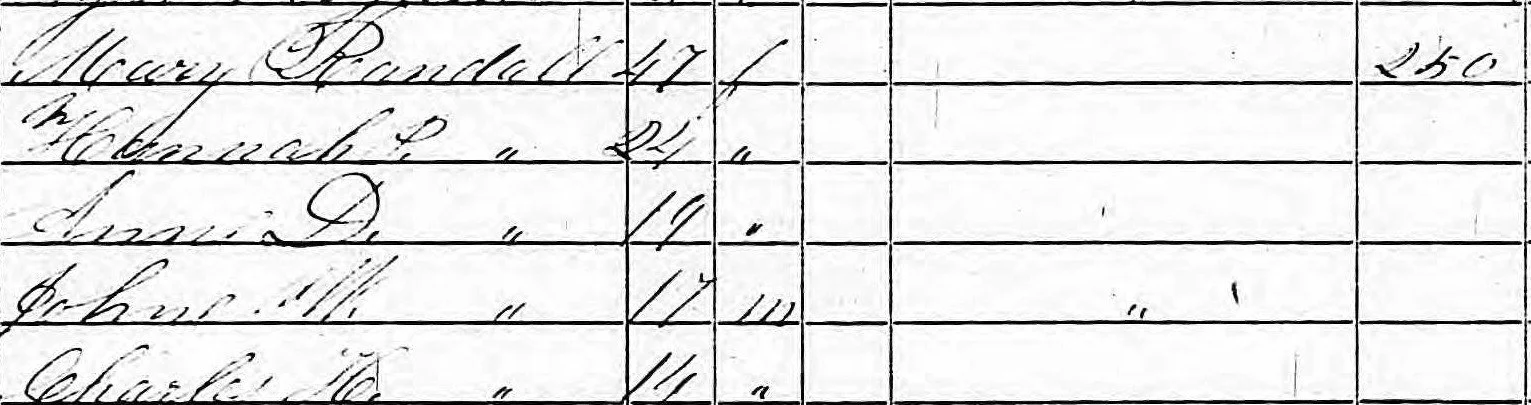
The 1850 census for Jay, Maine, lists Mary Randall, 47, and her children, Hannah P., Anna D., who would later marry George Pillsbury, John W, and Charles H.
Farms in Jay at the time average about $800 in value, while their farm was listed at just $250.
John Randall was sent out to find work to support his struggling family. By 1855, he had made his way to the farm of Moses Batchelder of Hampton Falls, New Hampshire. Batchelder, who also owned clam flats and part of a grist mill in Hampton, had a large and very successful farm in Hampton Falls. In the same 1850 census that saw the Randall family’s farm valued at $250, Batchelder’s farm was valued at an astonishing $6000. Randall worked for Batchelder, and also for Charles Chase, the Hampton Falls Depot master. Randall was a hard worker, and by September 15, 1855, the 23-year-old had managed to save $69 in cash and had purchased a watch worth $15. Clinton Tinsley, the tattooed man, met Randall at the depot, and Chase, the Hampton Falls Depot master, later confirmed to Perkins that Tinsley was aware that Randall had saved a lot of money.
Tinsley, said to be from Manchester, New Hampshire, had been working around Hampton Falls and was acquainted with several members of the Batchelder family. Six days before the attack, he and a sailor named John Delany reportedly visited the Hampton Falls Depot and tried to persuade Randall to leave with them, saying there was high-paying work to be found in Boston. When Randall protested that he was employed and could not leave immediately, one of the men offered him $10. Not wanting to inconvenience his employer (what a guy!), Randall declined.
On September 15, Tinsley returned from Boston with a more elaborate proposition. A Captain Weare, he claimed, needed a cook for a vessel sailing for the East Indies. The position paid $18 per month, and Captain Weare was supposedly visiting his father, who lived about a mile and a half from Newburyport. Randall could get the job and then head back up to Maine to say goodbye to his widowed mother and give her his savings before heading back down to Boston, where his trunk, and his life at sea, would be waiting. Tinsley even promised that he would keep John Randall company on his trip home. It was a completely plausible plan, and Randall agreed.
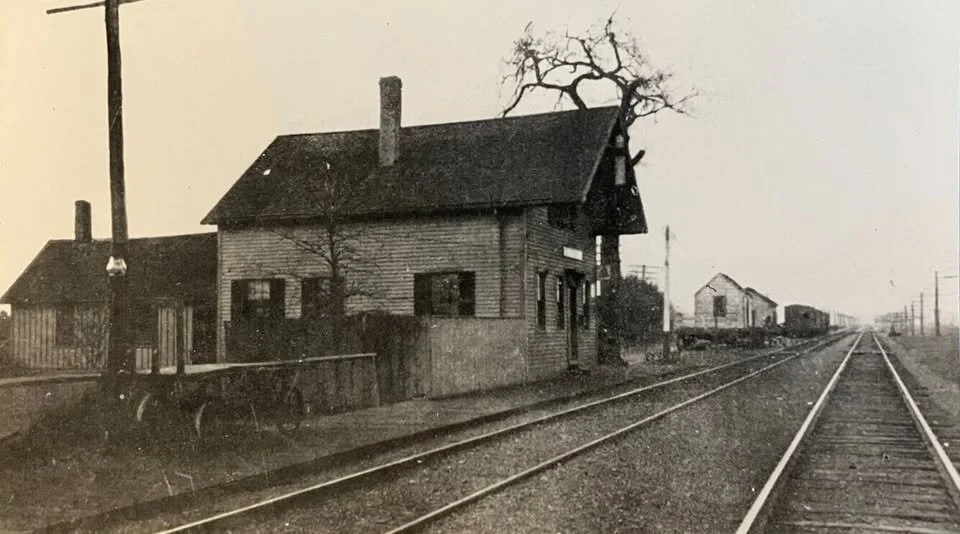
Hampton Falls Depot, c. 1900. Courtesy image.
John Randall and Clinton Tinsley left the Hampton Falls depot at 8 p.m. for the short trip on the Boston and Maine line to the Newburyport depot on Washington Street. Perkins’s statement traces the two men through the city in unusual detail, from Washington Street to Harris Street, down State Street to Brown’s store. At the store, Tinsley purchased a plug of tobacco from a boy about thirteen or fourteen years old. He asked Randall if he wanted to smoke. Randall declined, saying he had a smoke in Hampton Falls before he left. Earlier, at the depot, Clinton he had asked whether Randall wanted anything to eat or drink. The level of detail documented by Dr. Perkins in his notes captures Tinsley being very solicitous of his friend and future victim, and also points to Dr. Perkins’ finely-honed gathering of facts and details.
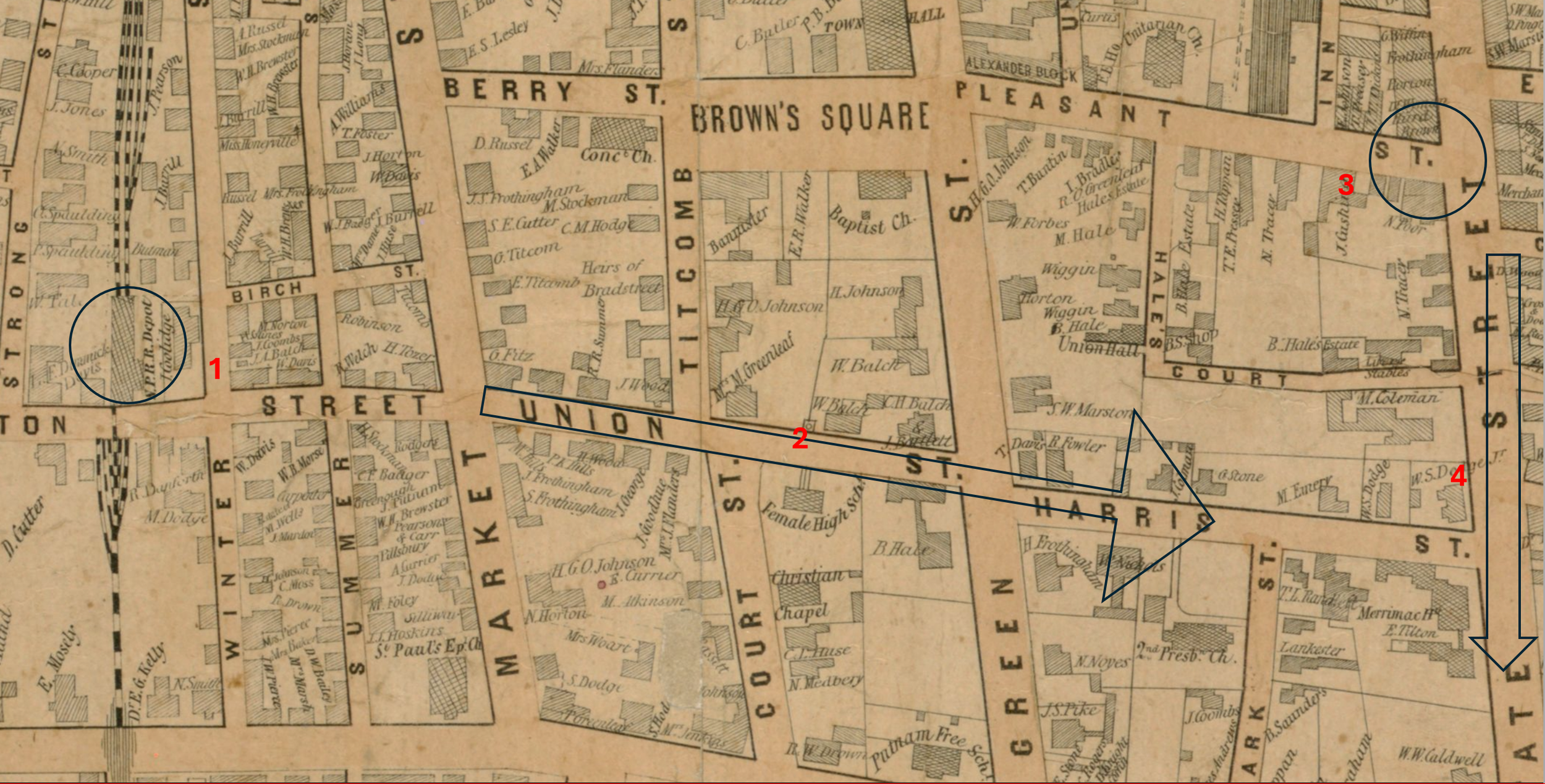
This section of the 1851 Henry McIntyre map shows the route that Tinsley and Randall took from the train depot (1), down Union and Harris Streets (2), then to Brown’s Store on the corner of State and Pleasant Streets (3), and then out State Street (4) in the direction of the present-day traffic circle.
After leaving Brown’s store on State Street, the pair walked past Oak Hill Cemetery and continued into Newbury, crossing the railroad tracks at the turnpike (present-day Route 1), Tinsley led Randall down Floyd’s Lane, now Hanover Street, past the place where it crosses the Little River. Tinsley turned off the road next to the bridge, telling Randall that he knew a shortcut across the marsh to the captain’s house.
A man appeared out of the darkness and ordered the pair to stop. Tinsley, still pretending to be Randall’s friend, told the man that they had no money - not “a damned mite.” When the man insisted that they had money and he was going to take it, Randall tried to run, but the man caught him, saying that he wanted Randall’s suit. He claimed that he had a shabby suit that Randall could put on in its place.
And this is where I’m a little heartbroken. Poor John Randall, knowing he has an entire season’s worth of wages for his family back in Maine, asked his trusted friend and companion what he should do. Tinsley said he should give the bandit his clothes. As he undressed, Randall slipped his wallet and watch to Tinsley, who was standing behind him, for safekeeping. Poor kid.
Randall was taking too long to undress, and the bandit ordered him to hurry up. “Strip ‘em off, and if you say a word worse than a whisper, I’ll blow your damned brains out,” is what Randall told Perkins the next day. Randall was naked except for his boots and stockings when the bandit shot him with his pistol. The shot struck and stunned him, and he fell, but was still conscious as both of the men, the traitor Tinsley and the man later identified as John Delany pulled off his boots and stockings and threw him in the Little River. When it was clear that he was still alive, they pulled him out, punched and pistol-whipped him, and, holding him by the ankles, tried to drown him in the river once again.
John Randall was proving extremely hard to kill. When the men pulled him out of the water again and he was still breathing, Tinsley asked Delany for his knife and began hacking at his erstwhile friend’s neck. Randall managed to grab the knife and tried to pull it away, but Tinsley stabbed him in his left side. He managed to get his feet free of Delany, who was holding him down, and managed to jump into the river, climb over a wall and run.
Naked and bleeding profusely, Randall ran toward a distant light. He found a house, begged for help, and the terrified homeowner ordered him away, threatening, for the second time that evening, to “blow out his brains”. He ran to another house. The door was slammed in his face.
Randall, who was sure Tinsley and Delany would find him, climbed over another wall, and crossed a cornfield. Daniel Lunt was standing near his barn across the field, but ran into his house as he saw Randall approaching. Randall, who believed he was dying, followed Lunt into the house and stood in his entryway, calling for help. As he grew weaker, he decided that he would hide in the barn. Only after he left the house and it was clear that he meant the Lunt family no harm did Daniel Lunt come out with some clothes for Randall and asked what had happened.
Daniel Lunt is one of two men, a same-name father and son. Daniel Lunt Sr. was 64 in 1855, and lived next door to his son, Daniel Lunt Jr., 29 years old with three small children in 1855. The son is the Daniel Lunt marked on the 1875 map below. Both men had good reason to fear for their families, but based on the proximity to the barn, my money is on Daniel Lunt Sr., a farmer being Randall’s rescuer. His son was a grocer and had a smaller plot of land until he inherited his father’s farm in 1860. Again, I digress.
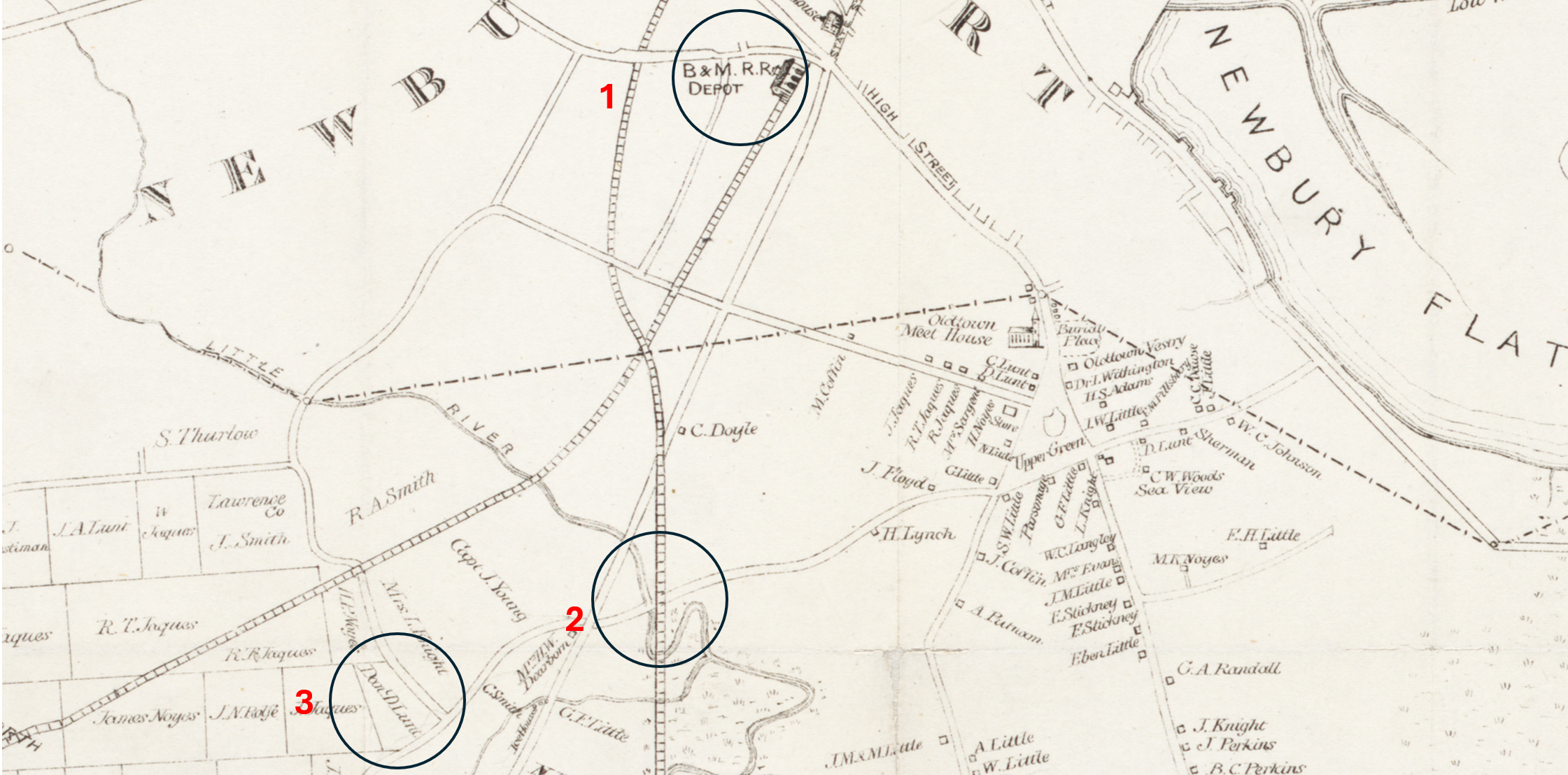
This section of an 1875 map shows the location of the Boston and Maine depot (1), the location of the attack on John Randall (2), and the farm of Daniel Lunt (3) where he was finally able to get help.
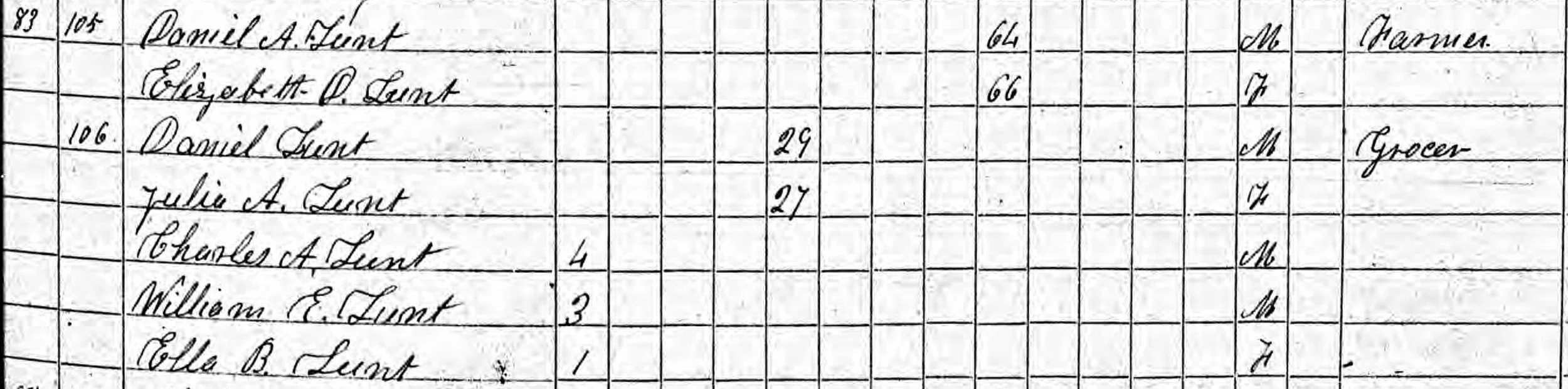
One of the two Daniel Lunts, father and son and next-door neighbors, probably saved John Randall’s life as he ran, naked and bleeding, from door to door begging for help. From the 1855 U.S. Census.
When Daniel Lunt heard whatever part of Randall’s story he could manage to convey, he took him to the watch-house, and Dr. Perkins and others were called. Randall’s injuries were appalling. The gunshot had blown open his cheek and smashed the bones of his face. His skull was visible through numerous head wounds, but miraculously not fractured. Three jagged wounds crossed his throat, and one had cut through his windpipe. The stab beneath his left arm was about two inches deep but somehow did not enter Randall’s chest. His legs were scratched and torn during his flight through the bushes. One of the physicians present, likely Perkins himself, told the Boston Herald that he thought the young man might live if “inflammation”, or infection did not “reach some vital part”.
Perkins had investigated numerous crimes or suspicious deaths, but he was not a detective in the modern sense. He was a doctor at a time when doctors, ministers, watchmen, and ordinary citizens jointly gathered evidence surrounding a crime. Despite his atrocious handwriting, Perkins would have been an excellent choice as an investigator, as he was detailed, thorough, and careful. His account of Randall’s testimony includes the note that he read Randall’s completed statement back to him in the presence of George W. Pillsbury of Scarborough, Maine (he appears not to have known that Pillsbury was Randall’s brother-in-law). Randall affirmed that the statement was correct.
Perkins painstakingly recorded both the suspects and the stolen property. Tinsley was about five feet ten inches tall and approximately twenty-six or twenty-seven years old, with a dark complexion, black hair curled behind, a black beard, and a moustache. He wore a shabby black broadcloth frock coat, light gray woolen trousers, a “blue factory drilling shirt” (see below for what the heck that is!), a straw hat, and a black silk handkerchief around his neck. He had no vest. Randall remembered that Tinsley was “inked all over”, with an anchor tattoo pricked into his hand with India ink, and his parents’ initials tattooed on his stomach.
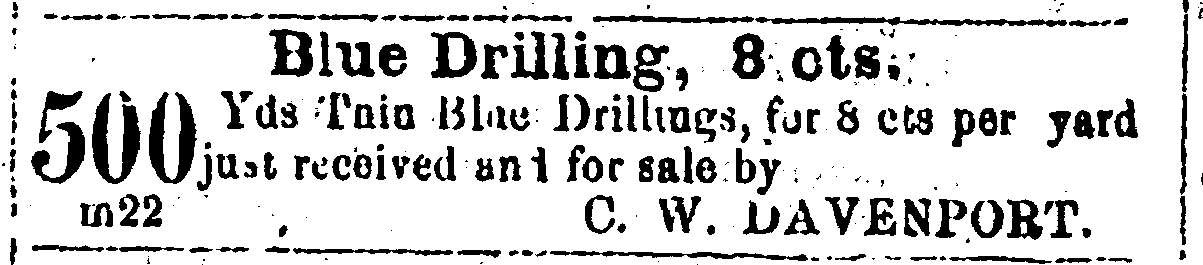
Randall described Tinsley as wearing a “blue factory drilling shirt”. Blue drill, or drilling, was a sturdy, durable, twill-weave, indigo-dyed cotton fabric generally used for manual labor such as factory work. It could be purchased for 8 cents a yard in Newburyport in 1855.
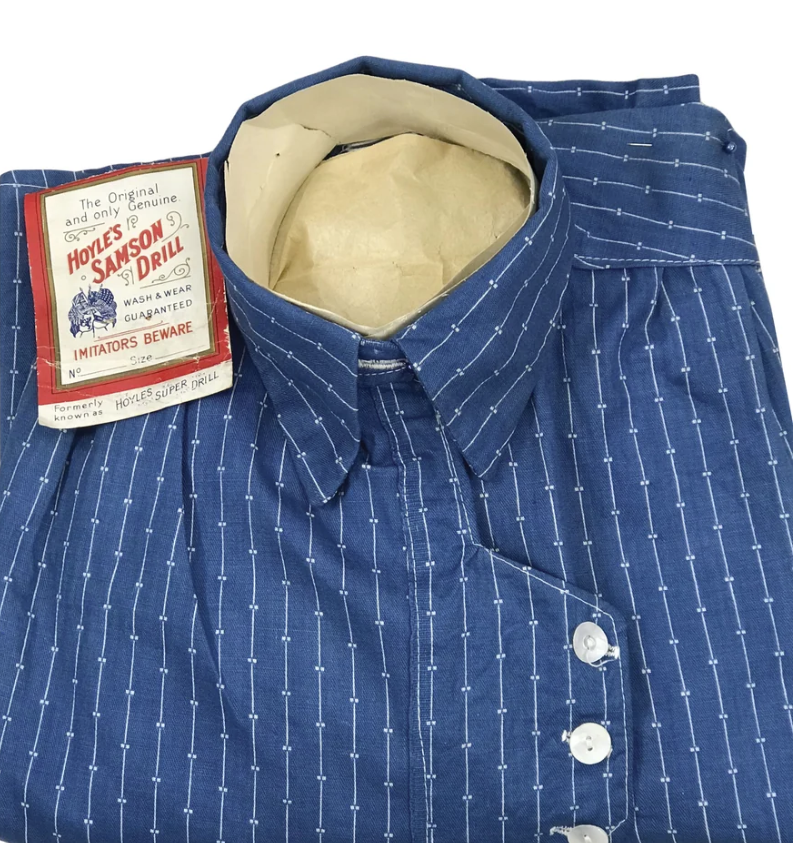
This c.1900 woman’s blouse is made with “Hoyle’s Sampson Drill”, the same material that Tinsley was wearing during the attack.
Because he had only encountered him in the dark, Randall could say much less about the second man who attacked him. He remembered a black coat and the knife in his hand. Randall thought it was most likely John Delany, whom he had first encountered in late July or early August in Hampton Falls. Like the attacker, Delany was short and thick-set. Randall added that Delany was a red-complexioned sailor between twenty-six and thirty years old who had sailed with Tinsley for four years. That they had approached Randall together to convince him to go to Boston made him a likely suspect.
Perkins’s notes, however, describe Delany as “about as big as the man who attacked you”, which suggests that Randall could not positively identify Delany. The newspapers accordingly called the second suspect a man “supposed to be named Delany.” John Delany, so far as I can tell, was never apprehended or sent to trial, but his disappearance after the attack is pretty damning. If any of you sleuths can find anything about Delany or Tinsley after September 1855, I’ll give you a $15 watch.
Perkins also inventoried Randall’s stolen possessions: the $69, his watch, a black fur hat with a burned place in the front of its brim, a black broadcloth frock coat with a velvet collar, black trousers, a vest, gloves, and calfskin boots with damaged straps. Such details would help identify the stolen goods if the robbers wore or attempted to sell them.
Officers and nearly fifty volunteers searched Oldtown and Rowley. A woman living near the toll-gate reported that a suspicious man had lingered in the neighborhood and drank at the toll-gate well several times. A massive quantity of bread - some 15 pounds of it, along with some cheese, was found near the scene of the attack, confirming that someone had been there lying in wait for some time.
The manhunt was on. Nearly fifty volunteers joined police officers searching Newbury and Rowley. Tracks found at the scene suggested that the two attackers had almost caught up with Randall, following him onto Daniel Lunt’s farm. On September 18, Marshal Brown relayed an alarming statement from Chase, the depot-master from Hampton Falls. Another young employee had allegedly been enticed away by Tinsley about six weeks earlier under similar circumstances and had not been heard from. The Newburyport Herald urged officers along the seacoast to watch outward-bound vessels, noting the rumor that Tinsley and Delany had escaped aboard the fishing schooner Hosea Ballou, bound for “the Bay of St. Lawrence”. On October 3, Newburyport received a telegraph dispatch that the Hosea Ballou had reached Port Hood on Cape Breton Island. There was no arrest reported, and in December the paper stated that nothing had been heard from the assailants.
Meanwhile, John Randall lingered near death in the Newburyport almshouse on Federal Street, too injured to make the journey back to Maine. News of the attack traveled from the Newburyport Herald to Boston newspapers, including William Lloyd Garrison’s Liberator. Newburyporters banded together to raise money for the now-penniless Randall.
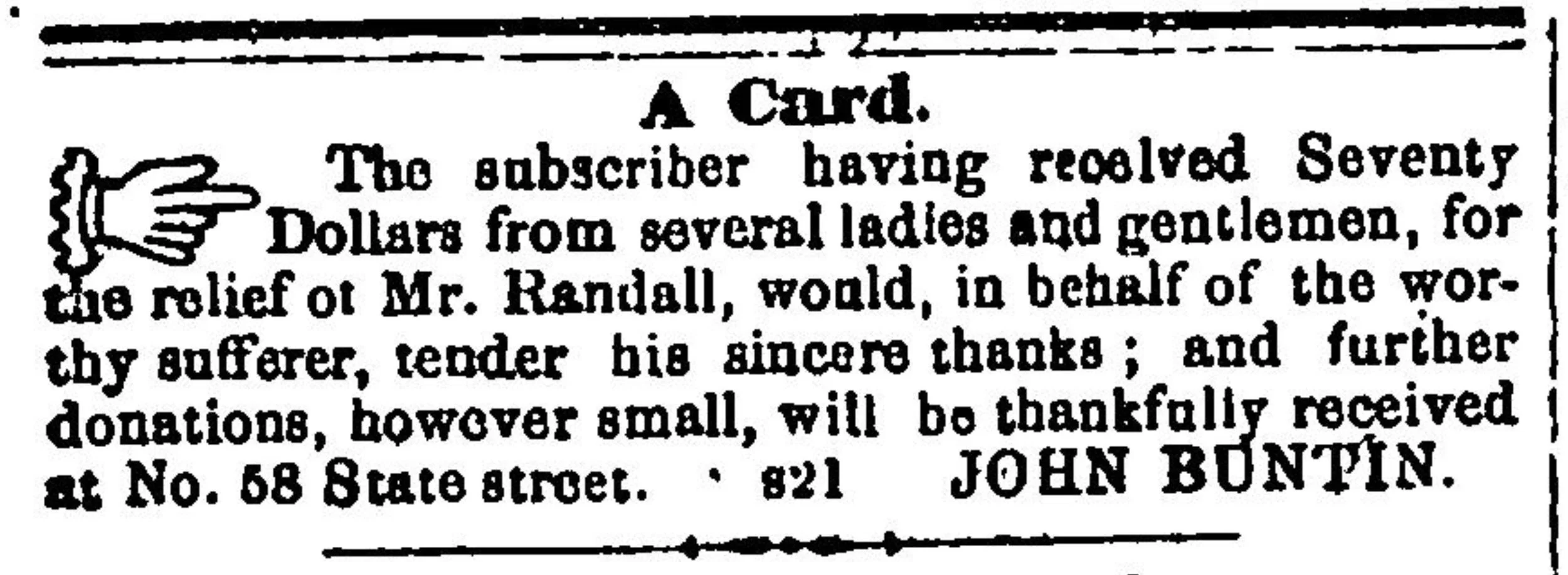
Less than a week later, on September 21, John Buntin was raising funds to help John Randell.
Randall’s largest donor, John Buntin, collected donations worth more than a season’s wages for John Randall. Buntin was a Newburyport merchant whose grandfather, also named John Buntin, served aboard the privateer Dalton, and was subsequently taken prisoner, with Paul Lunt, the father of Daniel Lunt, the man who saved Randall’s life. These kindnesses bring to mind the food and care offered to these men by ordinary English men and women as they languished in Mill Prison. I know it is a generation (or two) later, but still, it moved me. Gifts from Newburyport’s maritime community assisted a Maine farm-hand brought to our town by the false promise of work at sea.
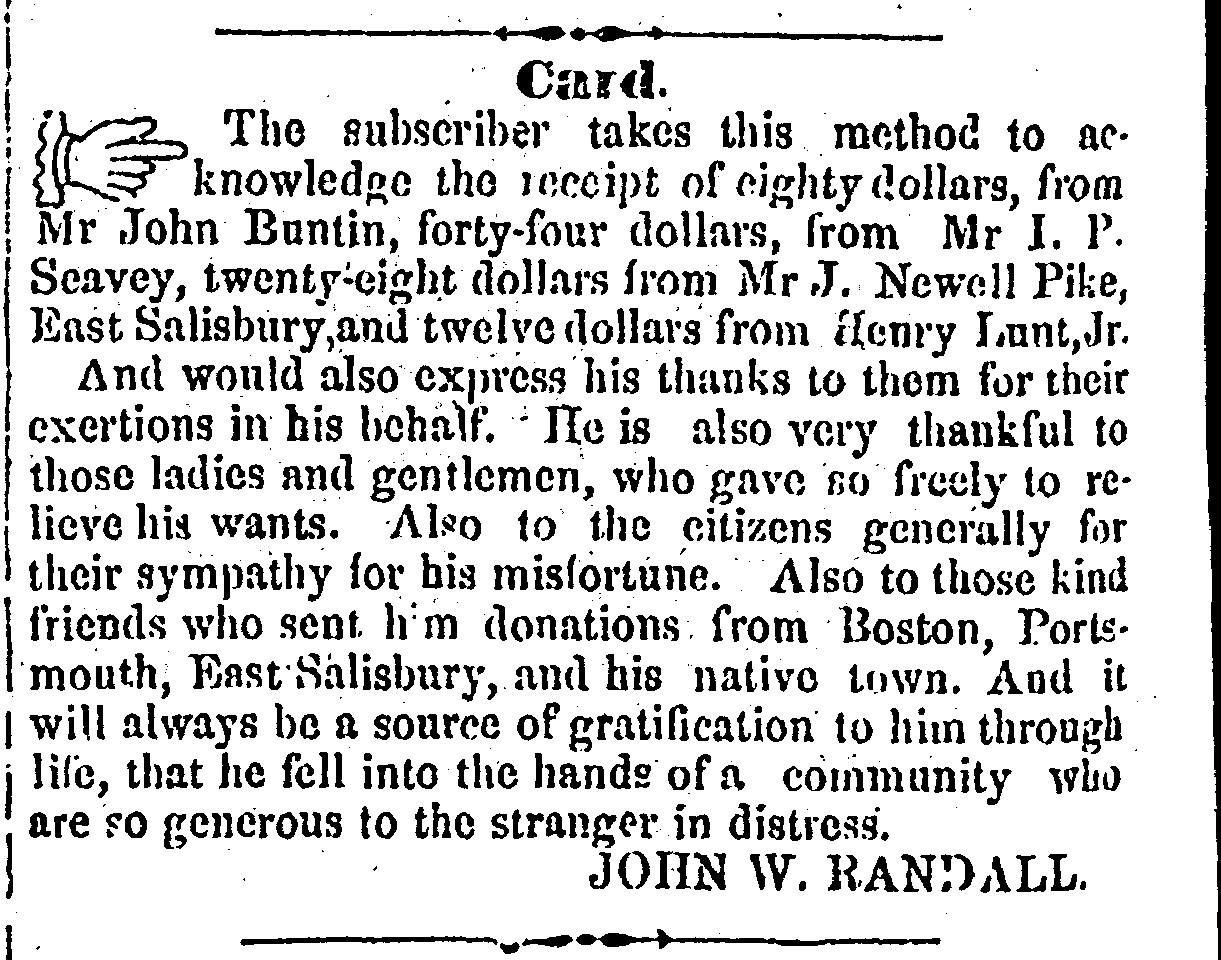
On October 6, Randall published a card thanking Newburyporters for their care and generosity. He had received donations totaling $164 from the Newburyport area and more from Boston, Portsmouth, and Randall’s Maine neighbors.
Randall recovered enough to return to Maine, but in December his wounds became dangerously infected. On December 14, the Newburyport Herald mistakenly announced that he had died. Six days later it printed a correction titled “Not Murdered After All.”

That John Randall was not, in fact, dead, was confirmed over a year later, in December, 1856. He popped into the offices of the Newburyport Herald.
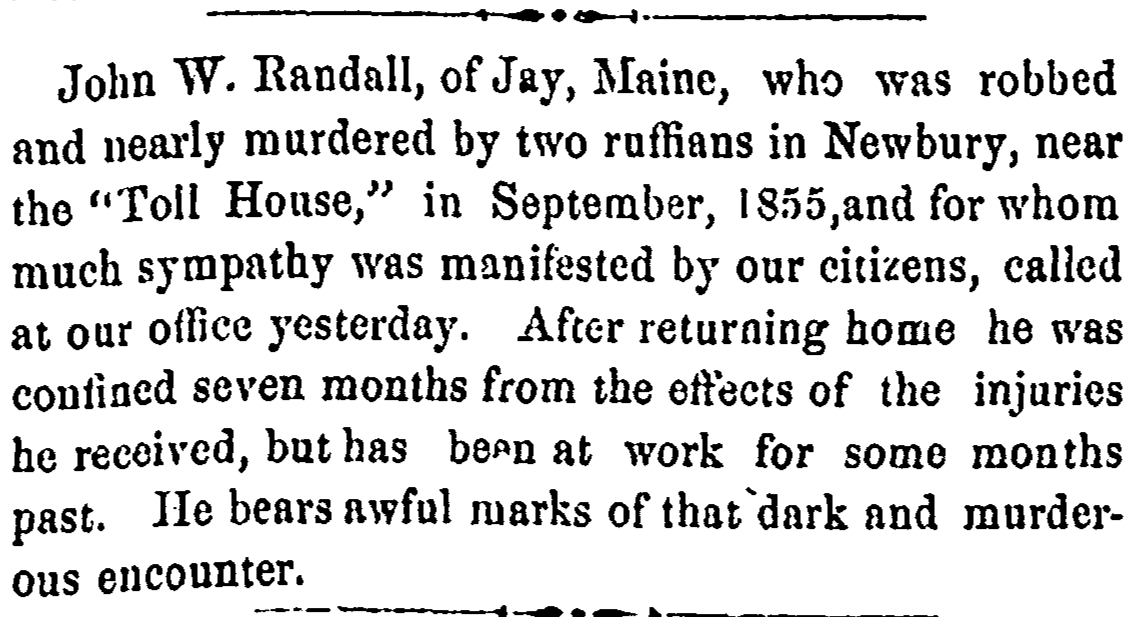
15 months after the attack, the Newburyport Herald noted that John Randall “bears awful marks of that dark and murderous encounter”.
I noted at the beginning of this tale that it had an unsatisfying end. Tinsley and Delany were never caught, as far as I can tell. John Warren Randall, our hard-working Maine farm-boy, spent the remainder of his life helping his mother hold onto their farm in Chesterville, Maine. In the end, Mary Randall outlived her son, who died in 1891, age 58.
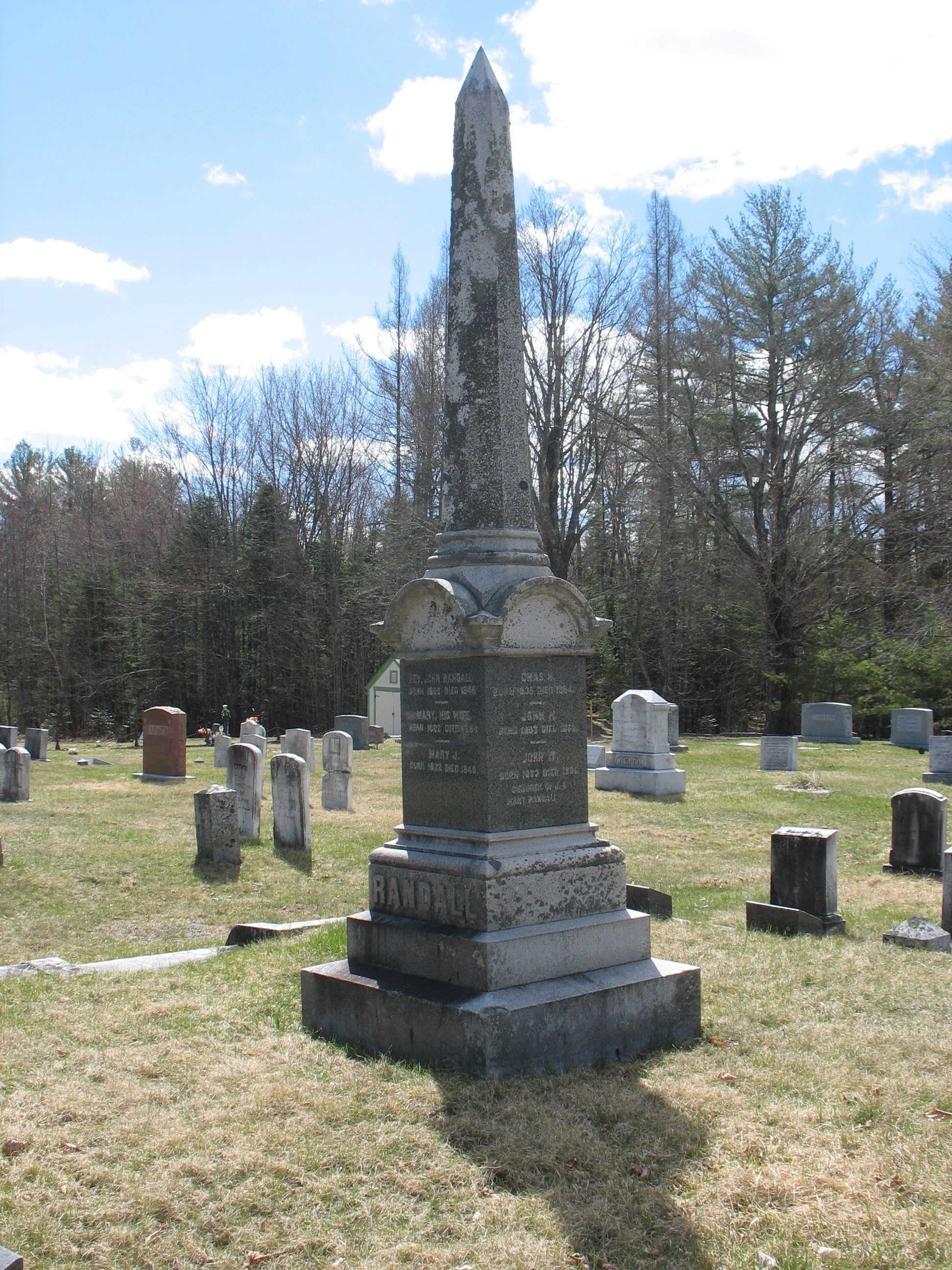
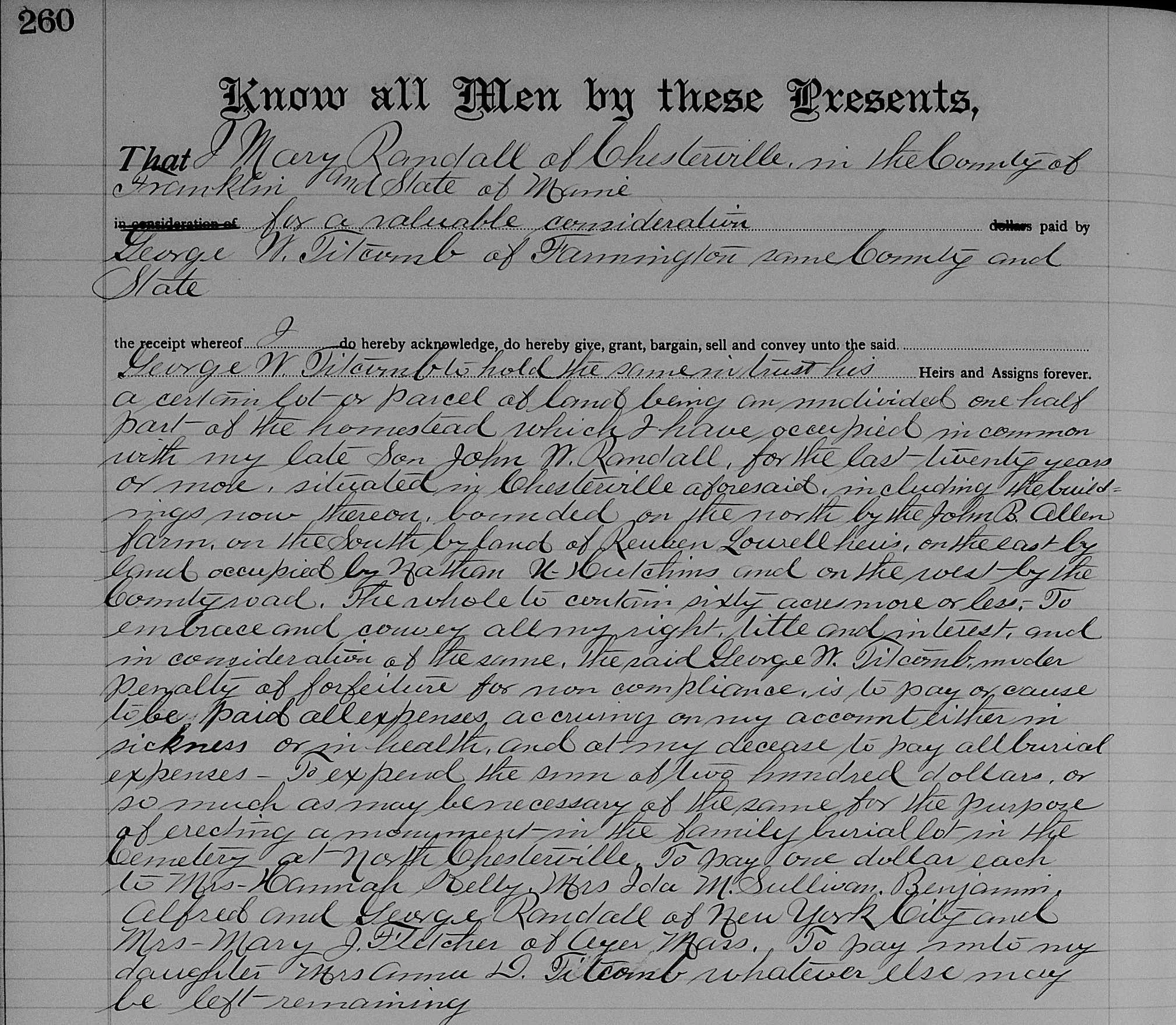
When Mary Ross Randall died in 1894, she left the farm she had “occupied in common with my late son, John W. Randall for the last twenty years and more” to her son-in-law, George Pillsbury, who had been present with Dr. Perkins as he gathered details from John Randall.
She asked that George Pillsbury “erect a monument” in the family plot in Chesterville, for which she bequeathed him the substantial sum of $200. Perhaps her hard-working son had been able to improve their farm with the funds raised for his recovery. Her will is below.
John Randall, who found doors slammed on him in his hour of need, also found friends in Newbury and Newburyport. I will give this young man, of whom I have grown very fond, the last word. May we all find such help in our hour of need.
“It will always be a source of gratification to me through life, that I fell into the hands of a community who are so generous to the stranger in distress.”
Transcription of Dr. Henry Coit Perkins’ Notes
Sunday Sept 16 — 1855[?] John Warren Randall — formerly lived belonged to the town of Jay Franklin Co. St(ate) of ME — Mothers name Mary R. — direct to Livermore Falls Me — had been living with Moses Batchelder of Hampton Falls — 4 mo lacking 3 days — last lived with Chs F. Chase Depot Master Hampton falls — left H Falls Wednesday the 8th (?) train for Boston not far from Mr. Ch. Lidding (?), with Clinton Tinsley of Manchester.
He lived until within a week with Capt Healy. He worked with him about 2 weeks. he worked before that with Moses Emery Batchelder of Hampton falls — he came from
Boston yesterday noon he told you and wanted you to go with him [illegible] to see Capt Ware whose father lived a mile & half from NPort that he was down to his father visiting he has chaise with 2 horses & would take you right up to Boston with him to Ship tomorrow to sail on Thursday to the East Indies as Cook, but before you left he was going with you to yr home — Tinsley —
He left the depot at H to Newburyport with you came down straight through Harris St to Brown Store where he bought a plug of tobacco of the boy about 13 or 14 years old. He asked at the depot if you would eat or drink. At Browns he asked if you would smoke as he was going to, you told him no as you had smoked before you left the depot at Hampton Falls.
2 men in morning, one an Irishman he does not know who the other one was — After you had got over the rail rd track at the Turnpike he said you went down Rolfes Floyds lane and turned into the little thicket and [illegible] to go across the marsh because he said he was nigher to the Capt house —
He went ahead a man met him & said “Stop.” Have you got Clinton said What do you want. He said have you any money — C(linton) said not a damned mite — The man said you have too $ & I am going to have it — You [illegible] started back but he caught you and he said you have got on too damned a good looking suit & I am going to have it & I have a suit here for you to put on. I said what would you do Clinton? He said would you take them off? Clinton said he would — I took my wallet out & slipt it behind me as I stood at the side of Clinton behind me as I stood at his side into his hand and my watch worth about $15 – you had $69 dollars, all but 3 were $10 bills, one a $2 and the other ones Ocean Bank bills except the $8 Mr. Chase paid you and $5 old piece which you had of Batchelder which you got there a week ago last Wednesday. At the same time he is taking off my clothes – He kept saying Strip Em off and if you say a word worse than a whisper & I’ll blow yr damned brains out — just as you had got yr shirt off & had not got yr boots off he fired his pistol — it stunned you and you fell but you knew what you was about. He pulled off your boots and stockings. He grabbed you by the body & threw you into the water head first but kept hold of by the ankles. While you were struggling, he hauled you out — the blood running out yr nose & mouth he then caught you by the hair of the head & commenced pounding you with his pistol. To other, one says turn the butt of the pistol — while you lay (gasping/gawking) he hit you in the face — he then shoved you off again into the river holding on your heels — then hauled you out & said “let’s have your knife” — he handed it to him — then he went sawing upon my throat — you at the same time getting hold of the knife & trying to pull it away — He then began upon your left side, while he was doing this you gave a yank and fetched yr feet out of his hands and ran thro the river, leaped over the fence or wall could not tell which, saw a light. went to 2 different houses — asked for relief — told them you had been robbed. The man replied you be off or I’ll blow yr brains out. The 2nd man shut the door against you and then you left the road & came got over the wall and came thro a piece of corn just near his house, saw a man at the barn you run down to the gate he was frightened & ran into the house — you went into his house into the Entry — and waited some time — then you [illegible] started for the barn[?] feeling that you should freeze to death — then you came out & he came out and said “you say you have been robbed, where was it and who was it”?
The following description of my search to detect the villains; Tinsley is about 5 feet 10 inches high, dark frock coat — black broad cloth pretty bad looking coat — pants a light grey — should think woolen. No vest, a straw hat, (not a collar//) wore some factory blue drilling shirt, should think he was about 26 or 7 yrs, of about his own height and build
[upper margin: old 6] a black silk handkerchief on his neck — hair black — black whiskers black moustachoes — dark complected man — his hair curled behind — Has an anchor ⟨on his hand — quite small[?]⟩ pricked in with india ink — Clinton was well acquainted with this individual — has initials[?] of his fathers & mothers name on his stomach —
Could not tell how the other man was dressed — ⟨knife in hand⟩ had on a black Coat — He said he had a suit for you to put on —
Mr. Geo. W. Pillsbury knows Mr. R(andall) at Scarboro Maine — was present & H.C.P & some of the inmates of the house (Mr. Abbott) & heard Mr. R affirm the above when read to him to be his affirmation —
Yr hat was a black fur one with a piece burnt out of the rim on the forehead part — The coat was black broad cl. frock — a black velvet collar — black broad cloth pants — calf skin boots — one strap broke in middle & the other pulled off [illegible] two round, a silk flounced vest – gloves lightish collar.
Yr trunk is in B – directed to the Milton depot with yr name marked J. R. on top with ? nails —
Declared by the wounded man in the presence of several inmates of the house, Mr Geo. W. Pillsbury of Scarboro, Mr. E and myself, H.C. Perkins
Clinton knew you had the money as Mr Chase can testify — Clint came to Hampton to Reuben Batchelder with John Delany — Delany went to Boston with Clinton — when Clinton left — for 6 days day[?] they came to Mr Chase’s & wanted you to go with them — I replied why will it not be as well for me to go on Saturday — I am engaged here & cannot go now [left margin: I tell which[?]] (which he told you if that was all he would give 10 dollars —)
Del is a short thick set fellow about as big as the man who attacked you. The 1st you knew of Del was the last of July or the 1st of Aug. do not know where he came from — Del & Cl both told you they had sailed together for 4 years — [illegible] Del had a red complected face from 26 to 30 yrs old. short & thick fellow —