
Black Gilliflower, Noyes Sweetings, and Grandfather’s Graft:
A Romp Through the Orchards of Old Newbury
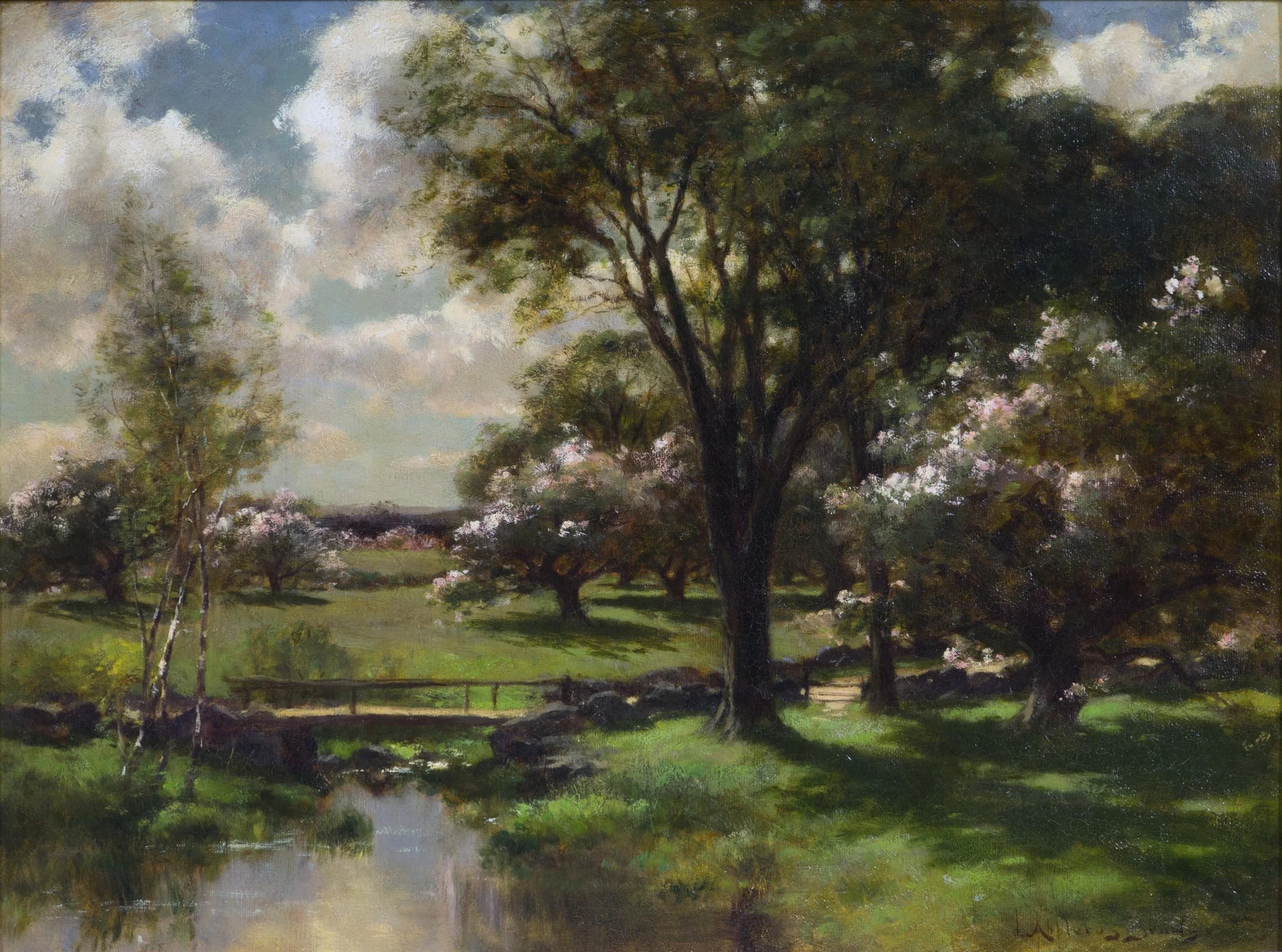
Bridge in Late Spring by West Newbury artists John Appleton Brown
Well, my friends, here I sit, twenty-seven tabs open on my computer, five books balanced on my desk, and no idea where to start this story, or if it is even a story at all. Just this morning I have been trying to solve a murder (from 1853), researching the ancestry of former Vice-President Dick Cheney, and marveling at the eight inch Heath Peach exhibited at the 1834 Newburyport Horticultural exhibition. Never a dull moment. I comfort myself with the knowledge that some of my favorite writing is a bit meandering, and one must start somewhere, so I will begin, in honor of Isaac Newton, with the fall of an apple. Fortunately for me, it landed on the ground by my feet, narrowly missing my head.
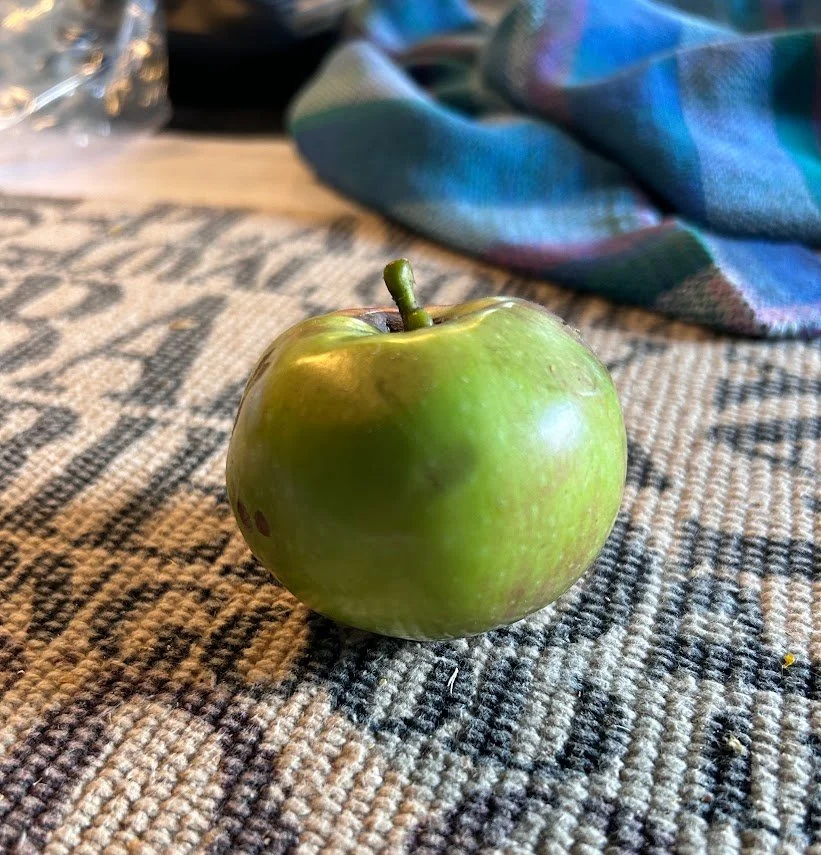
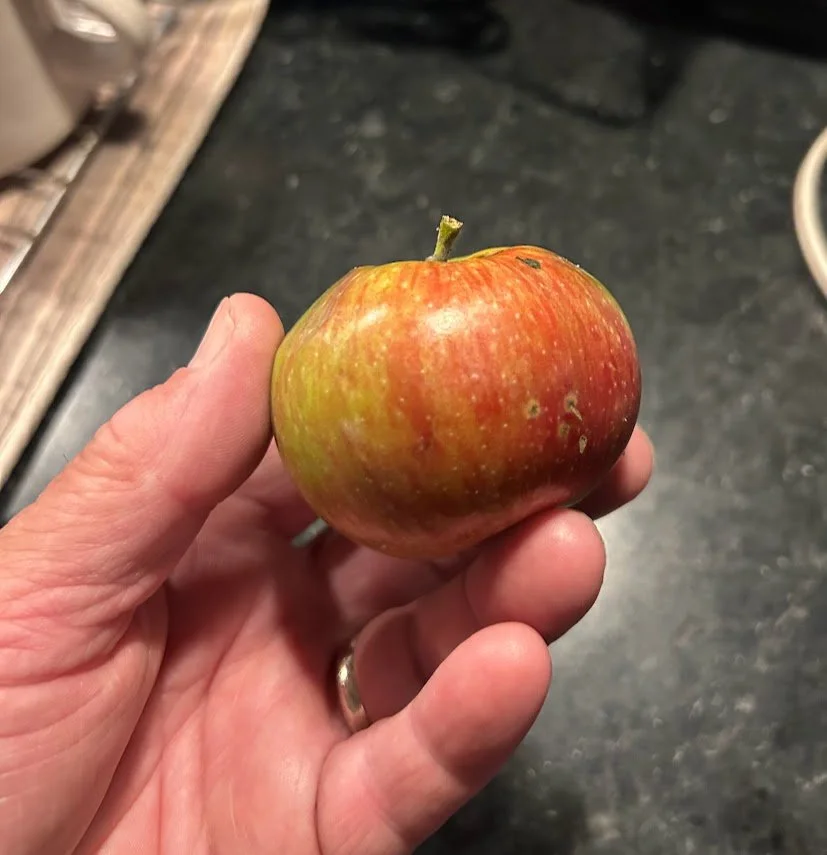
It was outside the chicken coop at the Poore Farm Sanctuary, and I was hot and irritated and armed with a broom, as a small, determined rooster named Michael was trying to convince me to fight him. The end of the big coop is in a patch of scrub that slopes down to a swampy area at the bottom of our pasture, and without determined maintenance, which it has not received, it has become a tangle of bittersweet, wild raspberries, and poison ivy.
I turned as this apple made a small, soft thud at my feet, and as I bent to pick it up, Michael the rooster made his move, landing a good stab in the middle of my bare leg. There was a flurry of broom and feathers and some choice words, and after Michael was safely returned to prison, I looked for the phantom apple tree. Somewhere in the tangle of vines, is an old soul, a sibling or descendant of the ancient trees of my ancestors, and I was determined to find it, but not at the cost of jumping, bare-legged and bleeding, into a patch of poison ivy. I valiantly withdrew, the mystery apple tucked in my pocket.
It is a small thing, this apple, bright green on one side turning to orange and red on the other. As I showed it to James later that night, I recalled that when we arrived back to the old homestead from Canada when I was twelve, there was a massive gnarled apple tree at the bottom of the field. It had a horizontal branch that was wide and bent at the perfect angle for napping or reading a book. It was a proper tree, so tall that it was the one struck by lightning many years ago, and it was taken down.
Remember when you had to really commit to a subject to get a picture of it? Film, Fotomat…the whole rigmarole, and this tree is one of the things I wish I had photographed while it ruled the lower pasture. The only picture I have of this tree is a picture of a picture taken by my cousin, but you get a sense of it.
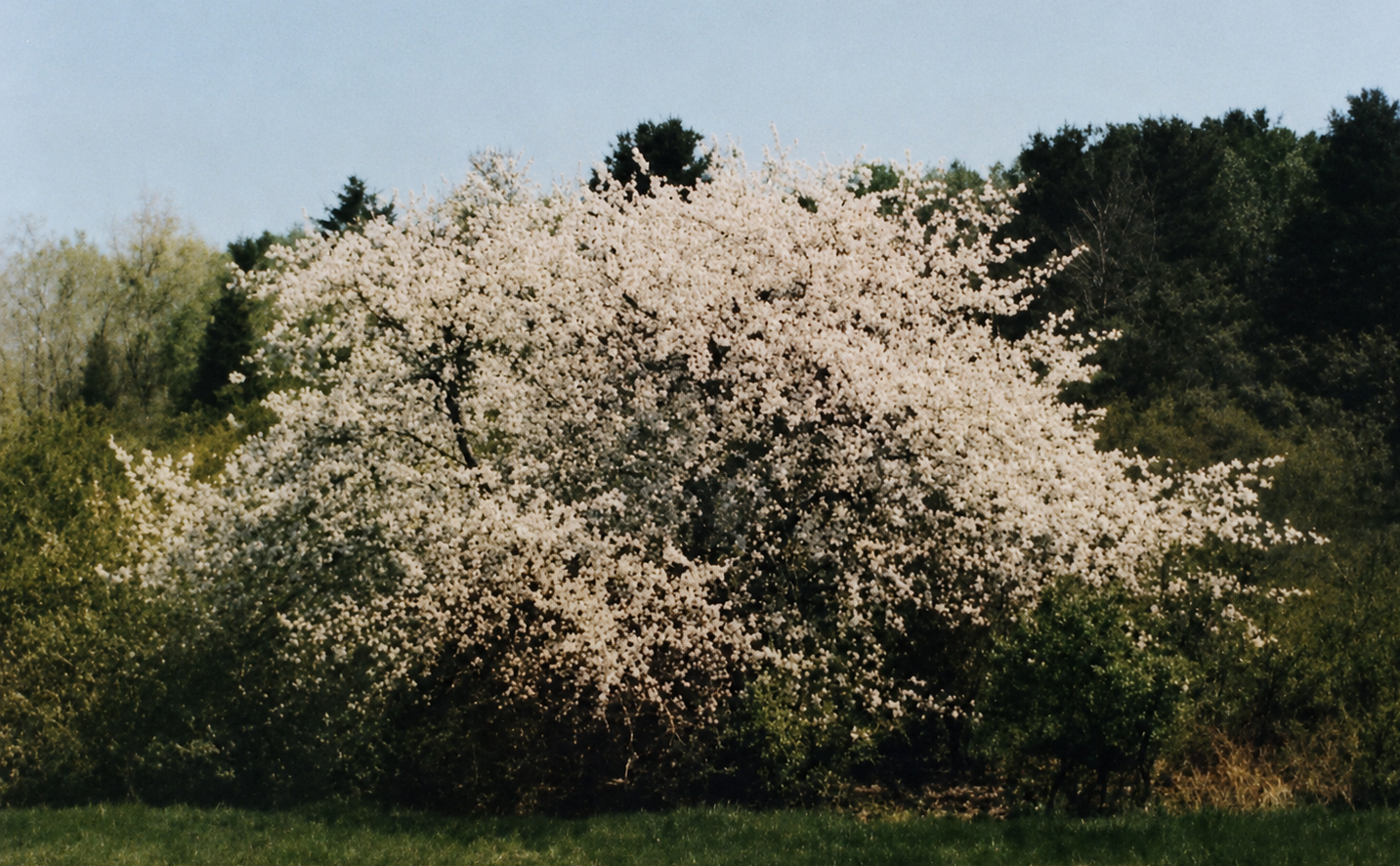
The old apple tree, c. 1960, courtesy of Jan Leslie
As I held the mystery apple to the light, I knew exactly who to call - John Quincy Adams! No, not that guy - the JQA of Long Hill Orchard in West Newbury, whose love for growing things of the fruit tree variety is unmatched. James sent him a picture of the apple. He texted back right away. “Possibly a red Gravenstein”, he said. “The timing is right.”
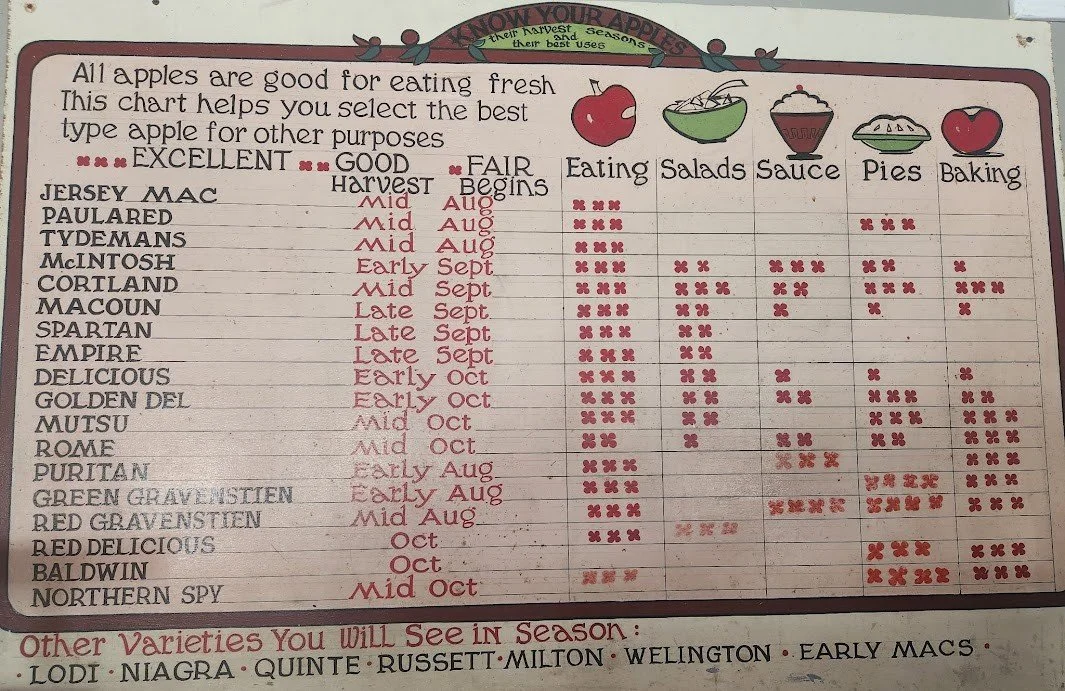
The legendary apple sign at Long Hill Orchard in West Newbury offers useful information about New England apples. Gravensteins are in season right now.
The idea that an apple from 18th century Denmark could have been part of my family’s orchards sent me back to the records - the 1880 agricultural census, to be specific. My great-great-grandfather, Moses Poore was an enterprising famer, and had married into the Thurlow clan of Cherry Hill Nurseries fame. His first wife, Susan Thurlow, died young, a calamity which I have written about here. Moses was a lifelong horticulturalist. In 1880, the records show that his farm boasted 150 apple trees, though in 1879 he had only harvested 75 bushels of apples.
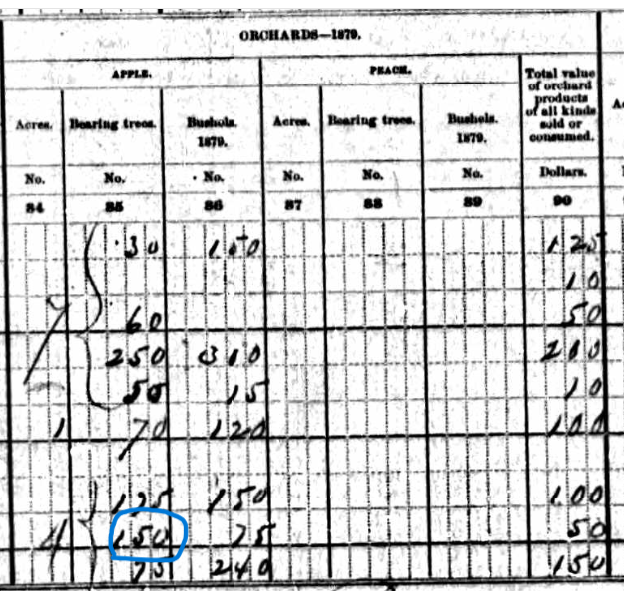
This section of the agricultural census reveals that Moses Poore had a 4-acre orchard with 150 apple trees, whose produce was valued at $50, a light haul for so many trees.
Were they young plantings, I wondered? Perhaps Moses was experimenting with new (to him) varieties of apples.
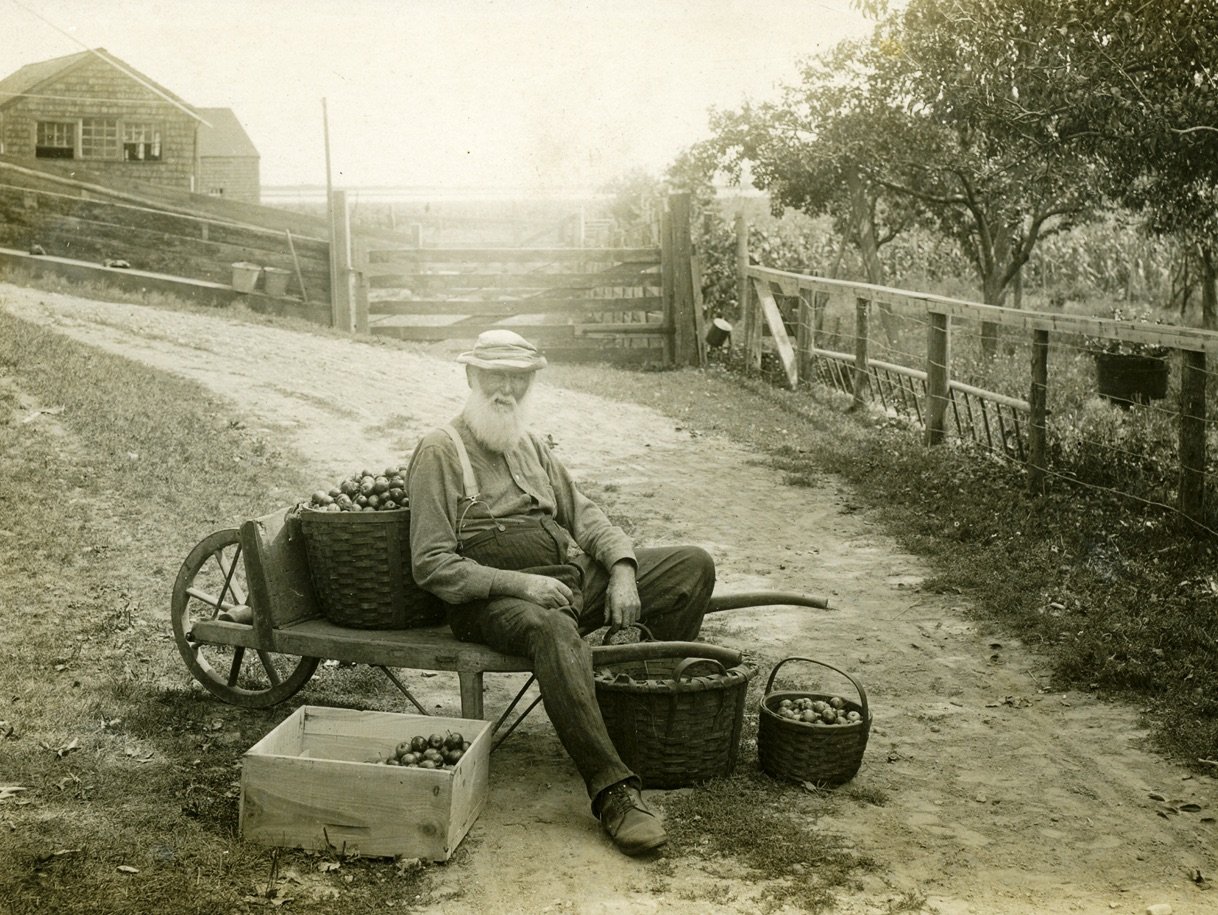
This undated image in the collection of the Museum of Old Newbury shows an apple-picker resting with the fruits of his labor. Note the size of the apples - far smaller than most market varieties today.
Since none of Moses Poore’s apple trees are named, and I have not yet found planting notes or receipts for his produce, let us return to a more general inquiry about the noble Gravenstein. As it turns out, this particular variety has a long association with the area.
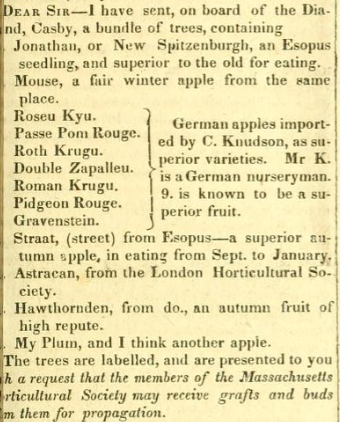
According to a letter printed in the 1829 New England Farmer, the Gravenstein and other “German apples” were sent to members of the Massachusetts Horticultural Society.
Though the Gravenstein apple was known in Massachusetts before 1830, the earliest record of its introduction to the Newburys appears decades later, in September, 1874, in the Newburyport Herald. The tale of the thwarted journey of this newcomer to Byfield, the “best apple in the world”, is worthy of repeating at length.
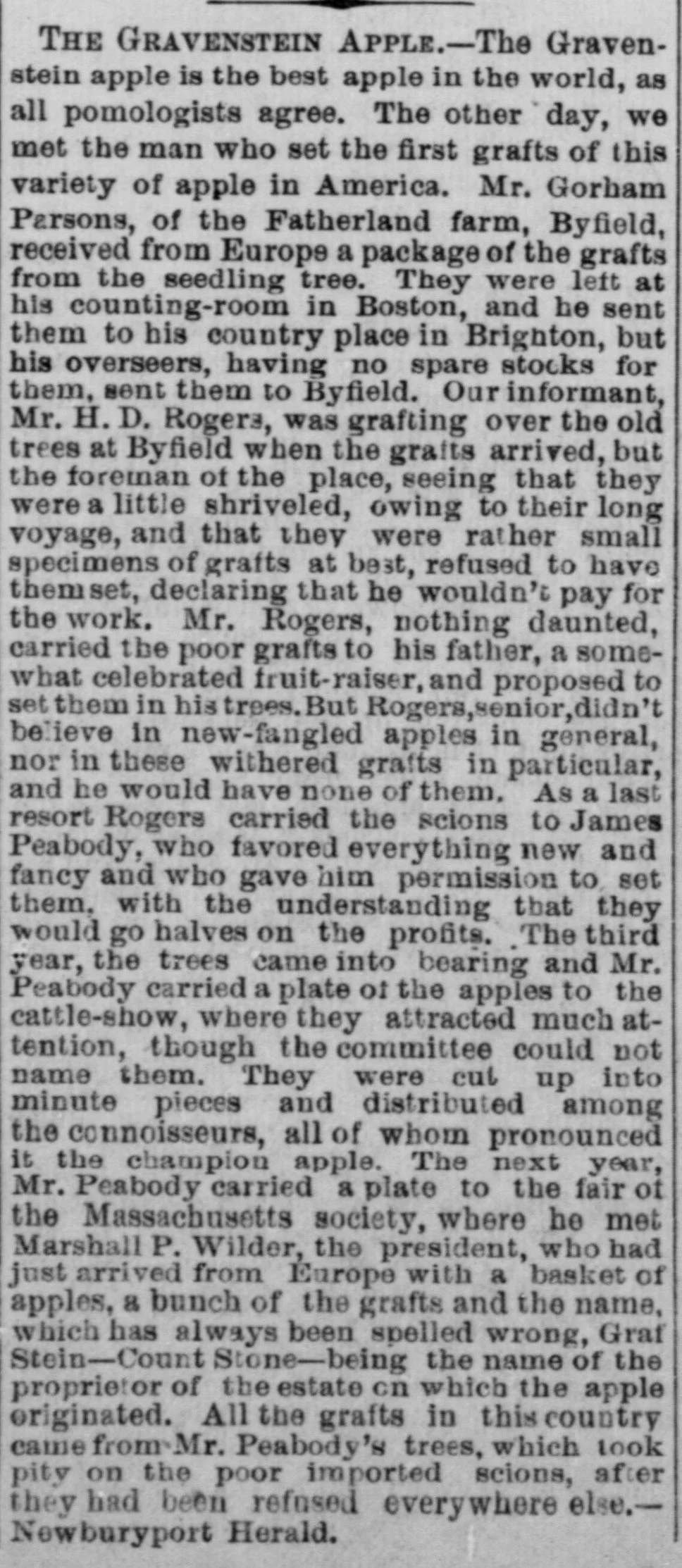
**THE GRAVENSTEIN APPLE.—**The Gravenstein apple is the best apple in the world, as all pomologists agree. The other day, we met the man who set the first grafts of this variety of apple in America. Mr. Gorham Parsons, of the Fatherland farm, Byfield, received from Europe a package of the grafts from the seedling tree. They were left at his counting-room in Boston, and he sent them to his country place in Brighton, but his overseers, having no spare stocks for them, sent them to Byfield. Our informant, Mr. H. D. Rogers, was grafting over the old trees at Byfield when the grafts arrived, but the foreman of the place, seeing that they were a little shriveled, owing to their long voyage, and that they were rather small specimens of grafts at best, refused to have them set, declaring that he wouldn’t pay for the work. Mr. Rogers, nothing daunted, carried the poor grafts to his father, a somewhat celebrated fruit-raiser, and proposed to set them in his trees. But Rogers, senior, didn’t believe in new-fangled apples in general, nor in these withered grafts in particular, and he would have none of them. As a last resort Rogers carried the scions to James Peabody, who favored everything new and fancy and who gave him permission to set them, with the understanding that they would go halves on the profits. The third year, the trees came into bearing and Mr. Peabody carried a plate of the apples to the cattle-show, where they attracted much attention, though the committee could not name them. They were cut up into minute pieces and distributed among the connoisseurs, all of whom pronounced it the champion apple. The next year, Mr. Peabody carried a plate to the fair of the Massachusetts society, where he met Marshall P. Wilder, the president, who had just arrived from Europe with a basket of apples, a bunch of the grafts and the name, which has always been spelled wrong, Graf Stein—Count Stone—being the name of the proprietor of the estate on which the apple originated. All the grafts in this country came from Mr. Peabody’s trees, which took pity on the poor imported scions, after they had been refused everywhere else.—Newburyport Herald.
It was, apparently, a bit of a tall tale. Marshall P. Wilder, former president of the Massachusetts Horticultural Society, had a firm rebuttal in a letter to the editor of the Newburyport Herald just days later.
“The Gravenstein Apple
To the Editors of the Boston Journal:
In a late number of the Boston Journal I noticed an article from the Newburyport Herald in regard to the history of the above named apple. This article does not give the date when it is said Mr. Gorham Parsons of Byfield received the first grafts from Europe. The history of the introduction of this apple was given by Capt. De Wolfe... It is as follows:—
“Being at Copenhagen in the fall of 1835, I noticed at the wharves a number of small craft from Holstein with fruit, principally apples. I bought some which were recommended as Gravenstein, a very superior apple, highly flavored as to taste and smell. I was so much delighted with this fruit, never having heard of it before, and being desirous of cultivating it in my little garden in Boston, I requested of my friends, Messrs. Good, Reynolds & Co., to purchase for me at the nursery two trees of that kind of fruit, and to be sure that they were the genuine Gravenstein, which they did. On my arrival in Boston in May following, the trees being nearly seven months out of the ground, I had some doubts as to my being able to make them live. Knowing Gen. Dearborn to be an amateur in these matters I presented him with what I thought to be the best one, and planted the other myself. They both lived and grew vigorously. About a year after I moved to Bristol, R. I., and took my tree with me and planted it there, and when I left that place several years subsequently it was in a bearing state.
“I was desirous to know the origin of its name and place, and was informed that it originated in a nobleman’s garden in Holstein, near to a family gravestone—hence the name Gravenstein.”
It is quite probable that the apple may have been introduced independently by two or more persons; and my recollection is that Capt. De Wolfe, at the time referred to, was master of a ship belonging to Gorham Parsons, so that his scions were doubtless cut from one of the trees brought home by Capt. De Wolfe. It is worthy of notice that this variety was imported directly from Germany by Samuel G. Perkins of Brookline, Mass., and also by C. Knudson, a German nurseryman near Albany, New York, at about the same time.
Mr. Rogers, the informant of the Newburyport Herald, is, however, in error in regard to my having brought a basket of these apples and a bunch of the grafts from Europe, as I never visited the countries of Europe until 1867, but he may have brought specimens of the fruit to the exhibition of the Massachusetts Horticultural Society during 9 years of my Presidency, from 1840 to 1848.
I have thought these facts might not be unworthy of publication, as the apple has become deservedly the most popular of its season.
Marshall P. Wilder.”
Well, the story of Gorham Parsons accidentally sending Gravenstein seedlings to Byfield, where the local yokels refused to plant them, thus delaying the cultivation of this wonderful fruit in Newbury, seems like it may or may not be true. What does seem to have proven true is that the Gravenstein is from Denmark, documented there in the 1660’s, and later brought to Germany. Though its ancient origins are lost to time, it seems that Marshall Wilder’s story, that a captain working for Gorham Parsons brought it back from Copenhagen, is more probable, and it was named after Gråsten Palace in southern Denmark, the castle in whose garden it was first cultivated rather than a grave in Germany.
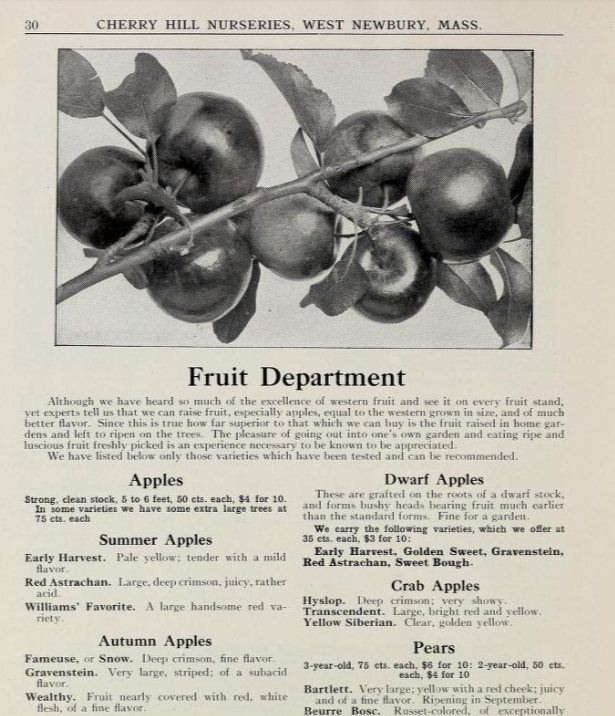
By 1913, Gravensteins could be ordered from Cherry Hill Nursery in West Newbury in standard and dwarf varieties. It was, in a way, the beginning of the end for the spreading apple trees that were once the pride of Newbury farms. For the average farmer, dwarf or semi-dwarf trees are easier to manage as they bear fruit earlier, can be planted more densely, and are much easier to harvest.
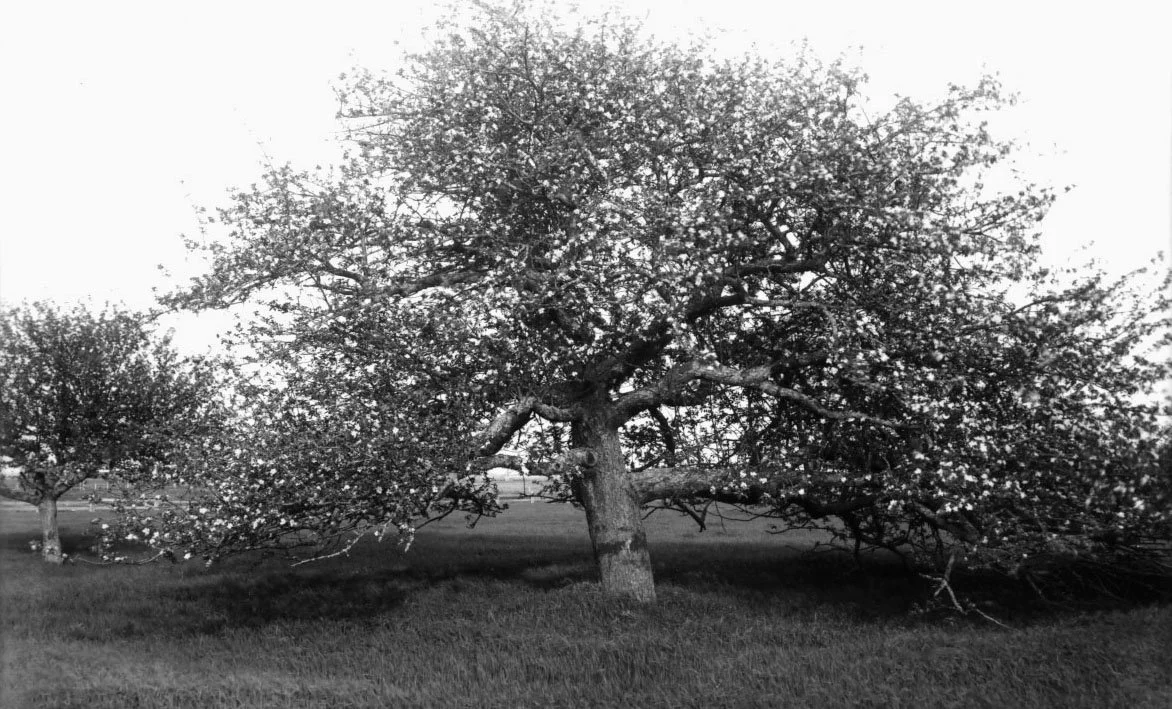
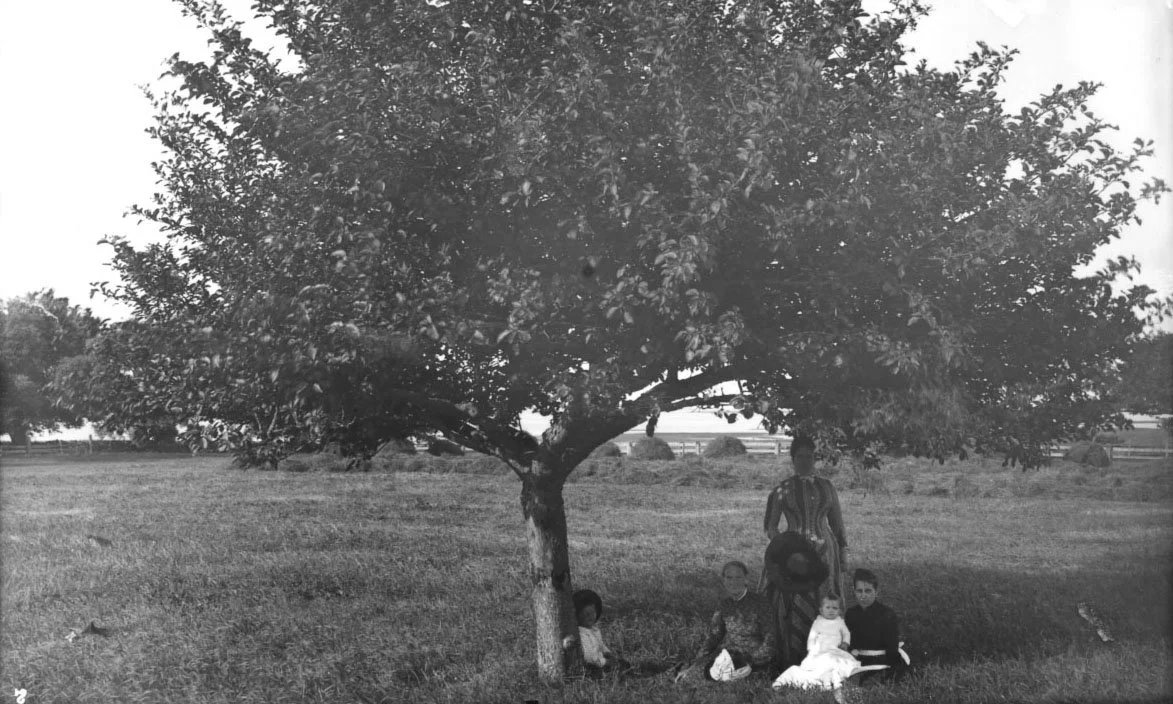
John White Winder took this image of an apple tree at his father’s farm on Ocean Avenue in 1890. Old apple trees were among his favorite subjects.
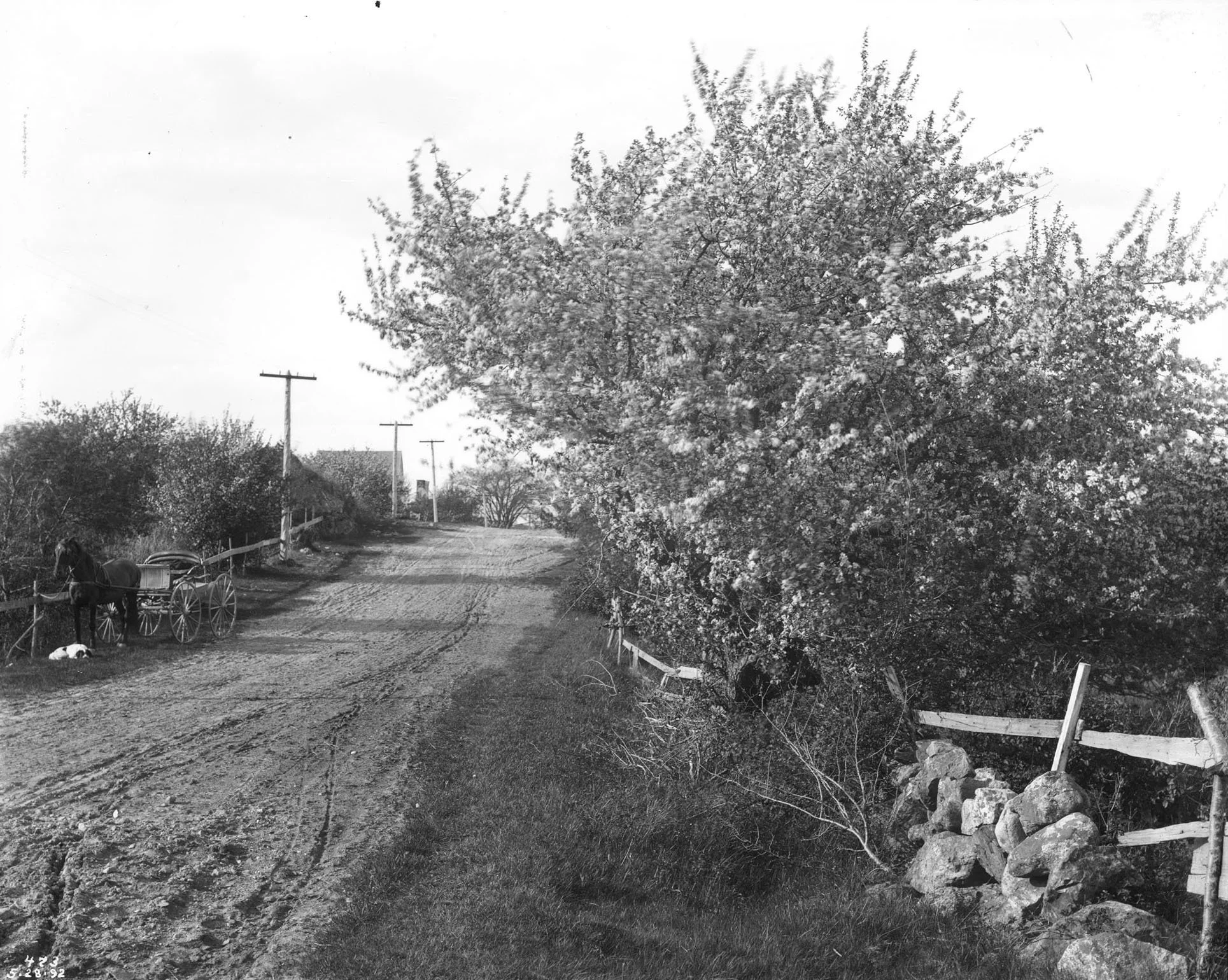
Winder took this image of the turnpike, flanked by apple trees, in 1892.
As I spent some time researching the apple trees of yore, I stumbled across this record in the diary of John Quincy Adams (not the owner of Long Hill Orchard - the other one), recalling a trip in 1833 through Newburyport, where he had spent some memorable years. “There was an hour of interval between the arrival of the Stage at Newbury-Port, and its departure for Boston; which hour I employed in visiting some of the haunts of my early youth, in this place, after forty-three years of absence from it—I found a new world, with relicks, yet fresh in my memory, of what was there. Mr Hector Coffin took me to an exhibition of the horticultural Society, where there was a fine display of fruits and Flowers”.
Hector Coffin is worthy of his own newsletter article, so I will give him short shrift here. Suffice it to say, he was a colorful character with a healthy sense of his own importance. I inherited a number of items that belonged to him, including a family crest that he invented and began using widely, earning the ire of the Coffin family in England, whose arms he had effectively stolen.
But I digress. I went looking for apples at the exhibition noted by John Quincy Adams, and by Jove, I found them. In 1833, enterprising farmers and aspiring country gentlemen were eager to show off their stock, as the sale of seedlings, grafts, and apples could dramatically improve a family’s fortunes. Though some of Coffin’s apples were well-known varieties by the early 1830’s, others were local or regional favorites, with memorable, charming names.
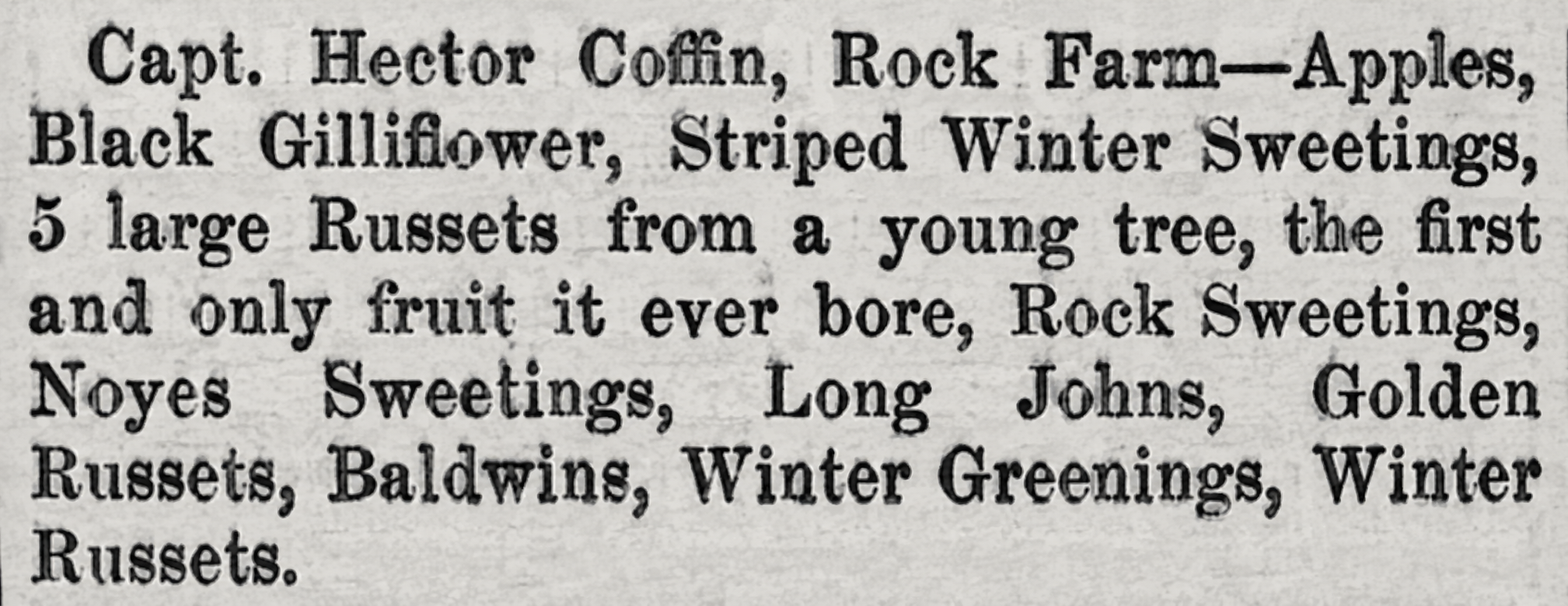
Other apples named in the 1833 Newburyport Horticultural Society exhibition include Cat Head, Ordway Pippin, Grandfather’s Graft, and Lady’s Blush
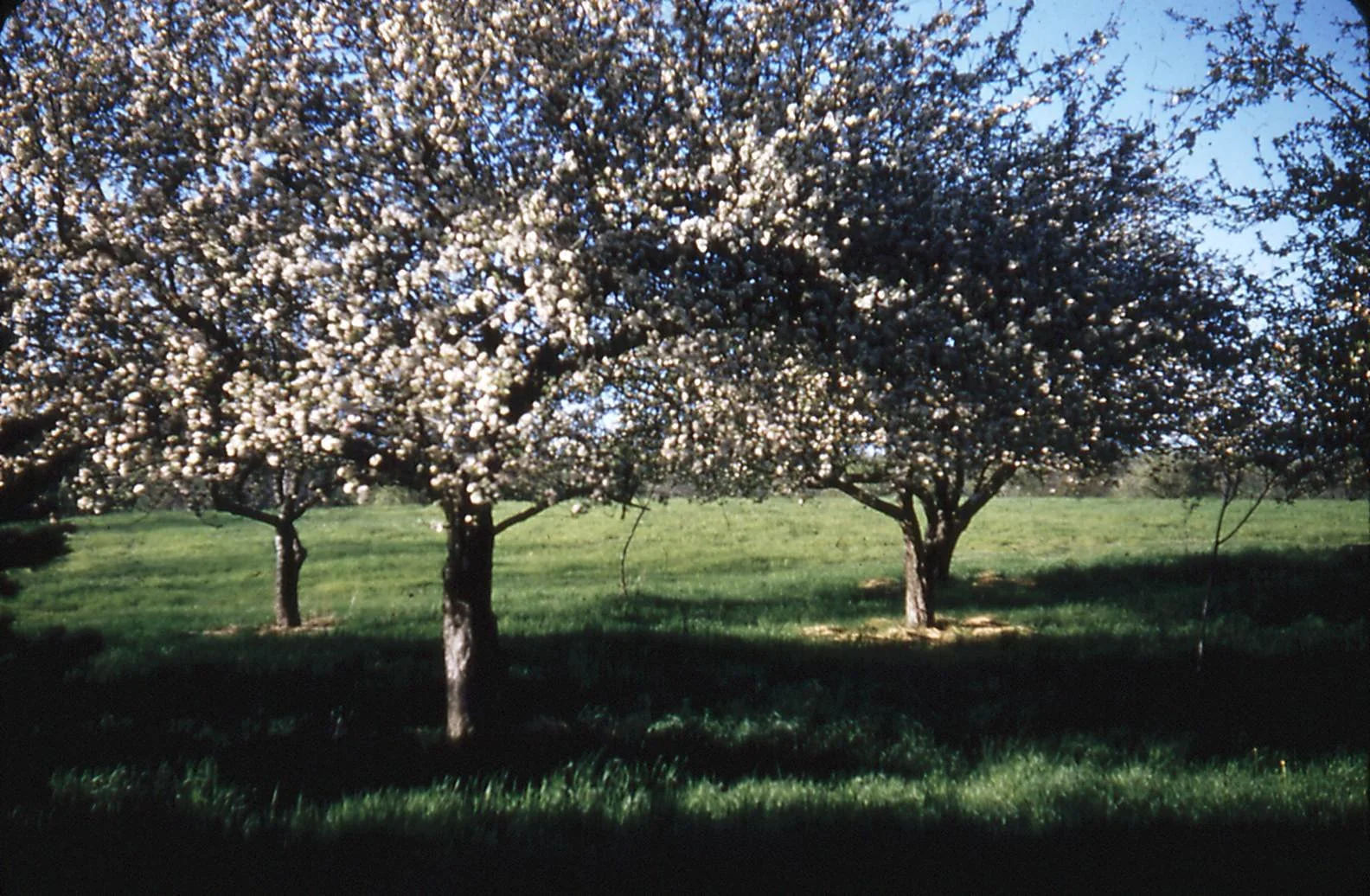
Long Hill Orchard, West Newbury, 1954, photo by Sue Follansbee.
However the tree that dropped the mystery apple at my feet arrived at the Poore Farm in West Newbury, I am now deeply invested in finding out which swamp tree produced it, whether it is, in fact, a Gravenstein, and whether Moses Poore kept records of his planting that are hidden in one of the dozens of unexplored boxes in my attic. Tomorrow, I don long pants, risk the rage of Michael the small rooster, and set off into the poison ivy to see what I can find. Whatever comes of my quest, I promise to update you all, and share more lovely images of the apple trees of Old Newbury, who have always been a source of wonder, pride, and inspiration to their owners.