
Adventures in the Archives: The Wheelbarrow Polka
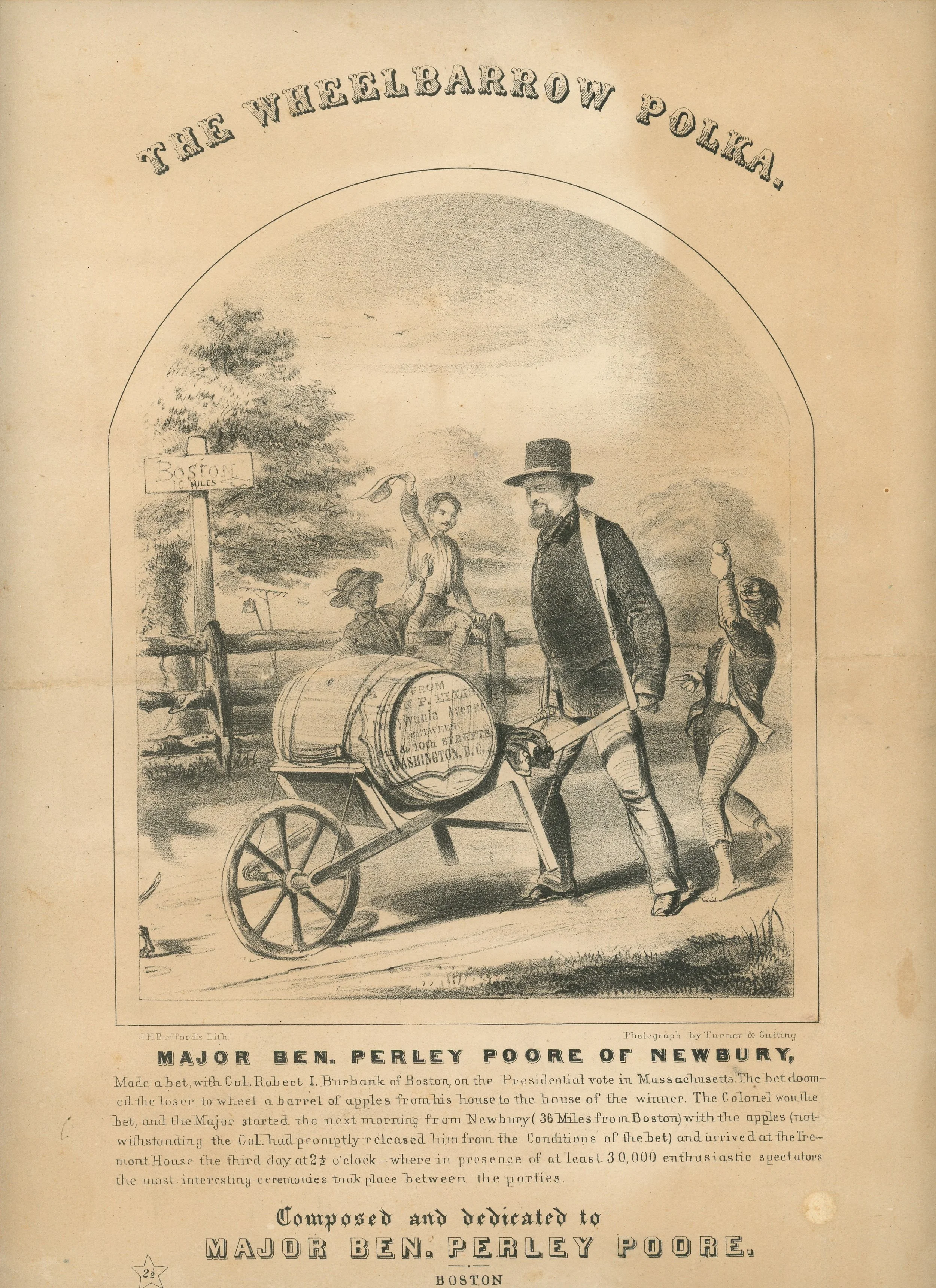
Above, our copy of the Wheelbarrow Polka (2025.71.11) from our Moseley-Poore Family Papers.
by Ashley Adams Serveiss, Collections Manager & Archivist
Last fall, I had the pleasure of processing the Moseley-Poore Family Papers, which are a fantastic collection of 19th century correspondence and ephemera from the Moseley and Poore families of West Newbury and Newburyport, respectively. I wrote a piece for our November 21, 2025 newsletter, which talked mostly about Benjamin Perley Poore (1820-1887) and his daughter Alice Poore Moseley (1851-1883). Today I want to cast a bit of attention on the funnier, quirkier side of West Newbury’s good-humored betting man from the 19th century.
Major Benjamin Perley Poore, who stylized his name as Ben: Perley Poore, was an author, editor, and journalist who split his time between Washington, D.C. and Indian Hill Farm in West Newbury, where his family had lived for many generations. Born in Newburyport and educated at The Governor’s Academy (where he was allegedly expelled for unruly behavior), Poore was a respected man of his time who, by all written accounts, had an excellent sense of humor. Despite the purported unruly conduct in his youth, he served in the 8th Massachusetts Volunteers during the Civil War (hence the Major designation) and ended up working as a newspaper editor, later becoming one of the most established journalists of the 19th century. In Washington, Ben: Perley Poore befriended the likes of presidents, senators, congressmen, and dignitaries, many of whom were likely entertained at Indian Hill.
In 1856, Poore attempted to start a political career when he ran for a seat in Congress in Massachusetts’ 6th District — this attempt was short-lived because Poore lost the election. That same year, he suffered another loss when he endorsed presidential candidate Millard Fillmore. As history tells us, Poore wagered a bet against Col. Robert I. Burbank that Fillmore would take more votes in Massachusetts than his opponent, John Fremont. The loser was expected to transport a full wheelbarrow of apples from his home to his opponent’s residence. By all accounts, we can assume that Poore was far from a sore loser and had a generally good attitude about humiliation — whether against him or his betting opponents, who in this case was also a friend.
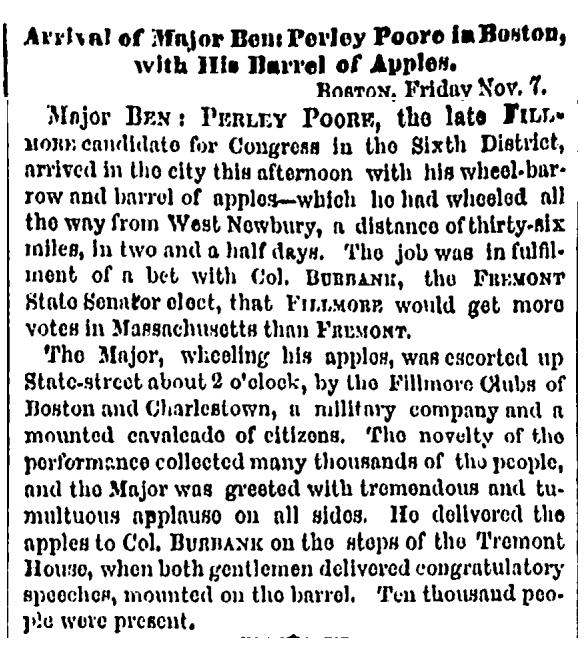
Above, an article published in the New York Times on November 7, 1856, which covers Ben: Perley Poore’s epic trip from West Newbury to Boston.
We now know that Fillmore lost in Massachusetts to Fremont, which meant our dear West Newbury native had to carry out his end of the bet. This of course meant transporting a wheelbarrow full of apples from West Newbury to Tremont House in Boston — a journey of 36 miles — which included a cavalry escort, support from various Fillmore Clubs, and throngs of crowds cheering him on over the two and a half day journey. Poore was allegedly met with a crowd of 10,000 excited fans (both for Fillmore and Fremont) once he reached his destination in Boston. The end result of this bet became the infamous Wheelbarrow Polka, an ode to Poore’s defeat and good humor around the whole situation, from start to finish.
We have an excellent copy of the Wheelbarrow Polka in the Moseley-Poore Family Papers at the Perkins Art & Research Center. As always, we encourage you to visit us to read the sheet music in-person! Our public hours are Fridays and Saturdays from 10am-2pm, or by appointment.