
Rare Declaration of Independence From Newburyport Found in London
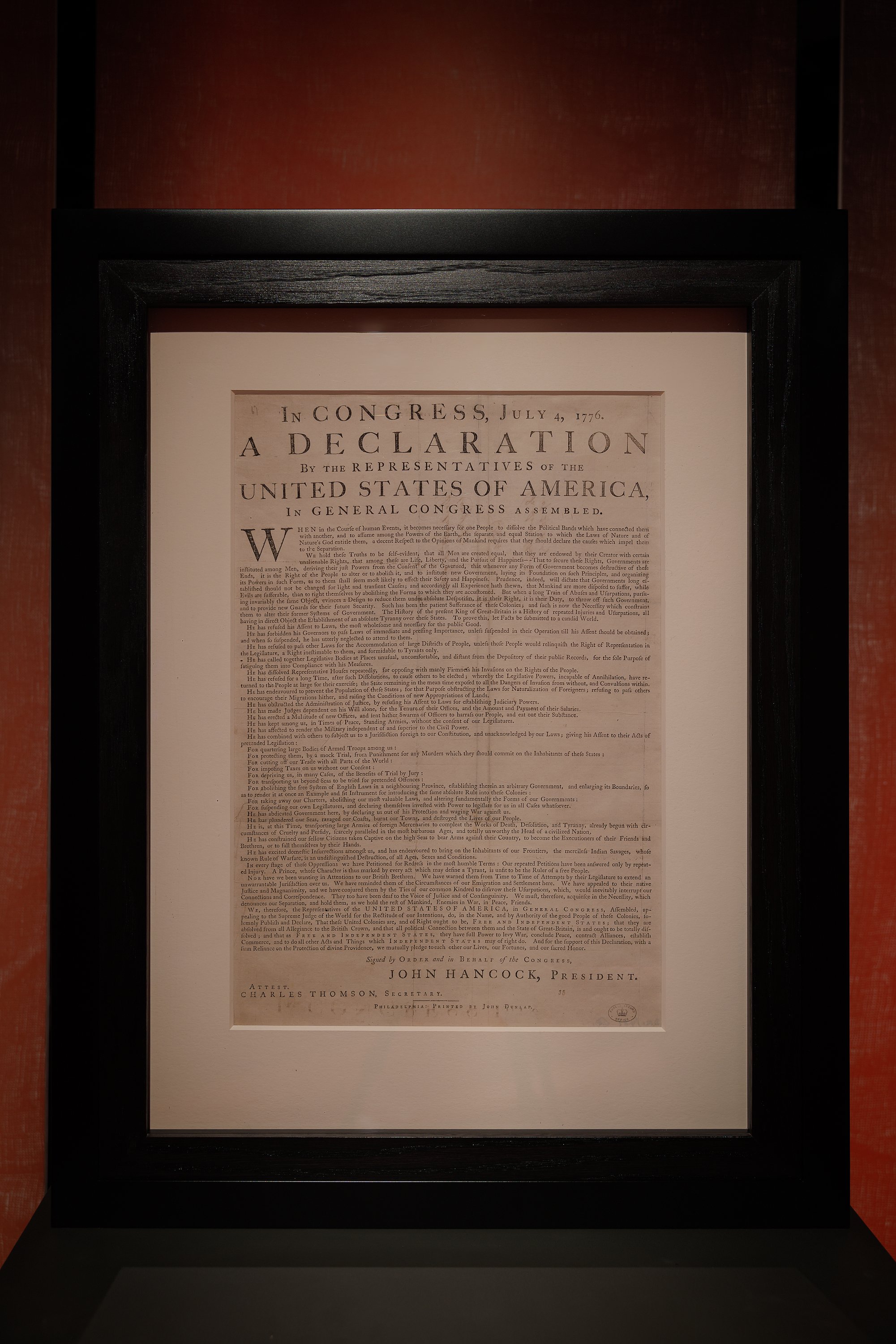
The National Archives in London has discovered a previously unknown copy of the US Declaration of Independence, printed between 15-19 July 1776 in Exeter, New Hampshire. Only 10 other copies are known to survive – all of which are in the United States. Image Copyright: The National Archives
A rare July 1776 printing of America’s Declaration of Independence was discovered just recently in the British National Archives, among papers seized during the Revolutionary War from the Dalton, a privateering brig from Newburyport. Printed in Exeter, NH, between July 16-19, 1776, it is one of just eleven copies known to survive and the only one outside the United States.
One of the first Americans notified was Bethany Groff Dorau, executive director of the Museum of Old Newbury, whose decades-long interest in the Dalton led her to study the British National Archive’s files of Dalton’s “prize papers” in August 2024. The rare document was in other files, however, and was only recently discovered by National Archives staff. This visit grew into a transatlantic relationship between the Museum of Old Newbury and the National Archives. At the Revolutionary Privateers at Sea Symposium in March of this year, the head of the Prize Papers Project at the National Archives, Amanda Bevin, Ph.D. was a featured speaker.
While cataloguing the Revolutionary War papers of Royal Navy captains, part of the British National Archive’s work for the United States’ 250th anniversary, staff made the surprising find among papers belonging to the Royal Navy captain whose ship captured the Dalton off the coast of Portugal on Christmas Eve 1776.

Illustration of the capture of the Dalton by the HMS Raisonable from Charles Herbert’s Relic of the Revolution.
Dr. Graham Moore, Revolution 250 curator at The National Archives, said: “This is one of the rarest forms of the Declaration we know about. It wasn’t meant to be preserved – it was printed quickly and distributed widely,” noting that printed copies like this one were often carried on ships to rally support for the revolutionary cause. “For the men on board the Dalton, it set out what they were fighting for, and why. The fact that it was worth carrying across an ocean during wartime tells us a great deal about its meaning and importance.”
Commissioned on October 17, 1776 by the American Continental Congress, the Dalton set sail from Newburyport on November 15th, fitted with 20 cannon and crew of 120 men under the command of Eleazer Johnson, Jr. The privateering brig was cruising off the Spanish coast of Cape Finisterre, hunting for British merchant ships, when HMS Raisonable, a 64-gun man-of-war with 500 men, chased them south along the Portuguese coast, capturing them on December 24th.
The Dalton was brought back to Britain, where its crew was jailed in Plymouth’s Old Mill Prison. Its papersꟷincluding its privateering commission and printed instructions from the Continental Congress-were held for Admiralty court proceedings, and all such papers from the Revolutionary War have been kept for centuries in the British National Archives. Staff there note that authorities at the time listed the printed copy of the Declaration of Independence as just “another paper.”
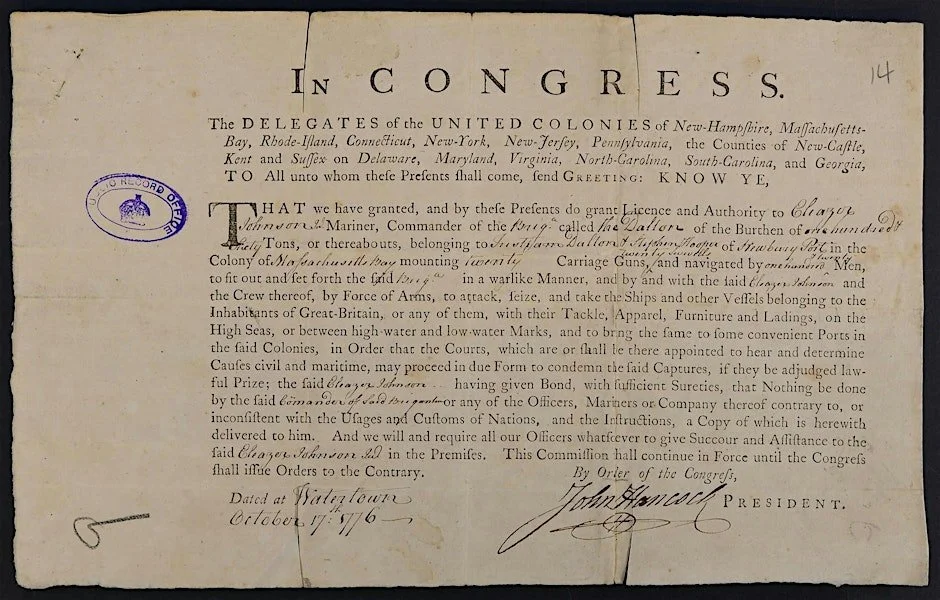
The letter of Marque of the Dalton, also held at the National Archives in London.
The irony of that dismissal is profound on this eve of the 250th anniversary of that paper’s signing and the birth of our nation. This rare contemporary copy of that paper, preserved in the holdings from that Newburyport vessel, is a treasure of national significance and a great tribute to our historic city.
Following its identification, the document has undergone careful conservation to stabilize the paper, repair a slight tear, and make it safe for handling, study, and future display.
Stay tuned for more!