
Finding Joseph Brun: An Acadian Quest
By M. Jordan Love, guest columnist
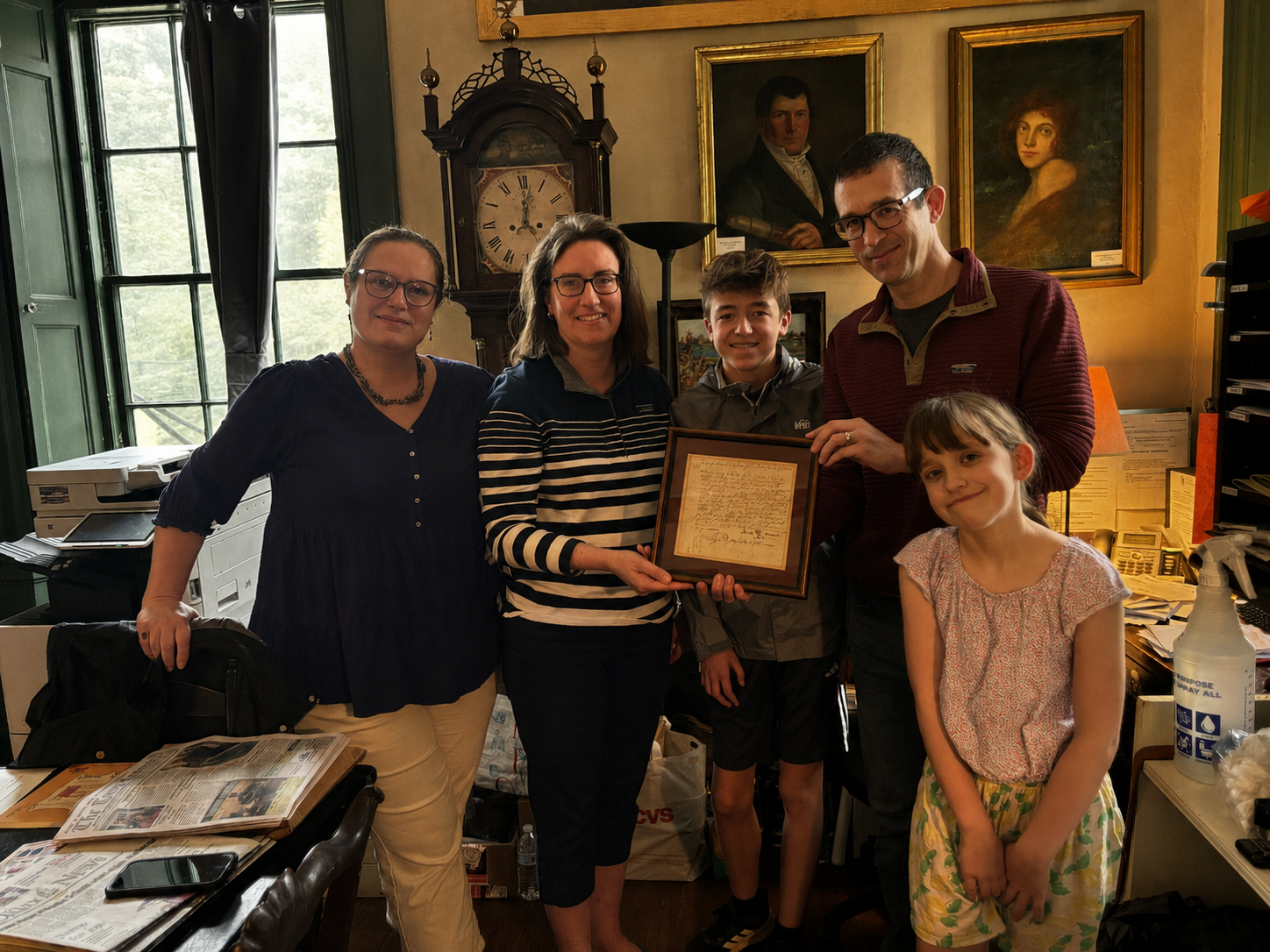
The Brun family visits The Museum of Old Newbury and answers the question of where their ancestor landed after the Acadian deportations.
Anyone who has tried to track down their French-Canadian ancestors will tell you that at some point they probably discovered Acadians who were deported by the British in 1755. Port Royal, Grand Pré, Beaubassin, Saint-Charles-les Mines: the names of the burned settlements reveal themselves the further you dig.
The Acadian censuses from 1670 to 1755, as well as a few select church records saved by heroic priests are all that reveal who the settlers were and where they lived. Many descendants owe their existence to those Acadians who survived the deportations and made it to Quebec, which accepted them after Britain and France signed a treaty ending the French and Indian War in 1763. However, where those Acadians lived during that time span was often difficult or impossible to find.

Portrayal of the Burning of Acadia, by Claude Picard
However, as I have discovered in my journey to research my husband (and children’s) Acadian ancestors, new and surprising documents have begun to surface in New England recently, such as a list of Acadians petitioning to be sent to France from Connecticut, or a list of “French Neutrals,” as they were called, receiving aid on the island of Nantucket. They had been unceremoniously dumped up and down the eastern seaboard, with their treatment varying widely, state-to-state, community-to-community. One pair of our family’s deported Acadian ancestors was Joseph Brun and Francoise Comeau.
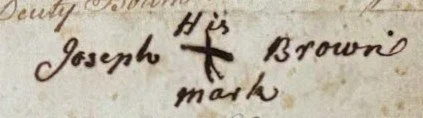
Joseph Brun’s signature. The X’s indicates his inability to read or write, and his name would have been changed to Brown(e) after the family had been deported to New England.
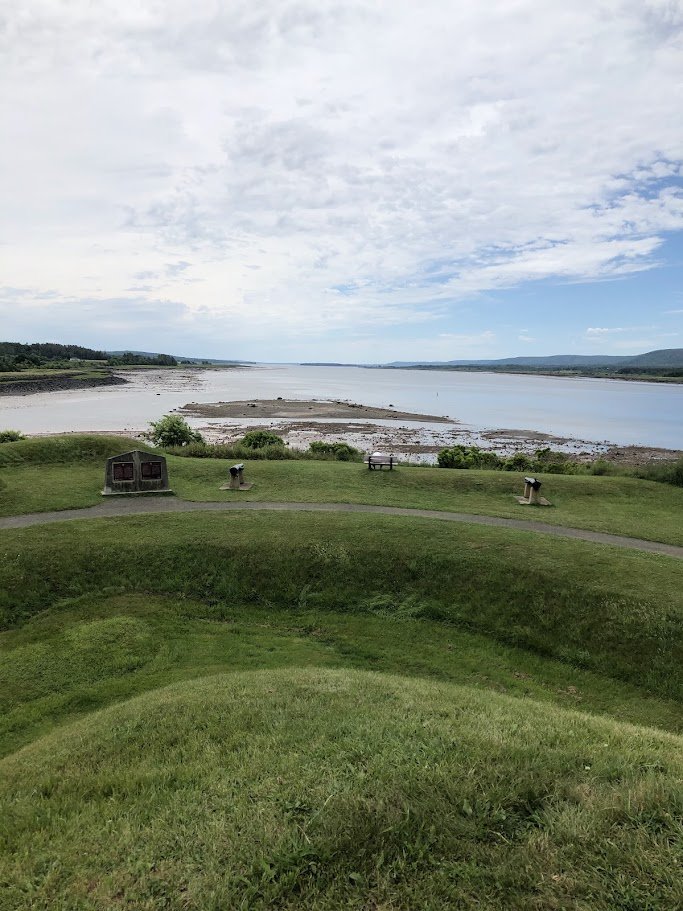
The view from Port Royal, where Joseph Brun and his family lived , in present day Nova Scotia.
I knew that Joseph Brun and Francoise Comeau had been newly married with a few young children, from church records and censuses from Port Royal in the early 1750s, and I also had discovered their death records, and the marriage records for their children, in the 1780s in the area of L’Acadie, a small town south of Montreal, Quebec. But where had they been in the meantime? How had they made such an arduous journey? On a whim I recently googled Joseph Brun’s name, hoping that another descendant may have posted their family tree to the internet with some source I had not yet seen.
Imagine my surprise when the Museum of Old Newbury website popped up instead! I learned from executive director Bethany Groff Dorau’s newsletter article from 2024 that Joseph and Francoise must have been among the approximately 2,000 Acadians dumped and dispersed in Boston, and that it was Newbury—soon to become Newburyport—that had taken them in.
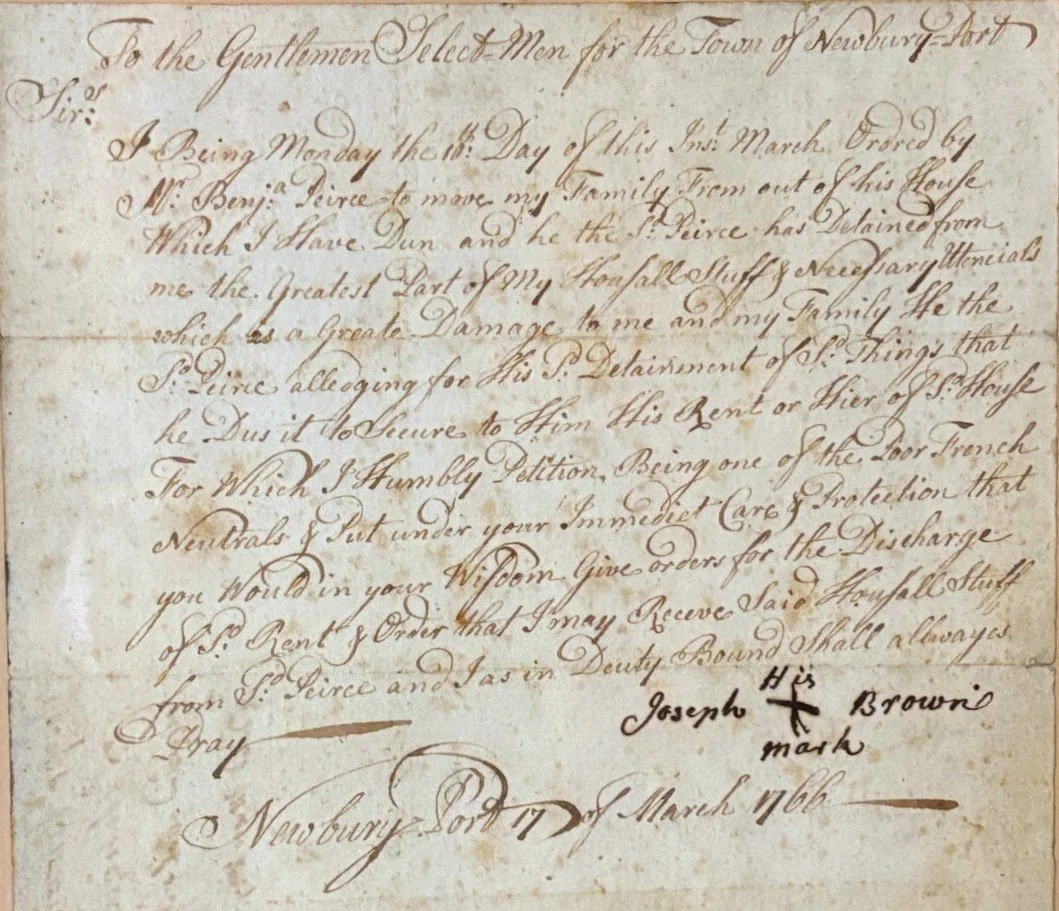
A document pleading with the selectmen of Newburyport for help recovering the possessions of Joseph Brown held by Benjamin Peirce, who had apparently kicked him out of his home, but kept his things. The document describes Joseph Brown as a “Poor French Neutral”.
“To the Gentleman Select Men for the town of Newburyport
Sirs: I being Monday the 10th day of this Inst. March ordered by Mr. Benjamin Peirce to move my family from out of his house which I have done and he the said Peirce has detained from me the greatest part of my housall (household) stuff and necessary utensils, which is a great damage to me and my family. He the said Peirce alleging for his detainment of said things that he does it to secure to him his rent or hire of his house for which I humbly petition being one of the poor French neutrals and put under your immediate care and protection that you would in your wisdom give orders for the discharge of said rent and order that I may receive said household stuff from said Peirce and I as in duty bound shall always pray -
Newbury Port 17th of March 1766”
The wonderful thing about original documents is the wealth of information you can get from them. As a museum curator myself, I frequently work with original letters, court records, sales and auction receipts, tax lists, and other documents to trace art and artists as part of my work at the Fralin Museum of Art at the University of Virginia. However, it wasn’t until I got into genealogy that original documents took on a whole new meaning. Joseph Brun signed with an“x”indicating he could not read or write. However, he had found someone to do the writing for him, in English no less, and to advocate on his behalf after his family was evicted from their rental home and their belongings withheld by landlord Benjamin Pierce.
The fact that the document dated to 1766, eleven years after the deportations, is significant—after the French and British signed the Treaty of Paris in 1763, ending hostilities, support for the French Acadians began to dry up. According to the New England Historical Society, the treaty gave the Acadians 19 months to vacate the New England colonies for French ones (Quebec, Haiti, Louisiana, or back to France). Colonists assumed the French were free to leave, but as many were still destitute and could not purchase passage to another place, they struggled to figure out their next move. This is likely why Joseph Brun found Newburyport was no longer paying his rent or supplying his family with food and supplies.

In 1766, the Newburyport town records show the selectmen receiving and considering the petition of Joseph Brun.
The petition also suggests they had been there for some time. Their son and our ancestor Joseph Brun Jr. had been born just two years before the deportations and had been a two-year-old toddler when the family arrived in Newbury. By the 1766 petition, after the town had been subdivided into Newburyport, Joseph Jr. was 13 years-old and had spent most of his childhood in Massachusetts. He probably didn’t even remember his original Acadian home. Having a 14-year-old son of my own, I thought about what Joseph Jr. must have gone through as a perpetual outsider in the only hometown he had ever known with parents who were eager to leave.
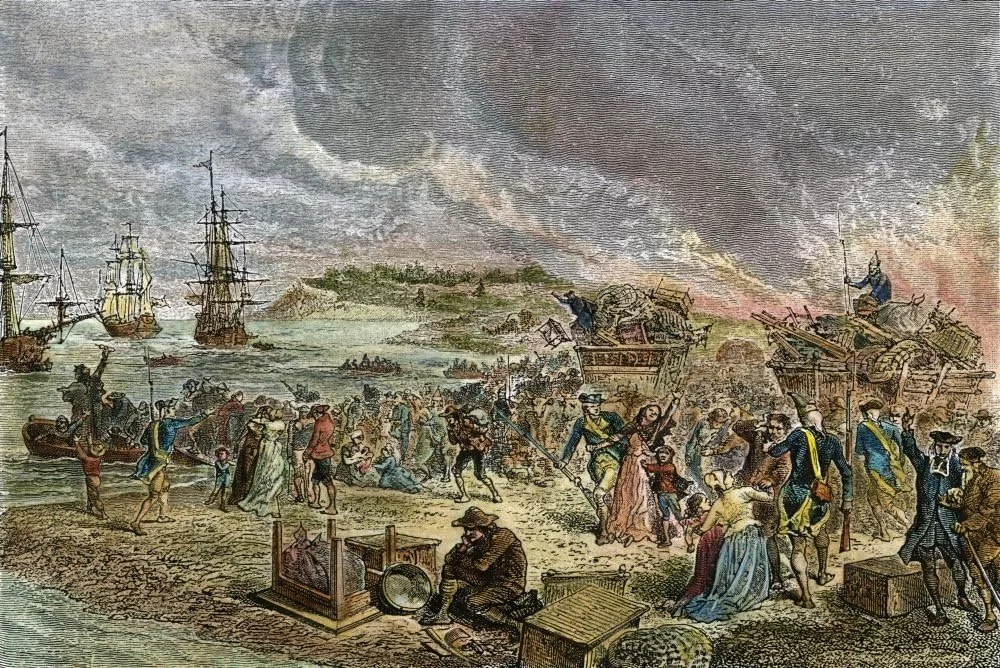
The Embarkation of the Acadians by Émile Antoine Bayard, 1881
By 1766, 900 Acadians gathered in Boston to swear allegiance to England in exchange for permission to leave Massachusetts and try to make it back to Nova Scotia or to French communities in Quebec or further abroad. Another wave left in 1767, attracted by the offer by Gov. James Murray of Quebec to allow Acadians to populate specific Seigneuries along the Saint Lawrence River. At some point, Joseph Brun and Francoise Comeau and their family were among them. As Bethany mentioned in her original post, Joseph died in 1768 just two years after the petition document at Newburyport. He had lived just long enough to see his family settled near Montreal. Francoise lived another seventeen years.
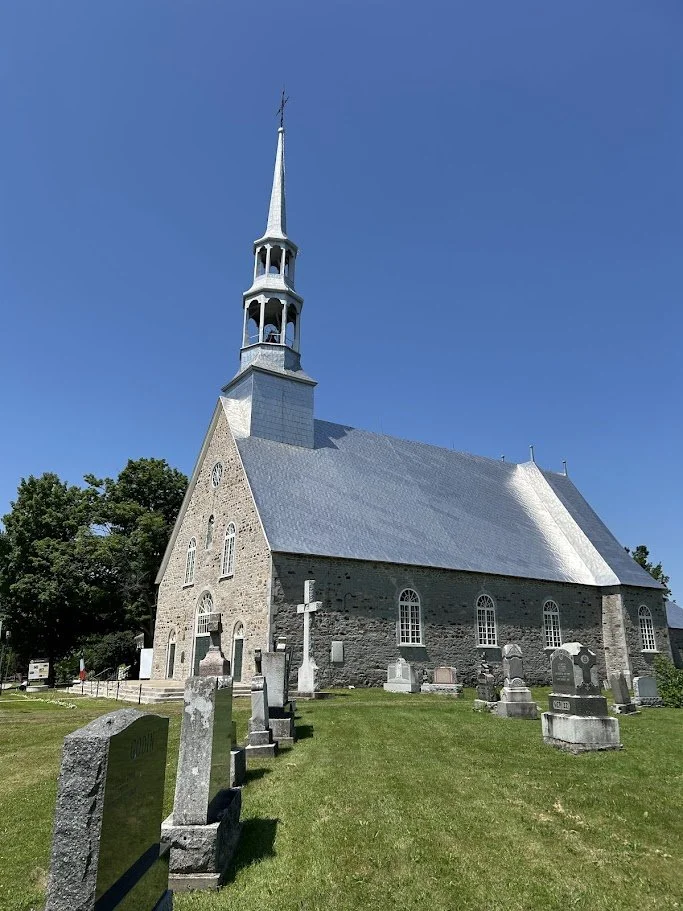
A visit to the church built at L’Acadie, Quebec reveals evidence of the Acadian’s return to Canada.
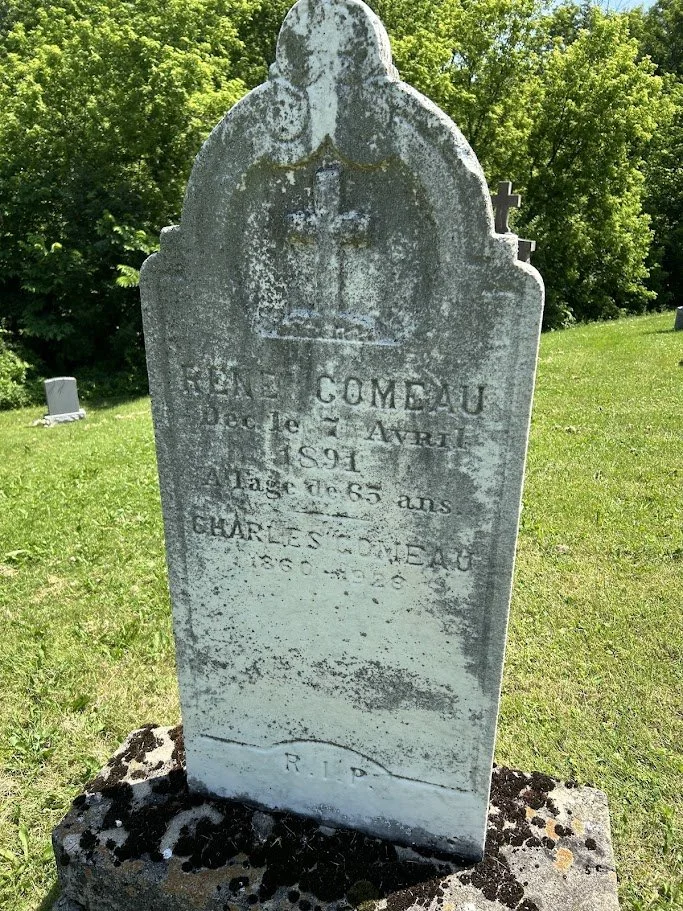
While no Bruns were found in the cemetery at the church, known Acadian names such as Comeau, Landry, and Roy were present on the gravestones. This is the headstone of Rene Comeau, thought to be a nephew of Francoise Comeau.
But their story doesn’t stop there. Their son, Joseph Jr. married Marie Anne Dupuis, who was born on Nantucket to an Acadian family deported to that island, mentioned previously. She had only known life on the island when her parents also made their way to L’Acadie, Quebec. The couple had a daughter Marie Angelique who married Clement-Luc Fortin, a community leader and advocate for Quebec independence from English rule. He was so involved in the movement that he had to flee to avoid capture and arrest by English authorities.
Their son, Francois Xavier Fortin, left for Fall River, Massachusetts, lured to work in the factories there, but discovering appalling conditions. His daughter fled north with her husband to work in New Hampshire, ironically just miles from Newburyport. Subsequent children moved back to central Massachusetts to work other factories alongside waves of other poor Quebec immigrants who migrated south in the first decade of the 20th century.
Deportations are in the news once again, and sometimes it feels like no time has passed since the Acadians were the ones caught up in international conflicts beyond their control. Canada’s recent decision to allow descendants of the Quebec migrants to become citizens has once again created a magnetic force that has pulled and pushed these French descendants back and forth in a dance between Canada and New England for four hundred years. So what can we learn from Joseph Brun and Francoise Comeau? What can I tell my kids about their ancestor’s desperate but determined petition? There are plenty of lessons about not giving up, but perhaps even more about leadership and helping to create conditions for people to thrive where they are.
Documents like those held by the Museum of Old Newbury remind us how far we have come, but they also hold up a mirror to remind us that we are still susceptible to the same forces and mistakes that past ancestors made.