
Gardens of the New Republic: A Perfect Companion for the Garden Tour!
Have you ever wondered how the beautiful gardens at the Cushing House came to be? In fact, at one time they were surrounded by equally beautiful gardens up and down the High Street. All of this was made possible by the growing ship-based prosperity of Newburyport in its early days. The impetus and stability of America's established New Republic led to the growing maritime trade and the soon-to-be-worldly sophistication of Newburyport's sailors and merchants. By 1776, Newburyport had expanded, from colonial Newbury's small scattering of agricultural settlers to a harbor-based community with wide connections across the world’s oceans that would ensure the town's future prosperity and growth.
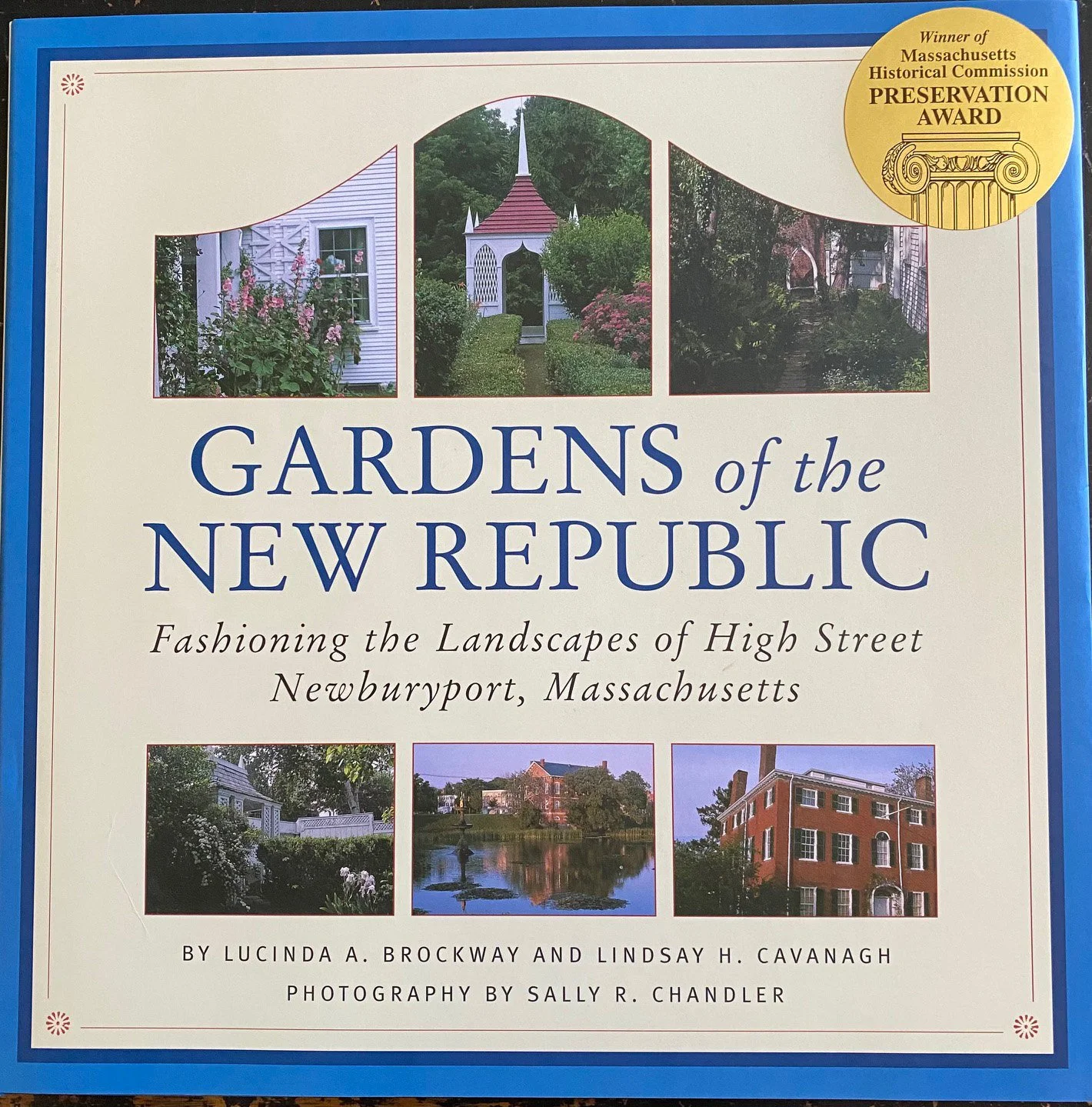
Front cover of Gardens of the New Republic
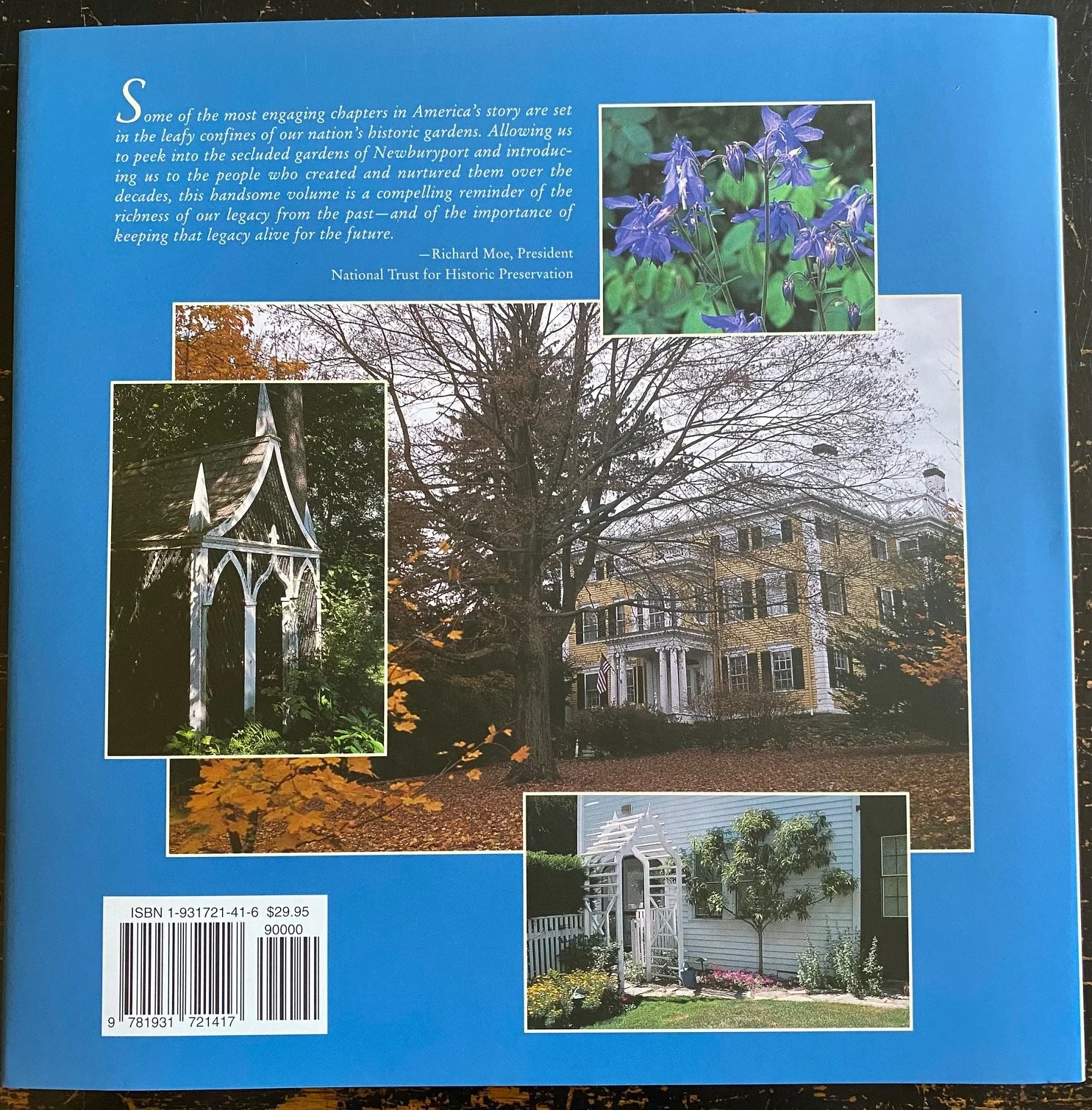
Back cover of Gardens of the New Republic
Through this shipping-based trade, an awareness of European and Asian traditions grew, bringing interest in foreign customs and styles to Newburyport. An assortment of books and how-to manuals were passed to home owners who slowly became interested in the unusual trees, shrubs and planting styles they learned about, as well as in the often-French-inspired layouts. Gradually these ideas were embraced by Newburyport's horticulturalists and ordinary folk. During the years of the merchant-traders followed by the successful mill owners, wealth came to Newburyport. The Federal grand houses and their secret and splendid gardens, not visible from the street because they were behind those big white houses, were the results. Having, caring for and enjoying a large garden designed for pleasure became one of the signs that you and your family were an important part of the city’s culture. As a result, fortunately, there are a considerable number of old black-and-white photographs that document the plantings, structures and even sometimes the perambulating owners of those green retreats.
Over the decades, many of these beautiful spaces began to change, fall into disrepair or even disappear, as their owners developed different tastes and preferences. And the Cushing House garden was no exception, despite some very careful tending by volunteers. In 1994, the Garden Committee felt the garden needed a new restoration to its old design, to complete the authenticity of the Museum’s interior. Lucinda Brockway, a well-known Landscape Preservationist, delved into its history from 1808-1997. She decided with the committee that the restoration should be based on the design that was in place during Margaret Cushing's early lifetime, between 1867 and 1905, when the garden was under the care of her parents. Margaret Cushing lived her entire life in the Cushing house, dying there in 1955, after which it became a Museum. By great good fortune, the Museum owns a hand-drawn diagram of the way the garden looked during her time.
Sally Chandler, Stefanie Hufnagel and Lindsay Cavanagh, all long time Society members, decided to take on the restoration challenge. The greatest challenge was raising the money. For five years the committee hosted a series of all-day landscape symposia at the Firehouse, featuring talks by well-known garden historians, punctuated by lunch. The symposium lecture by Brockway, discussing the 19th century gardens of Newburyport, led to another brainstorm – a book: Gardens of the New Republic: Fashioning the Gardens of High Street Newburyport, Massachusetts.
As Brockway’s presentation slides showed, Newburyport still had remnants and even a few nearly-intact survivors of the original gardens. Many had been photographed before they were lost, and others continued to keep the vestiges of their beauty. We decided to share these photographs (both old and new), paintings by local artists, stories and horticultural as well as Newburyport history, in a book. We determined that it would be published in time for the 25th anniversary of the Historical Society June Garden Tour in 2004, and it was! With the funds raised from sale of this volume we have contributed periodically to the care of the garden and to other projects. The book was awarded one of the 2005 Preservation Awards of the Massachusetts Historic Commission. It was the first time this prize was awarded to a book.
The book now is part of the community of the Museum of Old Newbury and part of the history of Newburyport. We are sure that you will find both knowledge and delight in perusing it.