
“Absolutely Private”: Uncovering Ruth Graves’ Diary
By: Freddy Kniker, Eliza Brennan, Tess Schmidt, and Heidi Ricker
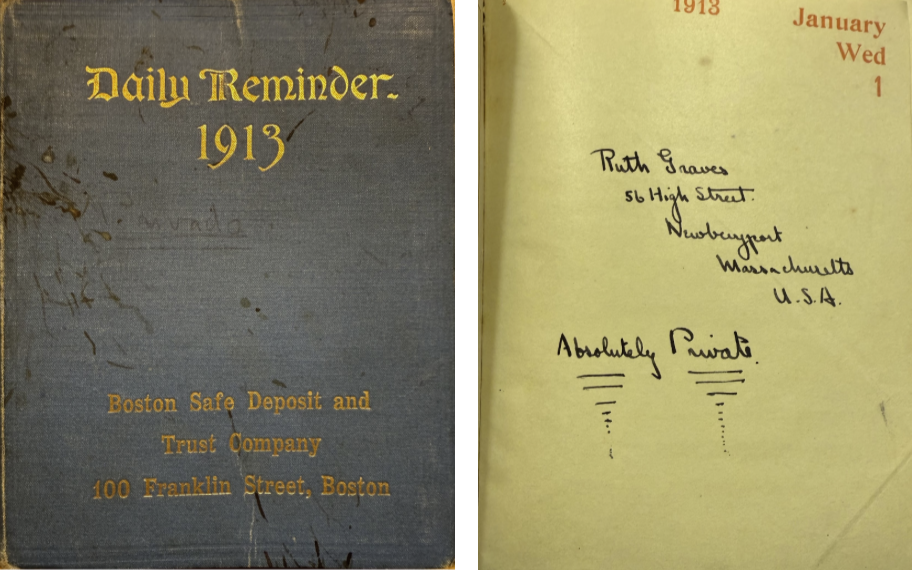
The front and inside cover of Ruth’s Diary
How would you feel if your diary was opened and read 100-plus years after you had tossed it aside? Even after you had written a warning - “Absolutely Private” on the inside cover. … Personally we would be rolling in our Graves.
Two years ago, interns at the Museum of Old Newbury began to assist with cataloguing and scanning the Graves letters donated by Tim Kendall, a descendant of the Graves-Pike family of Newburyport. They came across the vibrant character of Ruth Graves (1898-1977), daughter of Edmund Pike Graves, and were fascinated by her escapades. In the past few weeks, we (the intrepid Summer 2026 interns) have continued this uncovering of her life through letters and a new (to us) discovery: her diary.
It describes her family’s voyage from Montevideo, Uruguay to Barbados upon the S.S. Vauban, spanning from December 27th 1913, to January 24, 1914. We’re confident that the diary belonged to Ruth Graves, due to her name written in the inside cover, mentions of her sister and mother, and the handwriting matches from other letters written by her that we’ve uncovered. From what we can understand from other Graves letters, Ellen, Ruth, and their mother, Mary Warner Caldwell Graves traveled from Argentina to Newburyport, stopping in Barbados, after the death of their father and husband, Edmund Pike Graves. The diary depicts just a segment of Ruth’s journey from Montevideo to Barbados and remains a snapshot of her life.
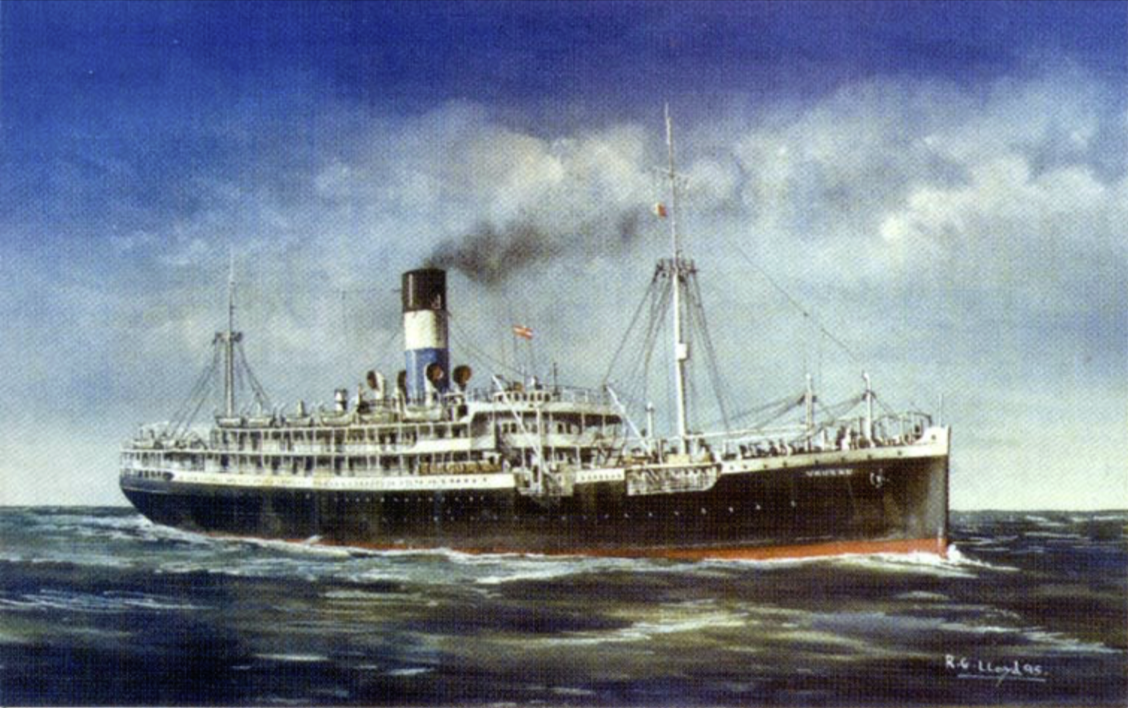
Postcard of Vauban by Isle of Wight artist R G Lloyd
(Sourced from https://www.bluestarline.org/lamports/vauban.html)
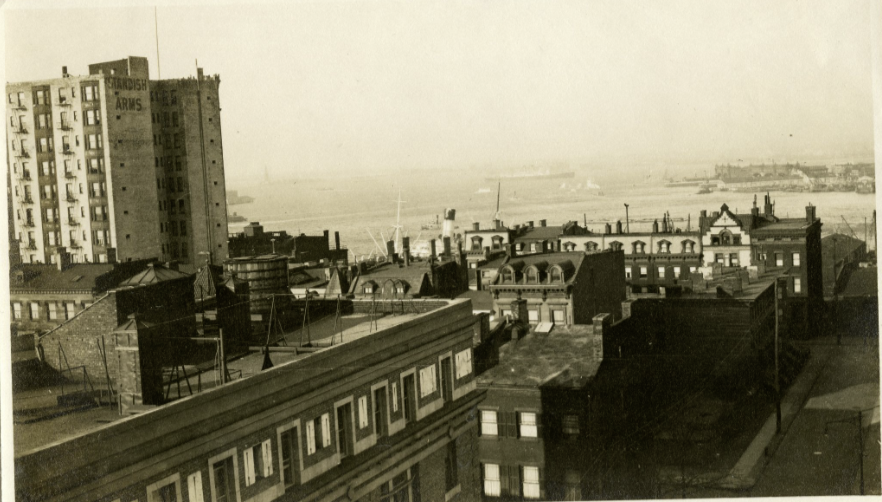
Brooklyn skyline with Vauban at port in distance taken by J.A Warden
Before we dive too deep into this diary, we should introduce ourselves. This summer we have a group of four college-level interns working at the Museum of Old Newbury. Firstly, Freddy Kniker is returning to the museum after excellent service as a high-school intern, but this time he is in college! He just finished his first year at Tufts University, and is excited to be back. Then, we have three new additions to the crew, Eliza Brennan, Tess Schmidt, and Heidi Ricker. Eliza is studying English and pursuing a Museum Studies certificate at Connecticut College, and just finished her junior year. Tess is also a rising senior, studying Communications at Pace University. Heidi just finished her sophomore year studying Classics and Art History at Wheaton College (MA), and similarly to Eliza, is pursuing a Museum Studies certificate. In addition, we have a wonderful group of high-school level interns, including Milena (actually a recent graduate), seen below on the right, and Noah, who has left us after a winter of diligent scanning to spend his summer in Australia! All of us are excited to be assisting the Museum this summer, and look forward to meeting you!

L-R back row: Heidi, Freddy, Eliza, Tess, Milena. Foreground: Bethany the director, Matt from the Daily News, and the real star intern, Herbie the piglet from Bethany’s farm sanctuary!
If you have been reading this newsletter for more than two years, you will remember the articles past interns Lilly and Annabelle wrote regarding the Graves family, and specifically two focused on Ruth’s many suitors and her eventual marriage to Roger Ernst. However those stories cover just a small fraction of the many Graves letters that we have gone through and the many boxes of letters we still need to read. It was at the bottom of one of these boxes of letters that we found Ruth’s diary from nearly a decade before her marriage.
Ruth’s diary is overflowing with anecdotes from her time at sea, descriptions of the sky and surrounding landscape, and updates on her fellow voyagers. Her tone is descriptive, cutting, and hilarious, and is a perfect insight to a teenager's life in the 1910s. It also starts to show the character of Ruth that develops and can be seen in her future letters to all of her suitors, a group of men that the interns have been calling “Ruth’s Roster.” Her diary also includes many returning characters, such as a Mr. Gibson, Mr. B, Ruth’s older sister Ellen, and her mother.
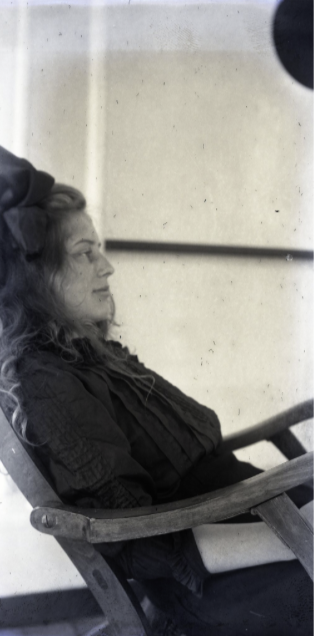
Image of Ruth’s sister Ellen on the S.S. Vauban sent to her by J. A. Warden, who was also aboard the ship.
On January 2, 1914, Ruth describes a new traveler on the S.S. Vauban as a “very dreadful looking old lady” whose “hair is drab and looks like a wig”, whose “nose is just like a parrot, her waist is all out of proportion, being as small as small, and she has a funny way of walking.” Ruth goes on to comment, “she must be a spinster because I don’t see how anyone could possibly marry her,” and then goes on so far as to refer to her as “this creature.” Ruth’s descriptions are brutal and cutting, and her attitude shows us that perhaps the judgement of teenage girls has surpassed the test of time.
In this diary, Ruth also reveals her emotional moments, particularly as a young girl blossoming into a woman. It’s important to keep in mind that this diary was written at a very turbulent time for Ruth. Her sister, Mary, had died the year prior, and her father just months before their journey. While she doesn’t explicitly mention her family’s deaths in the diary, we can only imagine how they might’ve weighed on her.
As former interns have written about in the past, Ruth maintains many different relationships and friendships evidenced by the collection of Graves letters. The diary explores her connections with other passengers aboard the S.S. Vauban, especially as she details an incident with two men on the voyage—Mr. G and Mr. B—who she has a playful relationship with. Her cavalier approach to their friendship is just an indication of her future relationships, and the variety of connections she makes with different types of people and walks of life. On January 3, 1914, Ruth writes,
“The morning passed uneventfully until about 11 when Misters G and B came up and handed me a little box beautifully tied up, saying ‘Don’t ever say we never gave you anything!’ Then they went off. I wasn’t going to open it at first because I thought it a joke, but my curiosity got the better of me, but I did with Mr. [J.] Warden[…]and I found a chupete or rather a ‘stop-children-from-crying-thing’ sucker. I laughed awfully much at first, as did everyone, thinking they gave it to me because the Com. always calls me Baby but then the full significance dawned on me. It was a gentle hint not to talk so much. Horrid things!”
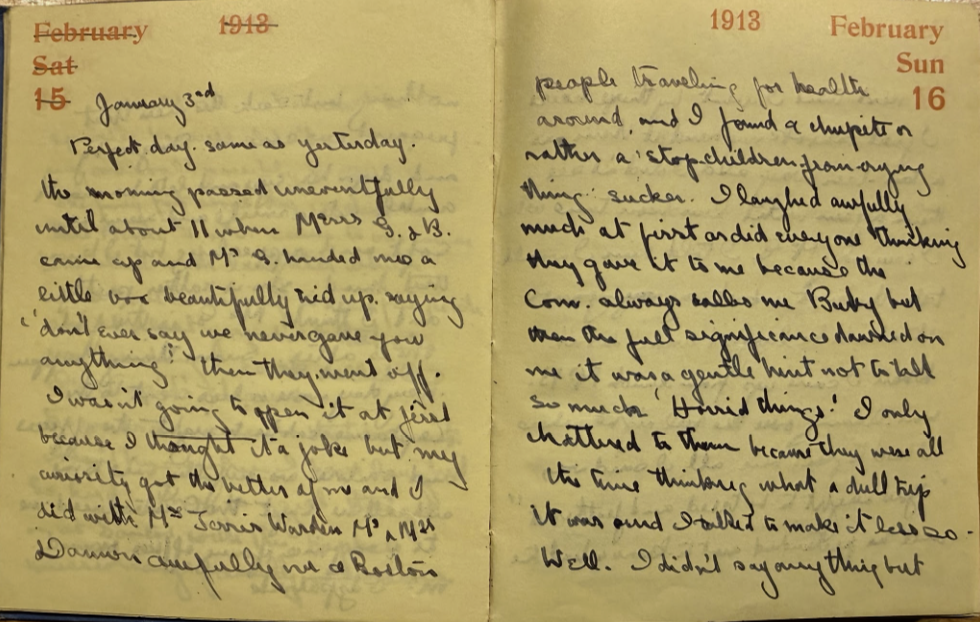
Image of the page from Ruth’s diary discussing the gift from Mr. G and B.
From what we gathered, a “chupete,” is a pacifier, which may be an insulting gift for Ruth, who—as someone who may be striving for maturity—is offended by the suggestion that she is merely a child. She processes what she believes to be a betrayal of friendship between herself and fellow voyagers. She explains that she was only talking so much as to make the “dull trip…less so,” and tries to understand how her new friends could act in such a manner. Much like the drama between her relationships in the future, Ruth maintains a tumultuous connection with her friends. When she sees Mr. B again after the incident, she tells him, “you ought to be tarred and feathered,” and remarks that “naturally when they came to tea [she] didn’t say much except to the other people.” While Ruth’s threats seem dire, she manages to quickly make peace with Mr. G and Mr. B.
Because Ruth was only about 15 or 16 when writing this, we are able to watch her character develop into a gregarious young woman who received plenty of messages from all sorts of people. In the same box as the diary we found an anonymous letter from about a decade later written to her mother, Mary Warner Caldwell Graves, from “a well wisher.” This letter informs Mary that Ruth is in “intimate correspondence with a low intriguing Spaniard.” I’m sure you don’t have to stretch your mind too much to imagine what that might mean.
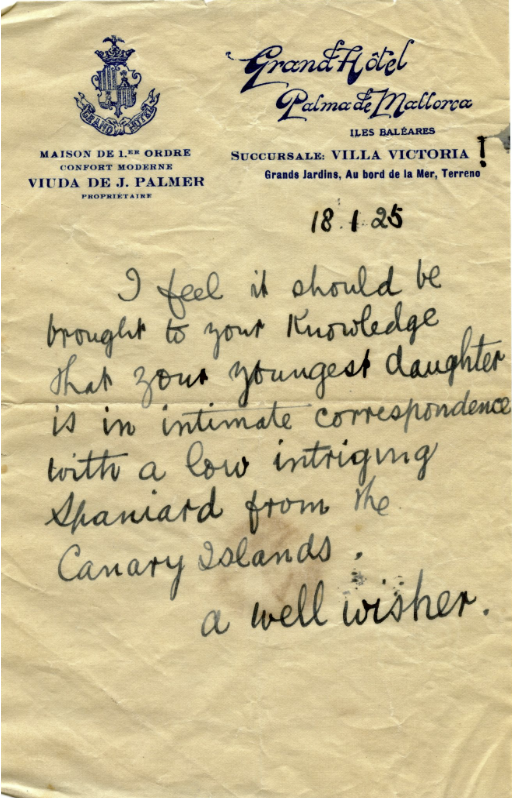
Letter sent to Mary Warner Caldwell Graves in 1925
This diary and letter are only the tip of the iceberg when it comes to the Graves collection. We searched our vast database of letters we have already read to see if we could find any more information relating to this “low intriguing Spaniard,” but could not find much of note, leaving this character shrouded in mystery. We have found evidence, however, that the Graves family spent time in Spain. Though the story is somewhat incomplete, we wanted to share what we had found so far. We are still digging through these letters in hopes of adding to this narrative and learning more about Ruth and her family, and would love to relate any new and exciting discoveries we come across in the future.
Though our days are always varied, giving us all a chance to work in every aspect of a thriving small museum, we are looking forward to spending time with Ruth and her family as we continue to catalogue these letters!