
House of the Angel Guardian
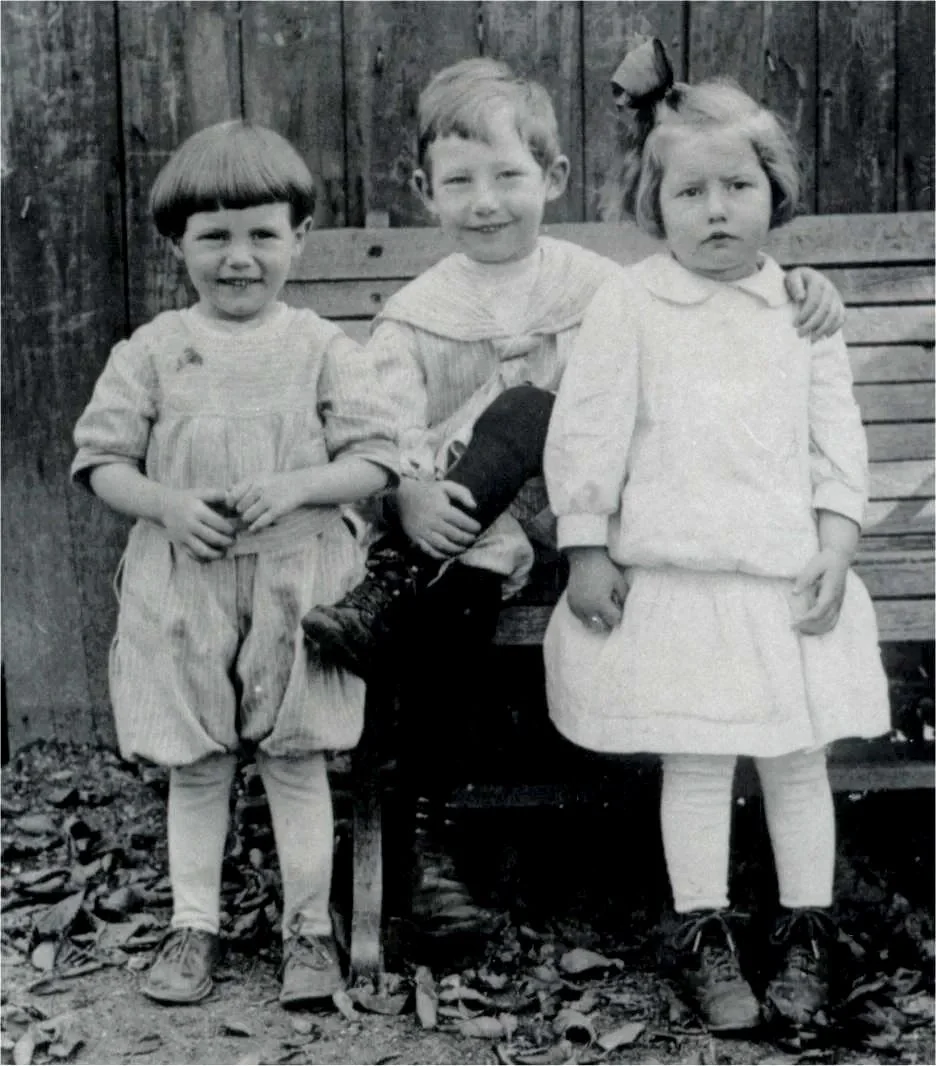
Arthur, John, and Margaret Muzrall, the year their father died, 1914
Well, friends, I’m sure some of you have had this experience. Over the last few weeks, my grandfather, gone for nearly 26 years, has been coming up a lot for me. Not like floating-down-the-hall style, but suddenly just coming up - a lot. The most recent time was two days ago, when my husband James made a gorgeous triple-layer orange chocolate cake for a dear friend’s birthday. Though chocolate cake is generally not my favorite, I have always loved the orange chocolate combination. It reminds me of the Terry’s chocolate oranges that my grandfather would send us, back in the day when you could only get chocolate oranges from abroad, or in an import store. As it was, we were miles from anything and rarely had sugar in any form. Those slices of chocolate with slightly bitter orange were savored for weeks. Midway through my slice of cake, it came back to me in a rush.
Then, yesterday, I was just sitting down to do some “real” work when I came across a mention of Boyhaven, a residential school and orphanage for boys in West Newbury in the mid-20th century. I am, as many of you know, a West Newburian, though I like to say that my house was built in Old Newbury, as it just barely pre-dates the establishment of the town. These are distinctions only for the truly nerdy. Still, I believe that West Newbury has had an outsize impact on the history of the nation, for a sleepy farm and comb-shop town. First Black town moderator? Check. Harvard University President? Check. Utopian community? Check. Flower purveyor to royalty? Check. Opera singers, Revolutionary War heroes, writers, artists, the list goes on and on. Not bad for a town whose entire population was small enough to go to the beach together one day a year. But I digress. Because of my particular interest in West Newbury, I was a bit ashamed of myself for knowing basically nothing about Boyhaven, so I dug in. At some point, I came across a reference to the House of the Angel Guardian as a founding body of Boyhaven. It rang a bell. I cogitated, dug around a bit, and there it was, in my grandfather’s oral history, recently transcribed.
“So then this is 1918, I was sent to Canada for a summer to live with my grandparents. I was very thin. They said I had anemia and didn’t expect me to live. However, I did recuperate, and when that fall came, they sent me back again to Boston, and then I was sent in 1918, to a place called the House of the Angel Guardian in Boston, which only took boys 11 years or older. I was 9 years old. It was run by monks who were, while not very cruel, very impersonal, and we were disciplined like we were, you know, waifs and strays, which we were, most of us.”
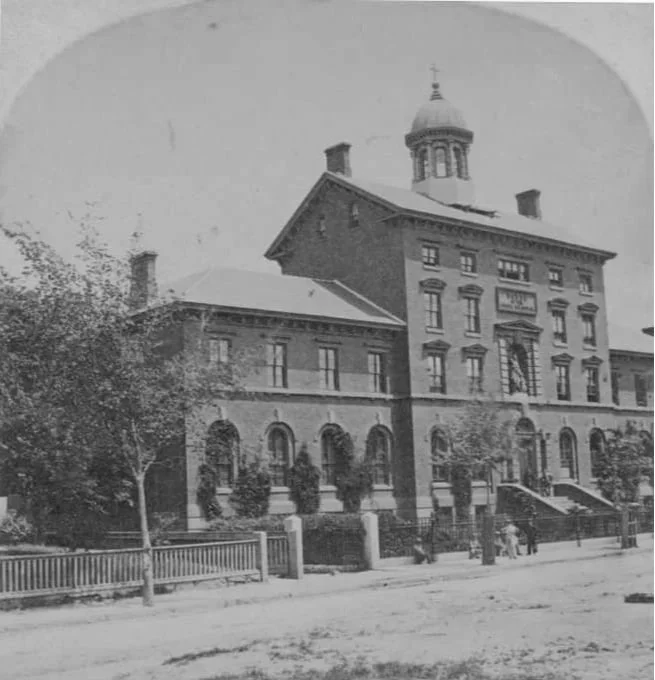
House of the Angel Guardian, 85 Vernon Street in Roxbury, Massachusetts, c.1880. Courtesy of Historic New England. In 1915, the institution moved to Jamaica Plain.
To be clear, my grandfather never lived in West Newbury - well, he did, in a way, for many decades, and again at the end of his life. We’ll get to that part of the story. For now, let me introduce you to John Edward Muzrall, who we all called Granddaddy, in his own words.
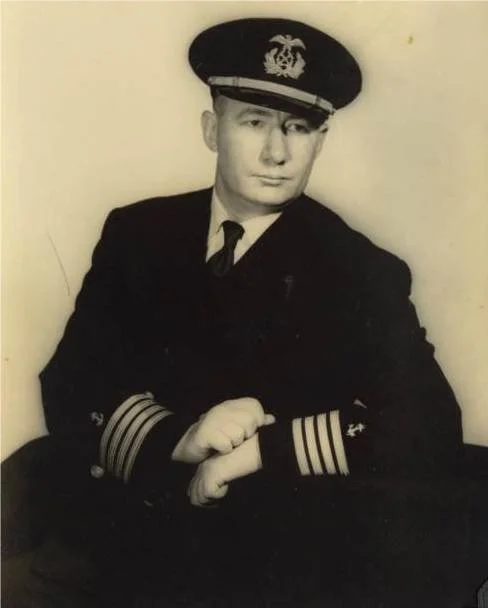
This is the Granddaddy of my memory - tall, broad shoulders, strong hands, a Merchant Marine officer, fastidiously tidy, a storyteller and polyglot, a man of strong opinions, kind but stern, a giant in my eyes.
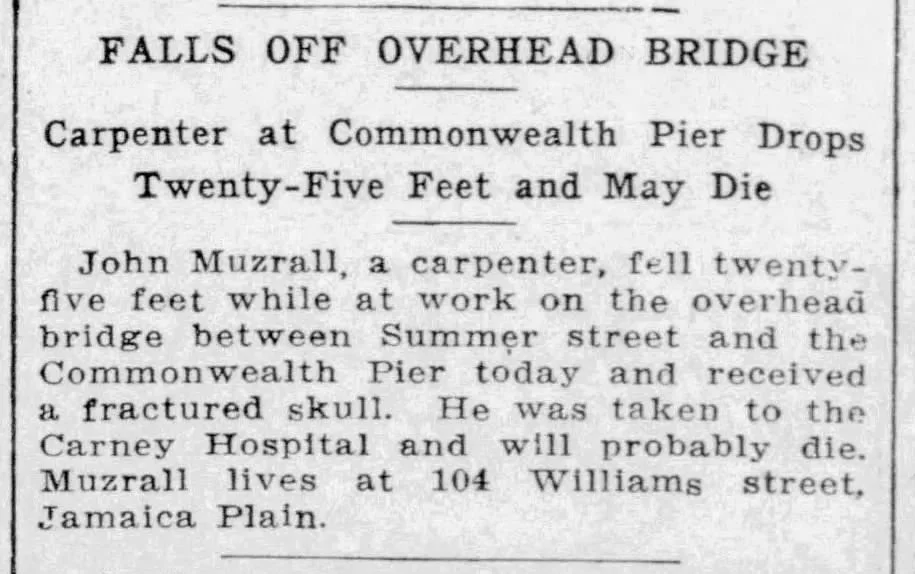
“I was born in Boston on September 29, 1909 my father and mother were both born in New Brunswick, Canada, and shortly after marriage, migrated to Boston, where my father worked as a carpenter foreman on various construction jobs in Boston. My mother was a housewife. There were four of us children, I being the first, and when I was five years old, my father died. He fell off the top of a building he was working on, and that left my mother, a widow with three children and pregnant with the fourth.”
My grandfather was in his 80s when he recorded his memories for his family “so you will have something to remember me by other than a photograph.” This is how he opens the recording, and it breaks my heart a little. He had a big life - a tough start to be sure, but then love and struggle and war and adventure and love again. Even without his recorded memories, we would have remembered him. My grandfather was always fiercely independent, a trait which cost his wife and children dearly. I think, having been institutionalized and abused at such an early age, he was also never convinced that anyone really, deeply cared about, or would remember him.
He also got some facts about his parents wrong, which makes sense as he was estranged from his mother for the rest of his life. He recalled that his father fell off a building when he actually fell off a bridge. He also thought that his parents married in Canada, when they actually married in Boston in December, 1908. His mother, Bridget Ann Harrison, who called herself Annie, was pregnant with him.
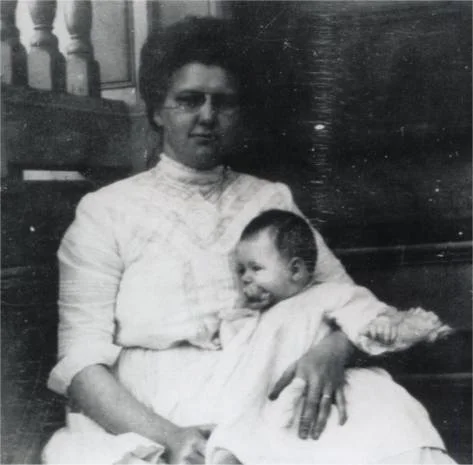
Bridget “Annie” Gertrude (Harrison) Muzrall in 1912 holding my great-uncle Arthur.
My grandfather’s words about his mother in his oral history are measured, but he harbored deep hurt and resentment toward her.

One of many mysteries of my grandfather’s life is why he was always told his birthday is on September 29. It appears on his baptismal record as September 9. Is it possible that his mother altered a later certificate to obscure her pregnancy at the time of her marriage on December 16? Is this a record-keeping or scanning error? We may never know, as we do not have his original birth certificate.
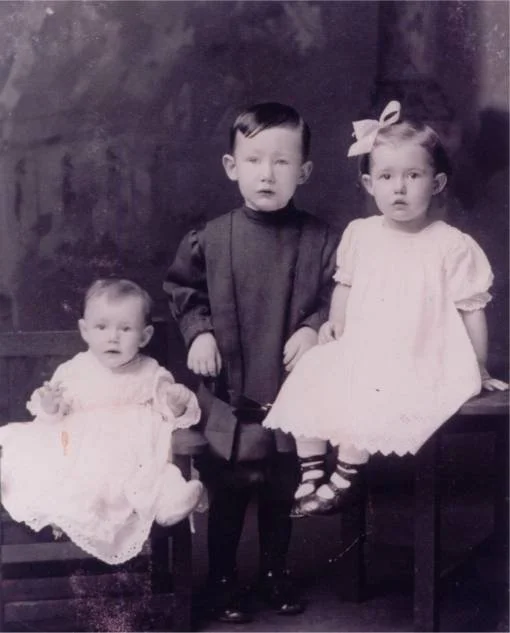
My grandfather, center, age 3 in late 1912 with Arthur, 1, and Margaret, 2
So, to recap, when John Muzrall Sr. fell off the bridge in 1914, these three children were at home, and Annie was pregnant with their fourth. I’ll let my grandfather tell you what happened next.
“Now, my father left $5,000 insurance, which in those days seemed like a very large sum, but listening to advice from her brother-in-law, a man named Melvin Duffy, she invested it all in a house in Somerville in Massachusetts. And of course, I don’t know much about the dealings that went on, but from what I’ve been able to find out, they were supposed to buy it jointly, and then he rigged some kind of a deal whereby he owned the house, and she paid him rent. Well, she had invested the money in the house and then she was broke. She tried to go to work, but naturally, there wasn’t any welfare in those days to speak of, and wages were low, and four children all hungry.
So she put three of us in an orphan asylum in Boston. That was I and your aunt Marge and your Uncle Arthur. Now we were separated and I was sent out to live with various families as a poor orphan. But of course, it was cheap labor. They needed somebody to help with the housework.”
Just a note that I have struggled mightily to find a brother-in-law or any other relative by marriage named “Melvin Duffy” in or near Somerville in 1914-1916. Any assistance on this front would be welcome.
“One time when I was being taken back to the orphan asylum, where I did not want to go, I was on the elevated train going from Forest Hills in Boston to the center, with the woman who was taking me back, and I was sitting there on the seats, and just before the door closed at one of the stations, I jumped out, leaving her inside the train and the train on its way. So I took the train back in the other direction to Forest Hills, and there I remembered a school chum of mine, and I went to him. His family took one look at me and called the police. Well, the police found out that I had run away, and I was sent back to the orphan asylum. Then I was sent out to a couple of other places, usually for, say, a month or two weeks. But I stayed a total of two years in the orphan asylum until I was over their age limit.
So then this is 1918, I was sent to Canada for a summer to live with my grandparents. I was very thin. They said I had anemia and didn’t expect me to live. However, I did recuperate, and when that fall came, they sent me back again to Boston, and then I was sent in 1918, to a place called the House of the Angel Guardian in Boston, which only took boys 11 years or older. I was 9 years old. It was run by monks who were, while not very cruel, very impersonal, and we were disciplined like we were, you know, waifs and strays, which we were, most of us.”
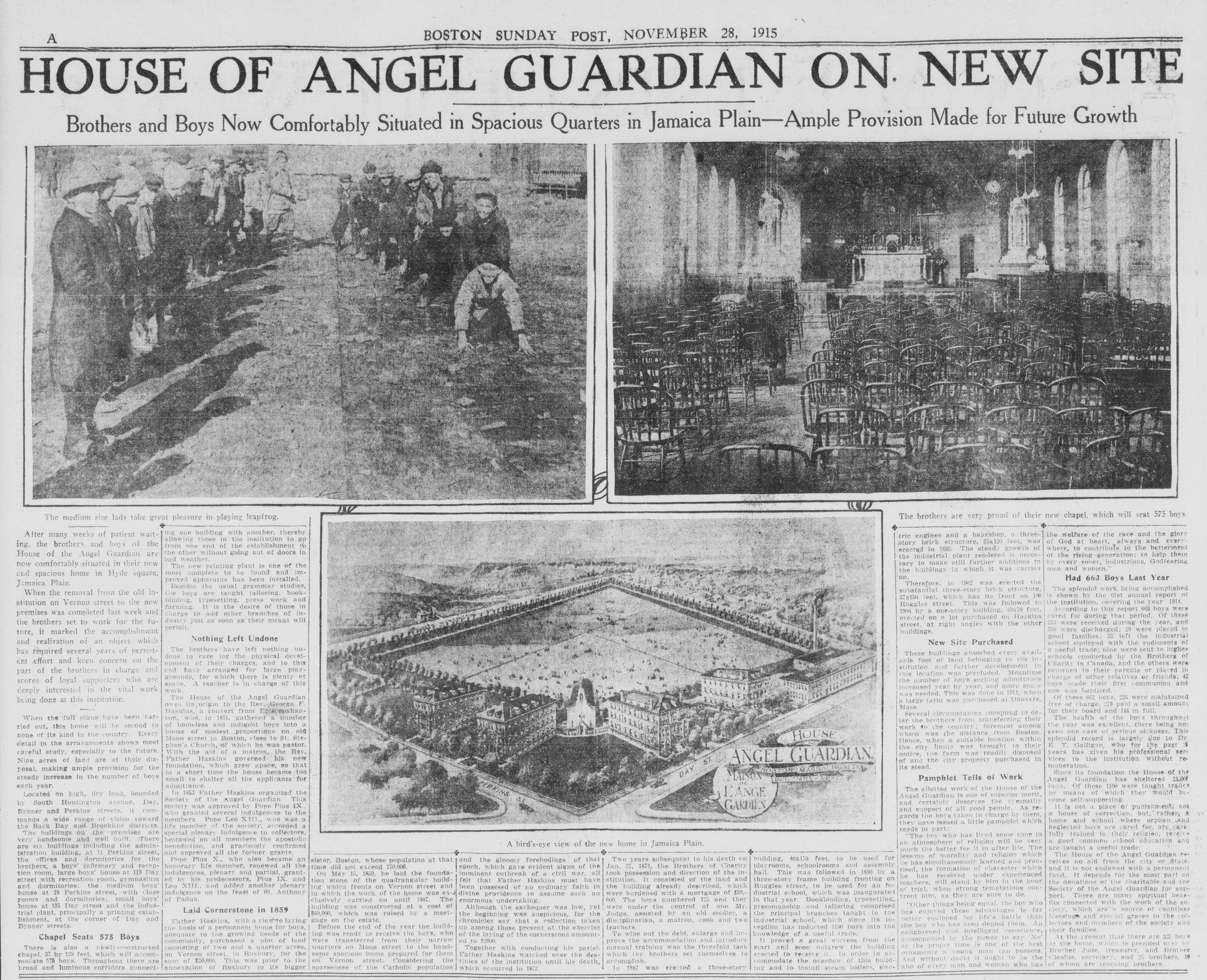
By the time my grandfather was sent to live at the House of the Angel Guardian, it had moved to a massive new complex in Hyde Square, Jamaica Plain. The chapel seated 575 boys.
“Now, they kept me there for a while, and my mother then set up housekeeping at Jamaica Plain, and I and Arthur and Marge went back there to stay with her, but she still found three children too much of a burden. So I don’t know what happened then to my brother and sister, but I was turned over to the state of Massachusetts as a state Ward, and then I was sent out to three different farmers in succession for different lengths of time.
The first farmer was in Douglas, Massachusetts. The family name was Dudley, and they’d been there about 300 years.
The farm had about 16 cows. There was Mr. And Mrs. Dudley and their four children, growing children. The oldest one was about 12.
They had a farm with work to be done, and I was set to do the housework. There were a total of 16 people there, including a couple of farm hands and another boy in my status who just milked the cows and took care of the barn. But I was cooking for these 16 people when I was 13 years old, and it was not gourmet cooking, obviously.
Breakfast was always hash, pancakes and coffee, and the hash was made out of what was left over from the day before.
So you’ll get an idea of what the menu was. I stayed there, but I still wasn’t old enough to work legally, so I had to go to school about a half mile away. It was a small school, two rooms and two teachers, and each teacher had four classes. And the way it was run that the teacher would allow 15 minutes out of each hour for each class, which meant out of each hour, we had 45 minutes for homework, recess, study or whatever, and it was a very nice way to learn, and we did learn just as much as if we’d been in a more regulated school with a principal and class bells.
When I graduated from there, that was the eighth grade. Of course, the whole summer was spent working on the farm, but when the fall came, I still wasn’t old enough to go to work legally, so this family decided they didn’t want me because I would have to be sent to the High School, which was over two miles away, and there was no public transportation. That meant I would have to walk, and they would lose too much of my services while I was in that school and traveling back and forth.
So they said they didn’t want me anymore... ”
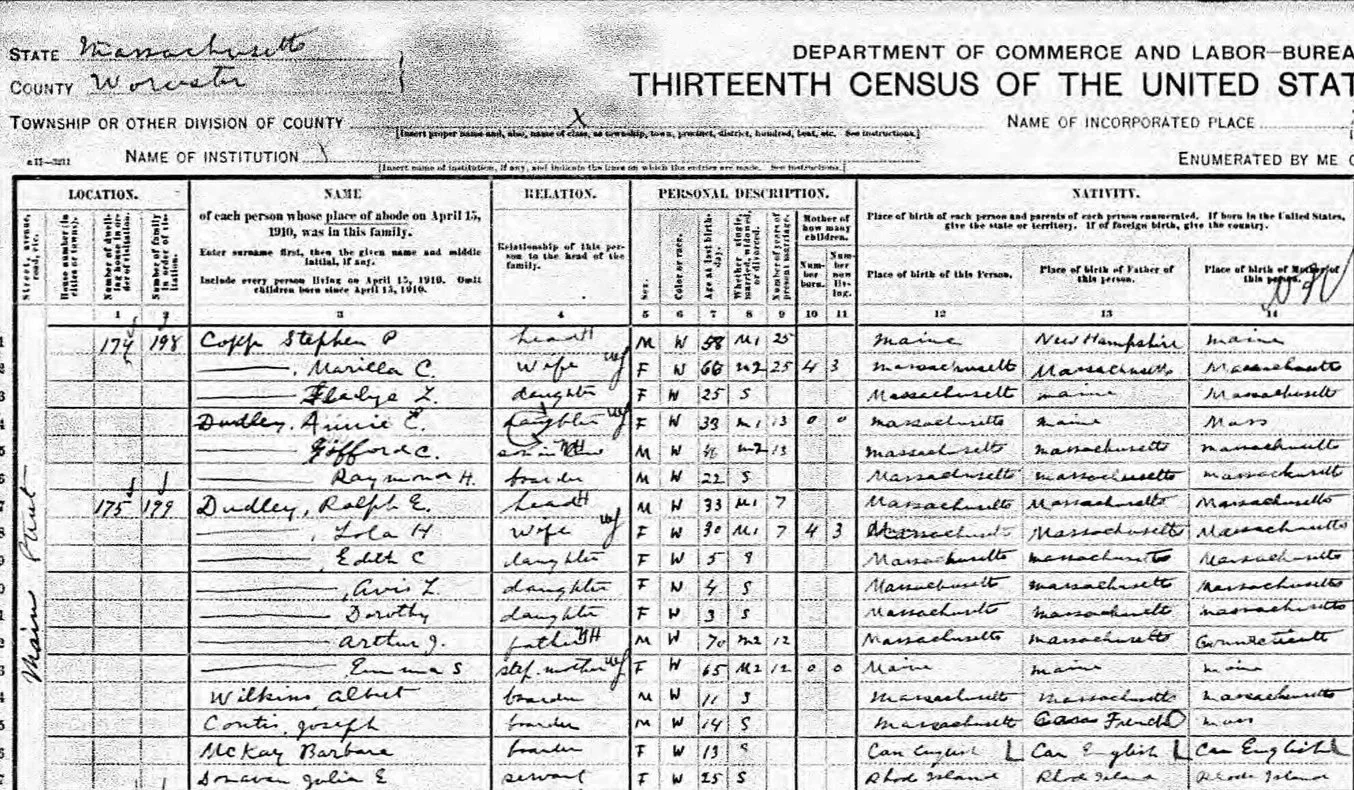
In the 1910 census, we find Ralph E. Dudley and his extended family living on a farm in Douglas, Massachusetts. The presence of three “boarders”, ages 11, 14, and 13 fits with this family hosting wards of the state. I believe this to be the farm where my grandfather was sent after being turned over to the state by his mother for the third time.
“The man (from the orphanage) came and picked me up in an auto, and he took me down to a farm in South Westport, Massachusetts, very close to the Rhode Island line. It was run by an old Scotsman from Aberdeen with his Scotch housekeeper.”

On line 39 in the 1920 census from Westport, Massachusetts, we find Joseph Boan, 66, born in Scotland, with his 52-year-old “servant”, Kate Laurie, also Scottish, and three other “servants”, all male, ages 19, 18, and 13. I believe this to be the “old Scotsman” that my grandfather was sent to in 1921.
“He had 32 cows, and he had another boy like myself. Now I arrived about three o’clock in the afternoon, and he took me in the barn, and he handed me a pail and a milking stool, and he says, you milk these cows. In other words, about eight of them. Well, I didn’t know how to milk cows. I hadn’t been doing that.
I sat down beside the cow, and I started trying to get some milk out of it. Of course, nothing happened. So he watched me for a minute, and he said, Stand up. And when I did, he fetched me a blow alongside the jaw that knocked me flat on the floor. He said that if you can’t milk, get up to the haymow and throw down the hay.
Well, I stayed there for two nights.
Breakfast was porridge with a little molasses on it. Nobody got any milk. He sold every drop of milk. He was a real Scotchman. On top of that, his English was so thick I couldn’t understand him half the time.
Well, the second night, I decided, this is it. I can’t put up with this anymore. Now it was mid winter, and the snow on the ground was about a foot deep. The temperature was probably 15 or 20 degrees. We two boys were supposed to sleep in a bedroom on the second floor, in the same bed. I got up very, very quietly and put my clothes on and went over to the door.
The door was locked. What am I going to do now? Well, there was a window leading out onto a porch roof, and it had a screen in it. So I went over and went to take the screen out, but the screen was nailed in. Well, I had a jackknife in my pocket, and I very, very carefully cut the screen out of the frame so I wouldn’t wake the other boy up. I didn’t know what his reaction would be if I was leaving that way. In fact, he might want to join me, but I didn’t ask.
I crawled out on the porch roof, which was covered with tin. And it’s a dead-still, cold, clear night, and every move I made that tin would crackle. Every time that happened, I figured this farmer would wake up and catch me, but apparently he slept sound, and so did his dog, because I didn’t hear a sound.
When I got to the edge of the roof, there was a gutter there, so I got over the edge of the roof, and I was hanging by the gutter, and before I could let go, the gutter tore loose. Well, here am I lying in the snow with the gutter across my stomach, and I figured, I’m sure they heard me now, but I laid there very quietly, and still no one woke up. So I got up and I started walking.
I walked 14 miles that night to a place called Tiverton, Rhode Island, which was a summer resort, so it was practically deserted, and there I thumbed a ride to Boston on a truck.
Now I always was big for my age, so people didn’t ask me how old I was. They assumed I was 17 or 16. Anyway, there were no questions. This truck driver let me off in Boston in the evening, and there I was - no money, no food, nothing but the clothes on my back. What am I going to do?
Well, I found a house where the cellar door was open, and there was a furnace inside that was in operation. So I went in, spread my coat out and so forth, and lay down on the floor and back of the furnace and got a night’s sleep. Next morning, at daybreak, my empty stomach was bothering me, so I went out, prowling around, and I stole two quarts of milk from a doorstep, and then I found a pantry window that was open, and I got a loaf of bread and a jar of marmalade. Well, that was my food for the day.
What did I do? I just wandered around. I didn’t want to stay in one place. People might ask me what I was doing, so I just sort of wandered around till nightfall. And remember, this is winter, and night came fairly quickly.
So I went back to the same cellar to repeat this. However, the man who was taking care of the furnace came down about 11 o’clock at night, and here he saw my feet sticking out from the back of the furnace. So he called the police and they wanted to know who I was, where I come from, what I was doing, and so forth, and I was bound I wasn’t going to tell them...”
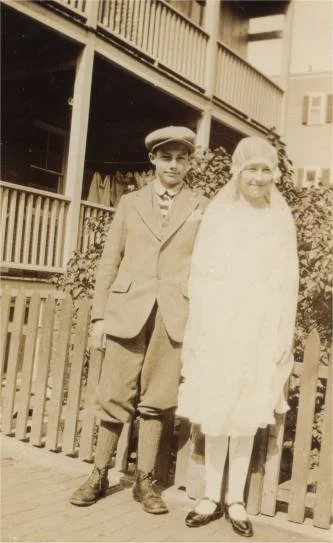
While my grandfather was escaping from cruel farmers and hiding under a furnace in Boston, his brother and youngest sister, Arthur and Evelyn, were living with their mother in Jamaica Plain. This is Evelyn’s confirmation in 1924.
And what, you may ask, has this to do with West Newbury? Well, plenty, as it turns out. Young Arthur here will grow up to marry West Newbury’s Louise Poore, whose sister Charlotte had already married his brother, my grandfather John Muzrall, who managed to escape and find a family of sorts in New York City…we’ll save that story for next time!
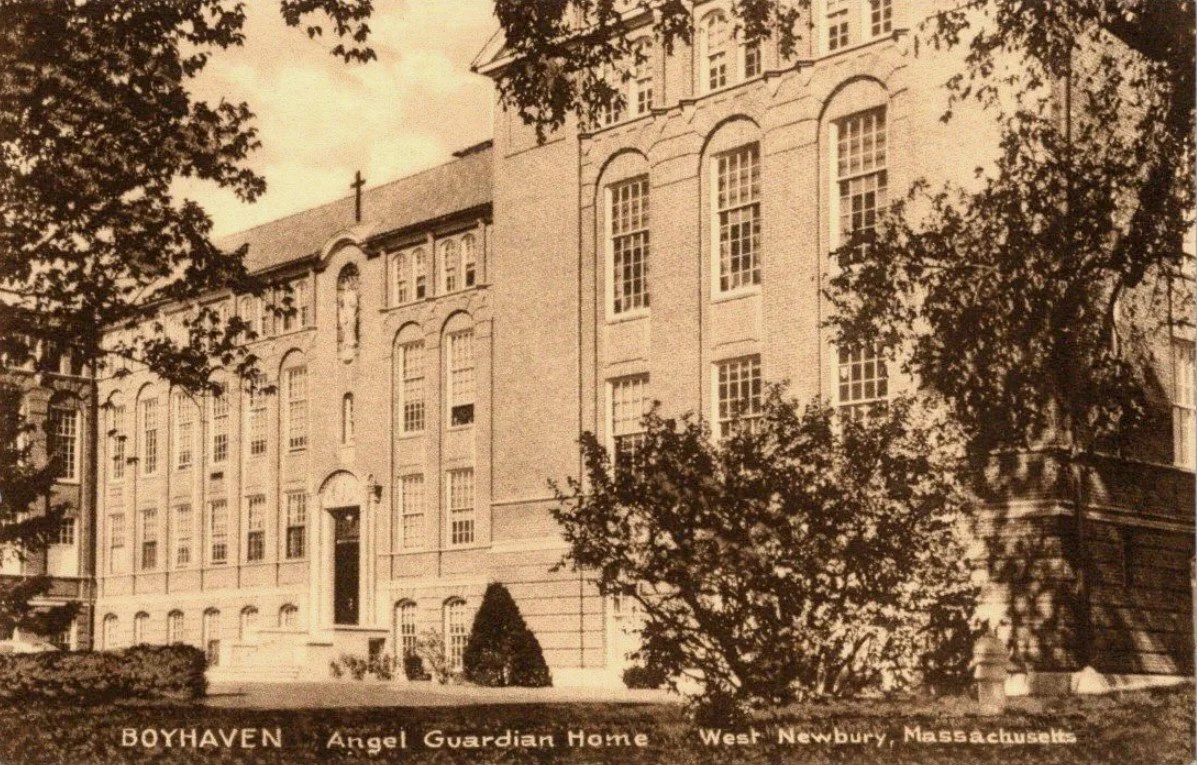
As for Boyhaven, the same Brothers of Charity order that operated the Jamaica Plain House of the Angel Guardian opened the site where the Page School now stands in 1926 as the Holy Angels Orphanage. On September 4, 1928, nearly 200 younger boys were sent to West Newbury from Boston, while older boys remained in the city.
In 1947, the residents of the House of the Angel Guardian in Jamaica Plain were transferred fully to West Newbury, and it became known as Boyhaven. In 1962, it was renamed Cardinal Cushing Academy after ownership was transferred to the Boston Archdiocese.
My grandfather was one of my favorite people. He lived with me at the end of his life, after he had gone blind. He was terrified of being institutionalized, and it was an honor to help spare him that. He left my mother with a collection of cassette tapes, which we have made efforts to transcribe over the years. This story reminded me that it is high time I transcribe the rest of the tapes - this is just the first one - and I look forward to sharing some of them with you.
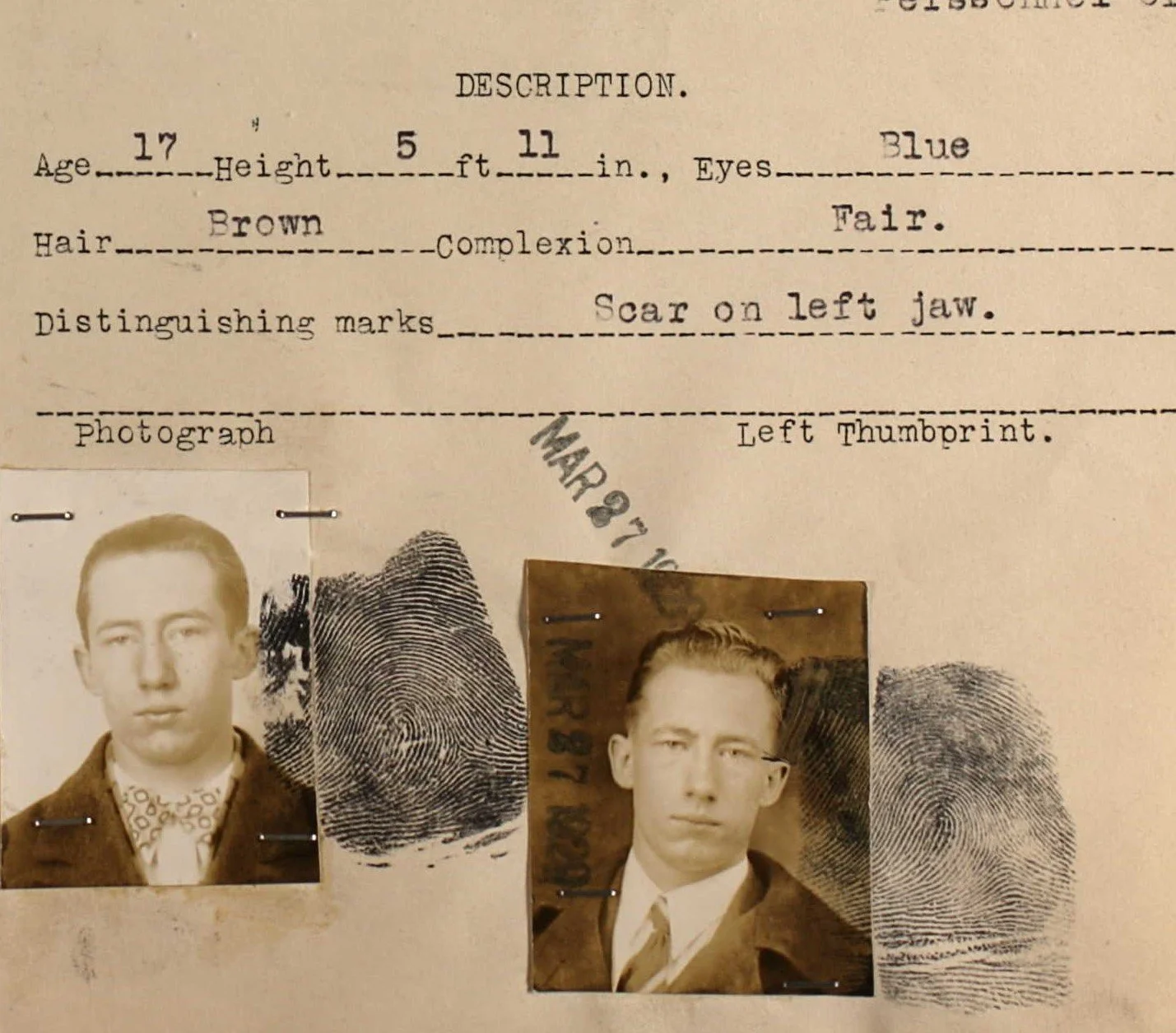
Next time, we will follow John Muzrall from Boston to New York, as he transforms from an Irish Canadian to a Swede and from a farmhand to a mariner. These are his shipping papers, age 17 on the left, 19 on the right.