Puzzle Me This…It’s Lovely Weather for a Sleigh Ride Together with You
Fruit Street looking toward Fair Street with John N. Cushing (left) driving the family sleigh, circa 1850-1875. The little girl is either Elizabeth Johnson Cushing or Margaret Woodbridge Cushing.
From the collections of the Museum of Old Newbury.
Start puzzle here.

Puzzle Me This...Tea for Two
Tea caddies (decorative containers used to store tea) were produced in myriad forms from small porcelain jars to small silver containers, rosewood and satinwood boxes, black lacquer boxes from China and fruitwood caddies in the shape of apples and pears.
The museum has several examples in its collections. The tea caddy pictured here dates from the late eighteenth century and is an example of Oriental export porcelain.
From the collections of the Museum of Old Newbury. Image credit: Bob Watts
Puzzle Me This...New England Bank Note Co.
Vignette Proof Sheet
Boston, Massachusetts
(1833-1858)
In 1833 Abraham Perkins and his son Nathaniel formed a partnership with other investors under the name New England Bank Note Co. and moved the business from Newburyport to Boston.
The new company advertised having the most skillful artists for engraving, updated machinery with the latest improvements and secure vaults for storing bank plates and dies. This proof sheet provided customers with examples of scenic vignettes and portraiture offered by the company.
Elaborate vignettes became increasingly popular in bank note designs and other security documents. By 1858, the New England Bank Note Company became The American Bank Note Co. whose first president was Charles Toppan of Newburyport.
From the collections of the Museum of Old Newbury.


Puzzle Me This...The Grammar School at the Bartlet Mall
Watercolor on paper
Cornelia Perrin Stone (1855-1940)
This brick schoolhouse was built at the eastern end of the Mall on town land near the Frog Pond. The one story schoolhouse was constructed in 1796 and enlarged in 1809. It served the town for nearly a century but was taken down in 1884 following its sale by auction.
Cornelia Stone, a Newburyport native, and a well recognized American artist, was popular in the early years of the 20th century.
From the collections of the Museum of Old Newbury.
Start puzzle here.
Puzzle Me This, Indeed!
Box of Puzzles
Lacquered wood
China
Late 19th century
This puzzle box belonged to Sarah Elizabeth Stickney (1831-1916), Captain Frank W. Brown’s second cousin. According to a note inside, the box was given to Sarah by an unnamed ship captain. The captain, perhaps a member of the Brown family, took his wife on a voyage to China, and Sarah took care of their children while the couple was away.
The ivory game pieces inside are carved with intricate designs of dragons, flowers and people. The games include Tangrams, Nine Linked Rings and Interlocking Burr.


Spring has Sprung
"Yellow Pansies for Mrs. Bradlee" by Laura Coombs Hills is a pastel on board, 8 7/8" x 7 7/8" and signed in the upper left.
Screened Just for You
Detail from a four paneled folding screen with ivory that was made for the U.S. market in the late 19th century.
It is believed to have been exhibited at the Philadelphia Centennial Exposition. The screen was bequeathed to the museum in 1910 by Susan Parsons Brown Forbes of Fatherland Farm in Byfield.
From the collections of the Museum of Old Newbury.


Family Register - "The Genealogy of Joseph Stanwood's Family"
Atkinson Stanwood (1801-1884), Newburyport, 1814; Watercolor and ink on paper, 14 3/4 x 12 inches
Undoubtedly influenced by geometric and decorative instruction he may have received in a public or private academy, thirteen-year-old Atkinson Stanwood embellished his family genealogy with demilune tablets, trailing vines, eggs and tassels. This colorful compass-drawn birth and death record depicts the family's history in a decorative way.
The coffins represent the first two wives of Joseph Stanwood and baby John Stanwood who died age two years. From the collections of the Museum of Old Newbury.
Embroider Me This…
Bird & Butterfly embroidery silk thread on satin fabric. From the home of the late Edmund Bartlet, Esquire, of 3 Market Street. Donated by Miss Martha Atkinson.
From the collections of the Museum of Old Newbury.


The Pillsbury Family
These portraits of Captain Oliver D. Pillsbury (1816-1852) and his wife, Adeline Pillsbury, and daughter, Addie Pillsbury, were painted by August Van der Borght in Antwerp, Belgium, in 1852. In the mid-19th century, it was not uncommon for a captain’s wife and children to accompany him at sea.
Captain Pillsbury left home for the high seas at age sixteen, attained the status of “master mariner” by age 29, and made his home in Newburyport after marrying Adeline Dole in 1845. The couple had two children, Addie, born in 1850, and Oliver, born in 1852.
Captain Pillsbury died in Charleston, South Carolina, in 1852, likely while commanding a ship sailing through that port. After his death, his wife and daughter were left to find their way home and to face how they would support themselves – a suitable case for the Newburyport Marine Society.
From the collections of the Museum of Old Newbury.

A Pear-fect Picture
Porch of Bartlett House, a high-style Georgian built in 1782 and located at 32 Green Street, Newburyport. This 1915 watercolor is by Cornelia P. Stone.
From the collections of the Museum of Old Newbury.

A Harbinger of Spring
Pastel of flowers in jug. Laura Coombs Hills, Stockbridge, Oct. 1904. From the collections of the Museum of Old Newbury.

Now, That’s a Pin Cushion!
The MOON is home to numerous sewing notions, spanning more than two centuries. From the collections of the Museum of Old Newbury.
Will you be my Valentine?
A postcard that reads, "To my Valentine. Oh, take these flowers I plucked for you, and with them my devotion too." Copyright 1884 by L. Prang & Co. Boston. From the collections of the Museum of Old Newbury.


Memories and Mementos
Select treasures from Caleb Cushing's memento mori for his beloved wife Caroline Elizabeth Wilde Cushing (1802-1832).
Items featured include her calling card, hand-colored playing cards, a miniature portrait on ivory (featuring a dramatic tortoise shell hair comb) and the certificate of marriage. From the collections of the Museum of Old Newbury.

Say “hello” to our biggest fan!
Ivory pierced and painted brisé fan with floral decoration, China, 19th century. The East India Company imported large numbers of plain and carved brisé fans in ivory and tortoiseshell well into the 19th century. From the collections of the Museum of Old Newbury.
Start puzzle here.

You Can Bank on It!
Cast iron "Home Savings" still Bank with original green and red paint.
Toy banks such as this one were popular during the last quarter of the 19th century. Many were made by the J. & E. Stevens Company of Cromwell, CT, established in 1843 for making cast iron hardware, hammers and iron toys.
By the mid 1860s, the company focused almost exclusively on toy production.
In 1869, J. & E. Stevens produced their first cast iron mechanical bank and became nationally known for their innovative designs of mechanical and still banks.
Start puzzle here.

Hats and Shoes and Shoes and Hats
”Saying you don't look good in a hat is like saying you don't look good in shoes." –Anonymous
The Museum of Old Newbury holds broad collections of hats and shoes spanning the eighteenth and nineteenth centuries. Pictured here are some favorites from those collections.

Winter Sun-set Boy
In the 1880s, Laura Coombs Hills (1859-1952) was an illustrator for Louis Prang and Company, designing cards.
After the turn of the century, she illustrated children's books and designed costumes. Her fairy-like figures with their diaphanous outfits evoked an enchanted kingdom.
Image inscription: Winter Sun-set Boy. Orange tights. Bluish plum colored velveteen waist and long tabs. Orange satin sleeve flounces. Cloth of gold upper waist piece. Long gold fringe round neck. Cloth of gold cap with gold rays. Short yellow veil with long ends caught at the waist behind.

A Holiday Poem
Creator, open our hearts to peace
Creator, open our hearts
to peace and healing between all people.
Creator, open our hearts
to provide and protect for all children of the earth.
Creator, open our hearts
to respect for the earth, and all the gifts of the earth.
Creator, open our hearts
to end exclusion, violence, and fear among all.
Thank-you for the gifts of this day and every day.
By alycia longriver - native american - micmac - 1995. Shown: micmac quill work chair seat.
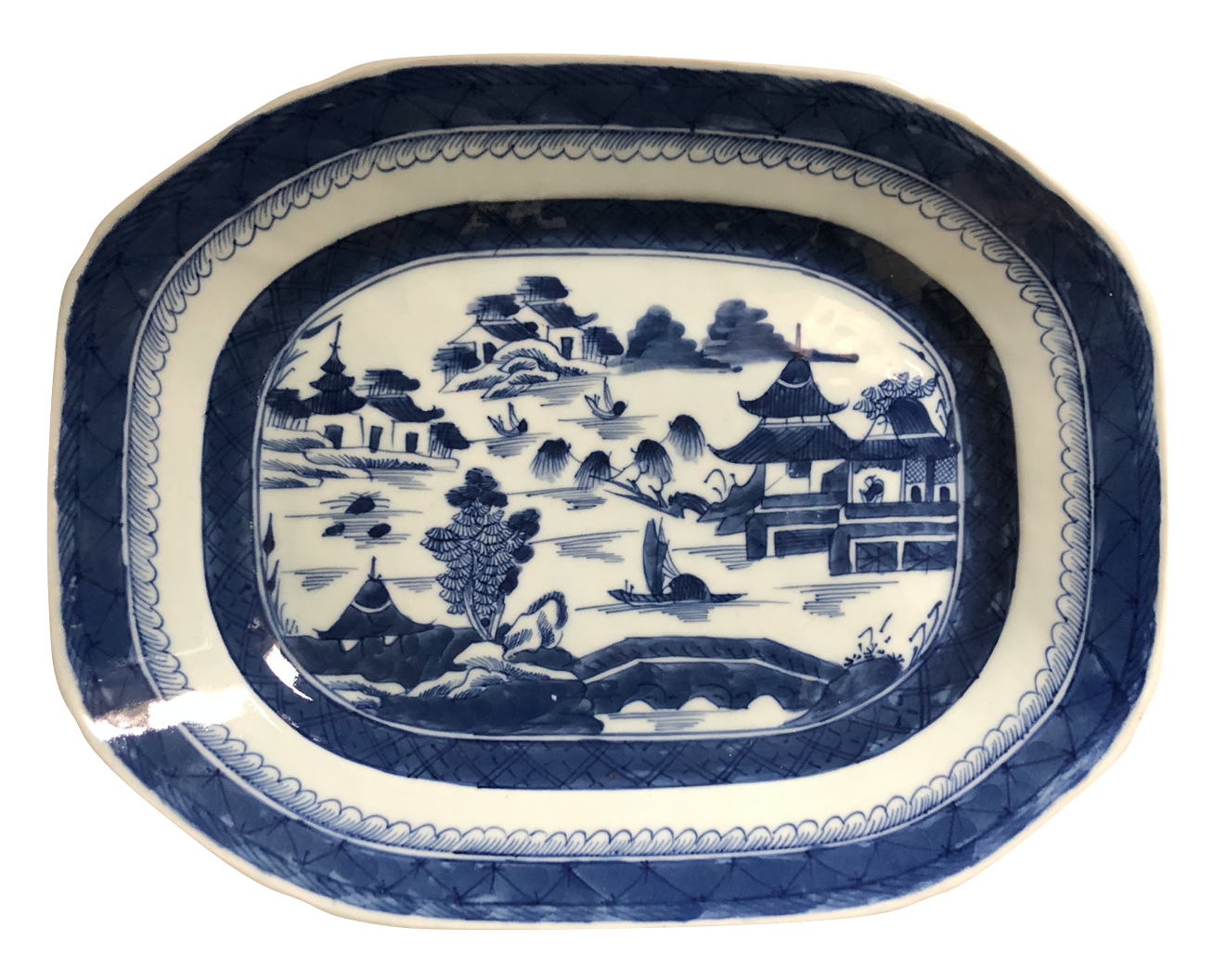
You “Canton” do that.
Canton ware was exported to the West and was popular in this country from the latter half of the 18th century to about the middle of the 19th century.
The traditional Canton design includes a tea house, bridge, river, mountains, boat and a willow tree creating a landscape intended to represent the harmony of nature. The sources for the images are found on early Chinese painted scrolls.
English potters in the 19th century, in an effort to popularize the blue willow design based on the original Canton ware, created a fable of star-crossed lovers.
The daughter of a wealthy mandarin was engaged to a prosperous merchant, but fell in love with a young man working for her father. On the eve of her wedding the lovers, Koong-se and Chang, escaped across a bridge to a secluded island where they lived happily until the jilted fiancé discovered their refuge and had them killed.

When getting hooked on something is a good thing.
Hooked and Braided Rug, probably Newburyport, late 19th century. This small, religiously inspired rug, by an unknown maker, is similar in design and color to other hooked rugs by the same maker in the museum's textile collections.

If you have the time, we have the puzzle!
Close-up of the hand painted face on a tall case clock, featuring movement by David Wood. The clock sports a paint grained pine case in imitation of mahogany veneer. It is perhaps the only one of its kind with a Wood movement.
Newburyport, 1810-1820. From the collections of the Museum of Old Newbury.

Why did the chickens cross Hay Street?
These domesticated exotic fowl pose side by side for their portrait dwarfing the house and farm of Amos Little Leigh (1847-1921) on Leigh's Hill, Hay Street, Newbury, shown in middle distance.
About this image: Dominique Leghorns, oil on canvas, Newbury, signed and dated "C.S.P./1876"

We’re Ready for Our Long Shot
BIRDS EYE VIEWS celebrated civic pride and provided a panoramic vista of a town or city as if from above.
From the 1850s to the early 1900s, thousands of American communities posed for this new kind of urban/town portrait.
About this image: Bird’s Eye View of Newburyport, 1880, Drawn and pub. by J. C. Hazen & E. H. Bigelow, Boston. From the collections of the Museum of Old Newbury.

Free Because of the Brave
During World War I and the years following, the American National Red Cross launched a series of fund-raising campaigns to support disabled veterans returning home.
A collection of so-called propaganda posters were produced to support these “War Fund” drives, the first of which was in June 1917. Their goal was to raise $100 million dollars to finance the organization's war relief efforts.
About this image: Production, Publication, Distribution, Manufacture, and Copyright Notice: New York : American Lithographic Co., [1921]
This Veteran's Day, please take a moment to remember our freedom is protected by the men and women of our Armed Services. We at the Museum of Old Newbury thank these brave soldiers both past and present.

Bayley the Beloved
Captain Charles March Bayley commanded and co-owned a number of ships in the mid-19th century, including the brig Cedric and barks Panchita and William Schroder. Bayley and his brother, Captain Robert Bayley, Jr., joined the Marine Society of Newburyport in 1849. Together with their father, the brothers operated Robert Bayley & Sons, a successful West Indies shipping firm based at a wharf near the foot of Fair Street.
Charles Bayley was a beloved Newburyport ship captain, and his obituary, dated March 14, 1892, read: “Captain Bayley was a man who was loved and respected by all who came in contact with him. He was of a genial disposition and was a great lover of children, many of whom will miss his pleasant smile and kind words they so often saw and heard.”
About Captain Charles March Bayley (1814-1892) - Watercolor on ivory, artist unknown, circa 1840. From the collections of the Museum of Old Newbury.

Everything Brown!
Newburyport Captain Nicholas Brown, younger brother of the noted Captain Moses Brown (1743-1804), was involved in trade and privateering during the last quarter of the 18th century. Privateers were legally authorized to seize British vessels and profit from selling the confiscated goods.
Of his fourteen children with his second wife Lucy Lamprey, at least four sons became shipmasters, and two daughters married shipmasters. Like many of Newburyport’s seafaring families facing the hardships and dangers of working on sailing vessels in the 18th century, Nicholas suffered the loss of five sons and a son-in-law who died while at sea, in a foreign port, or were lost at sea.
In 1819, near the end of his life, an unidentified artist painted this portrait of Nicholas and those of a daughter and granddaughter. These paintings have traditionally been attributed to local artist Moses Dupre Cole, a sign and portrait painter, based on similarities to known, signed Cole portraits.
About Captain Nicholas Brown (1747-1819) - Oil on canvas, attributed to Moses Dupre Cole, Newburyport, circa 1819. From the collections of Museum of Old Newbury.
Start puzzle here.

An Apple a Day
Newbury's first apple tree was planted around 1712 at the Adams family farm on Orchard Street in Byfield. By 1854, an estimated 21,000 apple trees were under cultivation in Newbury. Thousands of apples were harvested and shipped to New York, Philadelphia, and even London.
Here, one of many apple pickers rests to enjoy the fruits of his labor.
From the collections of the Museum of Old Newbury.
Start puzzle here.

Of Ports and Pearls
One of a set of four paintings of Chinese Hongs from the estate of Caleb Cushing. Cushing may have purchased these when he traveled to China in 1843. The Whampoa Anchorage for foreign ships is about 15 miles below Canton.
Cushing was dispatched by President Tyler, to serve as Envoy Extraordinary and Minister Plenipotentiary to China. He was responsible for negotiating the Treaty of Wanghia, between the Qing Dynasty of China and the U.S. Signed on July 3, 1844 in the Kun Iam Temple, the treaty was named after a village in northern Macau where the temple is located. The treaty officially established diplomatic relations between the two countries and granted most-favored-nation trade status to the U.S.
About "Whampoa Anchorage on the Pearl River” - Oil on canvas, Chinese school, 19th century, from the collections of the Museum of Old Newbury.
Start puzzle here.
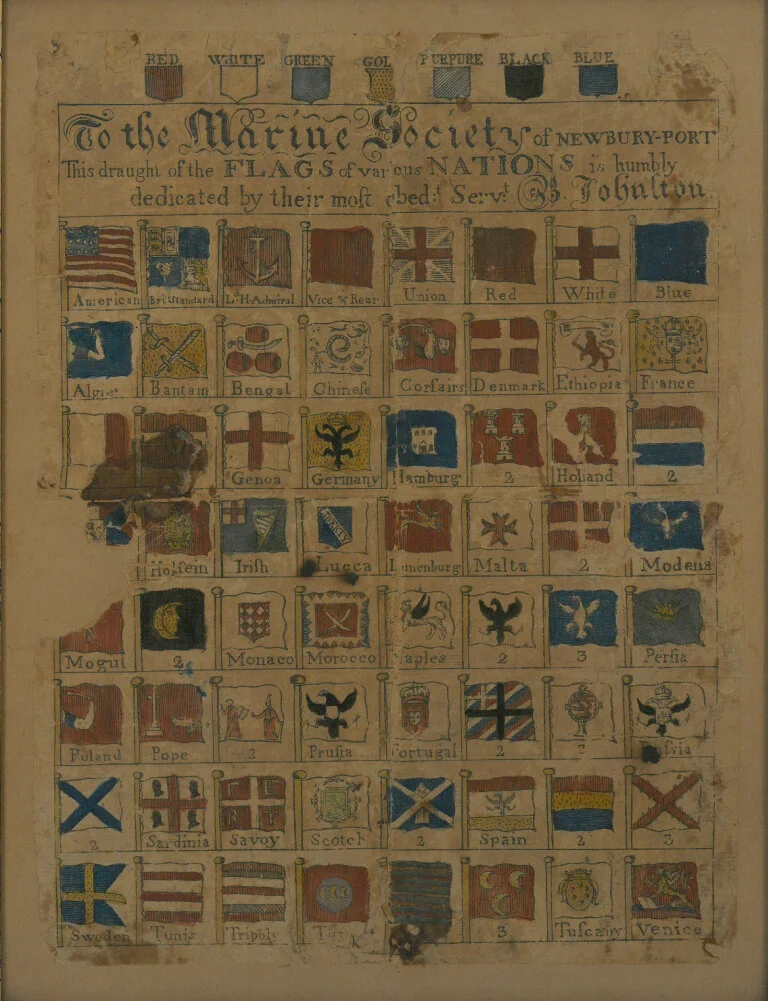
Long May She Wave
Sixty-four marine ensigns of forty nations are shown here and dedicated to the Marine Society of Newburyport, founded in 1772. Flags were an important means of identification at sea, and charts such as these would have been consulted by shipmasters. The ensigns for America and France, shown here, date this chart between 1777 and 1792.
About “Flags of Various Nations” - Colored engraving, ink and watercolor on paper by Benjamin Johnston (1742-1818), Newburyport, before 1792. From the collections of the Museum of Old Newbury.
Star puzzle here.

Here Comes the Sun (Hotel)
In 1807, Akin created a handbill, commissioned by Jacob Coburn, proprietor for many years of the Sun Hotel.
The image, which appeared in the Newburyport Herald, shows the former Tracy mansion that had been purchased by James Prince in 1806. Prince leased the mansion house, carriage house and stables to Coburn before returning to the property in 1810 and making it his home for nearly thirty years.
James Akin (1773 -1846) was from South Carolina and worked in Philadelphia and Newburyport. He was well known for his political cartoons including one entitled "Infuriated Despondency" depicting an argument Akin had with Edmund March Blunt, publisher of the American Coast Pilot, in Newburyport.
Copper Plate of the Sun Hotel, Newburyport, 1807, by James Akin, engraver, from the collections of the Museum of Old Newbury.
Start puzzle here.

The Sea was Angry that Day
This painting is one of a pair depicting the Ship Burmah in distress during a storm on February 21, 1837. The ship's master, Captain Deford, was bound from New Orleans to Portsmouth, New Hampshire with a load of cotton when it went ashore on a reef near Plum Island in Ipswich Bay.
Jacob Knapp Lunt, a Newburyport pilot, recognizing the imminent danger that threatened the ship, took a boat from the shore to rescue her, risking his own life in the process. He succeeded in getting her off the reef and took her into Salem Harbor. The vessel and cargo were insured for $90,000. For Lunt's valuable service, the underwriters paid him the sum of $300.
Rescue of the Ship Burmah off Plum Island, 1865; oil on canvas by Clement Drew (1806-1889).
Artist Clement Drew was born in Kingston, Massachusetts. He maintained several studios in Boston between 1827 and 1873 and also acted as an art dealer and framer. Drew was a prolific painter of marine scenes, often illustrating ships in distress on the high seas.
Bequest of Wilhelmina and Sylvia Lunt.
Start puzzle here.

A Fine ex-Sampler!
This sampler illustrating some of the Cushing Family genealogy was made circa 1850 by Nancy Cushing in Portland, Maine.
It is interesting to note that the family's Newburyport homestead is accurately depicted including the carriage house with its original High Street orientation.
Start puzzle here.

Spofford Gate
This early 20th century photograph of Harriet Prescott Spofford's garden gate at Deer Island near the Chain Bridge was taken by Newburyport photographer Florence Thompson.
Thompson hand tinted her photographs as was popular during that period. Spofford (1835-1921) was an author of novels, poems and detective stories.
Her career spanned six decades.
Start puzzle here.

The Good Reverend “Damnation” Murray
On June 4, 1780, Reverend John Murray (1742-1793) was installed as second pastor of the Old South church, a post he held until his death thirteen years later.
He is portrayed here in front of the pulpit window of the church. The sermon held in his right hand is from John III, 16.
Murray’s impact was both spiritual and political, and he had an ardent fervor for the patriot cause. His fiery sermons earned him the moniker Damnation Murray.
He is said to have “never preached less than one hour, and often exceeded two hours.”
Oil on canvas portrait, circa 1786, attributed to Christian Gullager (1759-1826)
Start puzzle here.
China Trade Tea Chest

This elaborate 19th century China Trade tea chest is a favorite object within the collections of the Museum of Old Newbury.
It belonged to Thomas Gold Appleton (1812-1884). His initials and the Appleton family crest appear on the inside lid of the chest. Appleton, a contemporary of Caleb Cushing, was a poet, artist and patron of the arts. Although he was a Harvard-trained lawyer, he rarely practiced law and spent his life traveling.
Start puzzle here.

Votes for Women
We celebrate the ratification of the 19th Amendment granting women the right to vote.
The amendment was passed by Congress on June 4, 1919 and ratified on August 18, 1920. Shown here, a color illustration of three suffragists for the song “Votes for Women: International Suffragists’ Song” by Ed Markel.
Credit: Library of Congress, Music Division
Start puzzle here.

The Wolfe is Hanging Outside the Tavern
Newburyport's Wolfe Tavern opened its doors in 1762 with Captain William Davenport as innkeeper. Davenport had served under General James Wolfe who was in command of the army tasked with taking Quebec.
Wolfe is remembered for his victory in 1759 over the French at the Battle on the Plains of Abraham in Quebec. Although he was killed in the battle, his men defeated the French and captured the city.
The original tavern sign was destroyed with the tavern during the Great Fire of 1811.
When the tavern reopened on the corner of State and Harris Streets in 1814, Newburyport artist Moses Dupre Cole was engaged to replicate the original sign.
Start puzzle here.

Abraham Perkins' Porringer
Abraham Perkins was a successful businessman and partner to his more well known brother, Jacob.
Through his ventures, Abraham was able to afford fine objects and furnishings with which to embellish his family home.
Silver objects and glassware were luxury items in early 19th century homes, with much of the silver produced in Newburyport from the 1760s onward. This silver porringer is engraved with the initials “A.P."
Porringers are shallow bowls used in food service and have been in existence since before the 1600s.
Start puzzle here.

The Hustle & Bustle of Green Street
This view of Green Street, mid-18th century, shows both residential and commercial buildings with the harbor beyond. (Collection of the New York Historical Association at Cooperstown.)
Start puzzle here.

Pitcher Perfect
This Liverpool pitcher made in north west England in the early 1800s commemorates an American ship and family. Many of these were produced beginning in the late 1700s and continuing through the 1850s.
They celebrated American military battles, heroes and America's new independence. The Titcomb pitcher also bears America’s new shield and the inscription "Peace, Plenty and Independence."
Start puzzle here.

Ready-and-Abel Johnson
Abel Johnson (1793-1826), son of Newburyport merchant and shipmaster Capt. Nicholas Johnson and brother-in-law of John Newmarch Cushing, was a shipmaster himself in the merchant trade out of Newburyport.
He was elected to the Marine Society in 1818 and died off Cape Henry, Haiti, at the age of 33. He might not have yet been 20 years old when he sat for this painting. Despite his handsome face, Hannah Gould, a Newburyport author, wrote an unkind rhyme for the entertainment of her girl friends, about his limp caused by one leg being shorter than the other.
The portrait was painted in Amsterdam by artist Charles Delin (1756–1818).
Start puzzle here.

Long May She Wave!
Numerous treasures can be found in the Museum of Old Newbury’s nooks and crannies, including this vintage flag from our collection awaiting proper storage. It is believed to be a 100% cotton Veteran’s burial flag, generally given to the next-of-kin as a keepsake after its use during the funeral service. As a last nod to this year's Independence Day, we share this image to honor the many that have served to keep our country free.
Start puzzle here.

Living la Vida Hosta!
Just one more day until the first installment of the 41st Annual “Virtual” Garden Tour drops. Shown here is the pride of the Cushing House garden, the 1808 Hosta, named because it was one of the first plantings to compliment the newly constructed Federal style home. Hostas are America's most popular perennial garden plant for very simple reasons…they are one of the few plants that thrive in shade and they are extremely easy to care for and propagate. There are hundreds of varieties and their colors can vary from pale yellow to the deepest of blue-greens, with many variegated forms like the 1808 also available.
Start puzzle here.

Sailing for Gold
Gold rush fever was in the minds of many New Englanders in the late 1840s. In Newburyport, 16 men from the Rockport Granite Mining Company boarded the ship Euphrasia for a 149-day voyage of approximately 17,000 miles around Cape Horn to California. According to the Newburyport Daily Herald, the ship was cleared for departure on Saturday, November 10, 1849. If you missed it in our newsletter, click here to read the whole story (https://conta.cc/3dVuJt1).
Start puzzle here.