
Louis Somerby, “A Youth of Lovely Spirit…”
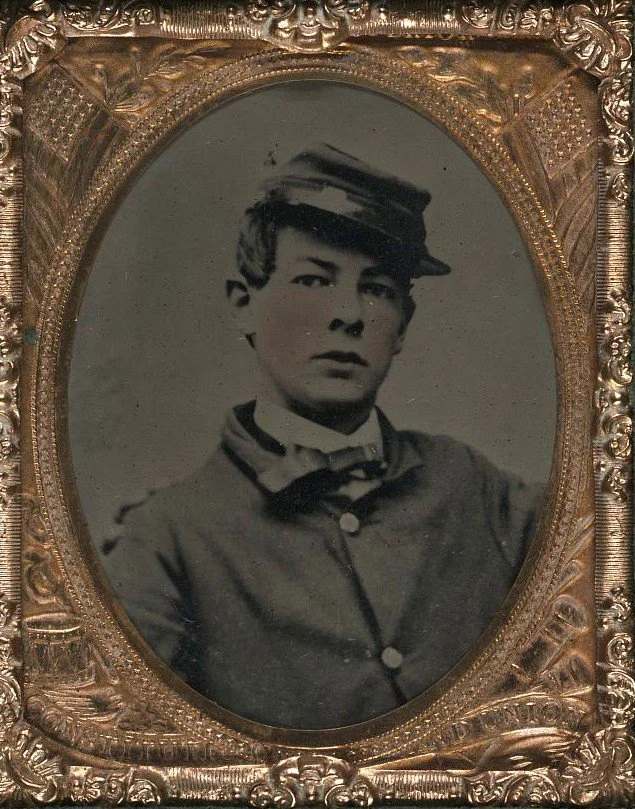
It started with a tombstone. Well, it actually started several years ago with an email. Or, perhaps, it started on August 3, 1846, with the birth of a cherub-faced baby boy, the first-born son of ship’s carpenter Abram Somerby and his young bride, Mary Wheeler. This is the hardest part of a story like this one - where to begin. Each thread whips through so many lives and carries us through time.
We’ll start near the present. A couple of siblings, descendants of the Somerby family who had grown up in Newburyport, were getting on in years, and like so many families, they had a few precious family objects and were hoping to learn more about them with an eye to finding a safe place for them in the future.
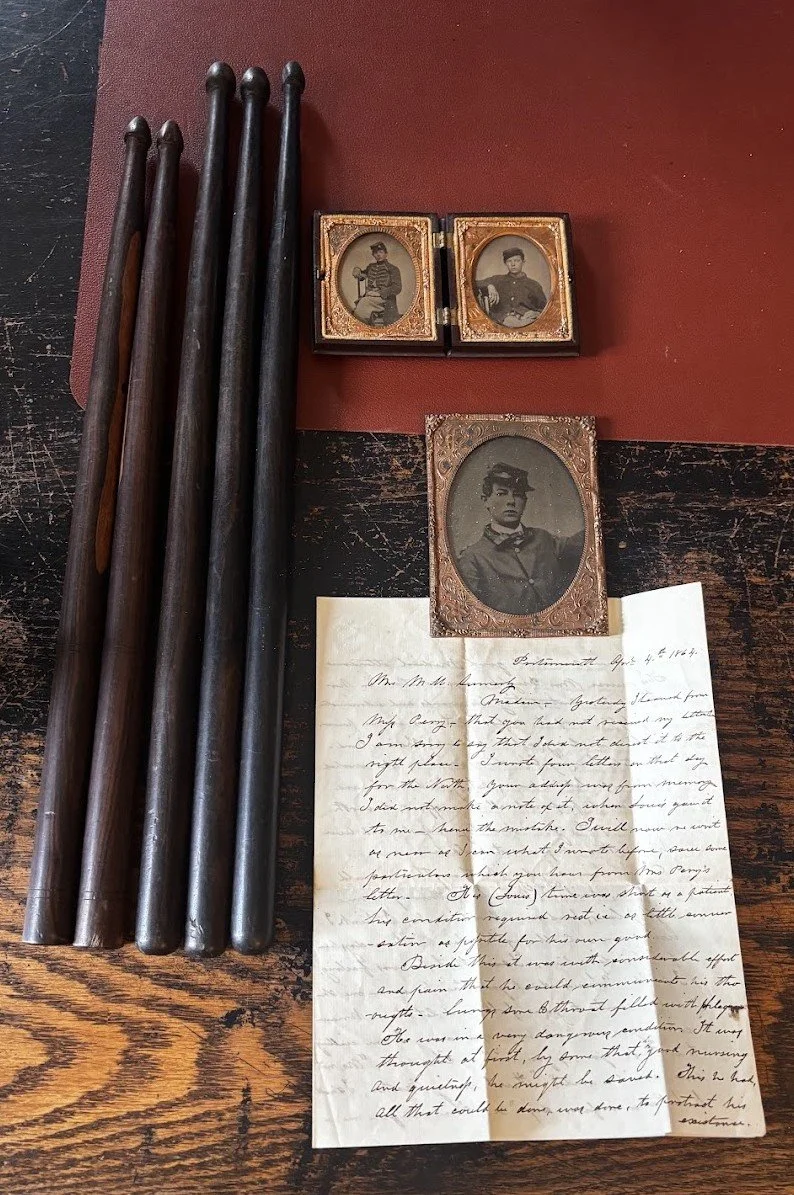
Among the cherished items they had inherited was a collection of artifacts linked to a young Civil War soldier named Louis Somerby, and the siblings wanted to visit his grave. Enlisting the help of Ghlee Woodworth, they returned to Newburyport where Ghlee had identified his headstone in Belleville Cemetery, and brought the items, at Ghlee’s encouragement, to donate to the Museum.
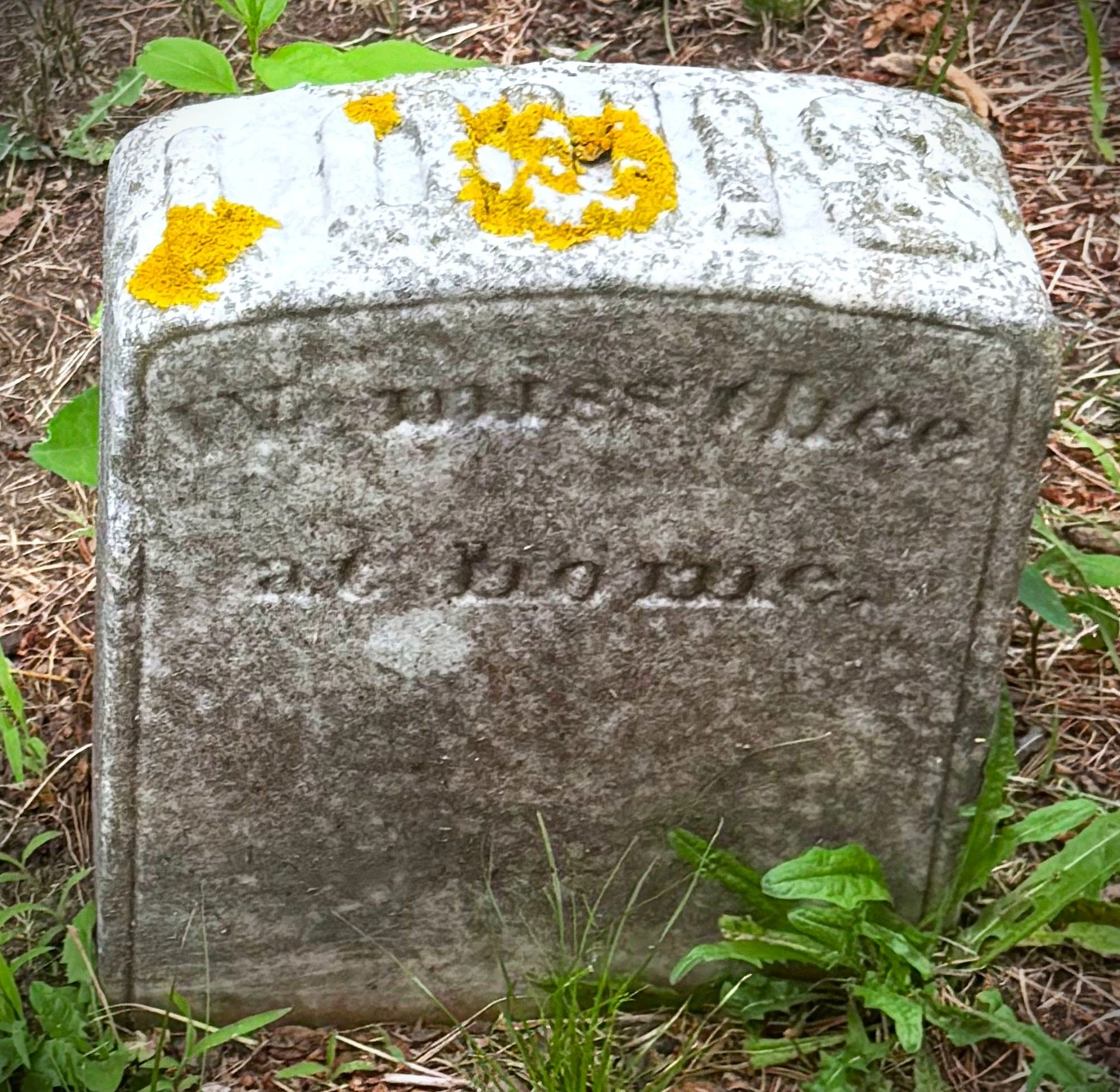
Louis Somerby’s gravestone says simply, devastatingly, “Louis. We miss thee at home.”
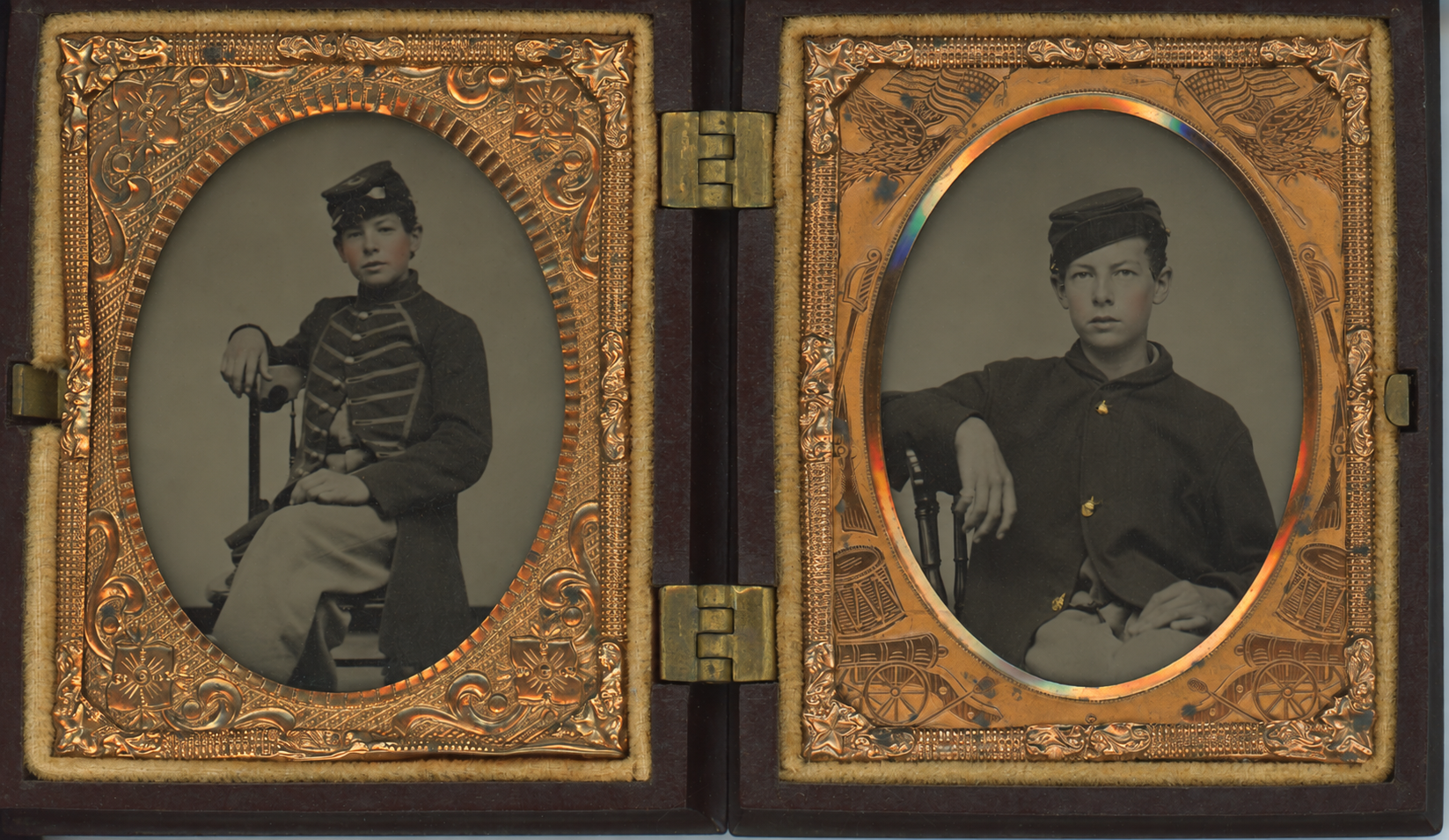
The siblings were meeting with Ghlee and Ashley, our Archivist and Collections Manager, when I walked into the office. There was something terribly familiar about the face staring back at me from the three photographs (one tin-type and two ambrotypes) in the collection, but I put it down to the uniform or perhaps the pose. The collection was fascinating - five drumsticks, the three photographs, a letter, newspaper clippings, a picture of the house on Merrimac Street that had been in the Somerby family for generations, and a picture of an unidentified relative from the early 20th century. We had a lovely visit, and the Somerby siblings bequeathed these precious relics, infused with love and grief in equal measure, to the museum, and by extension, to all of you.
This boy belongs to all of us now.
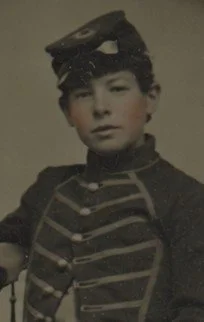
I could not shake the feeling that I had “met” this child - because despite all that he went though, he was still just a child - before. As with most of these kind of donations, the first step for me is to do some cursory genealogy, and because I am a proud inbred townie, the easiest way to do this is to pop them into my massive, sprawling, gnarled family tree. I know I am a Somerby descendant, so I looked up “Louis Somerby” in my tree. He was there already, my 3rd cousin, as was this image, the same as the larger image that had just been donated, with a full compliment of research and records already in place.
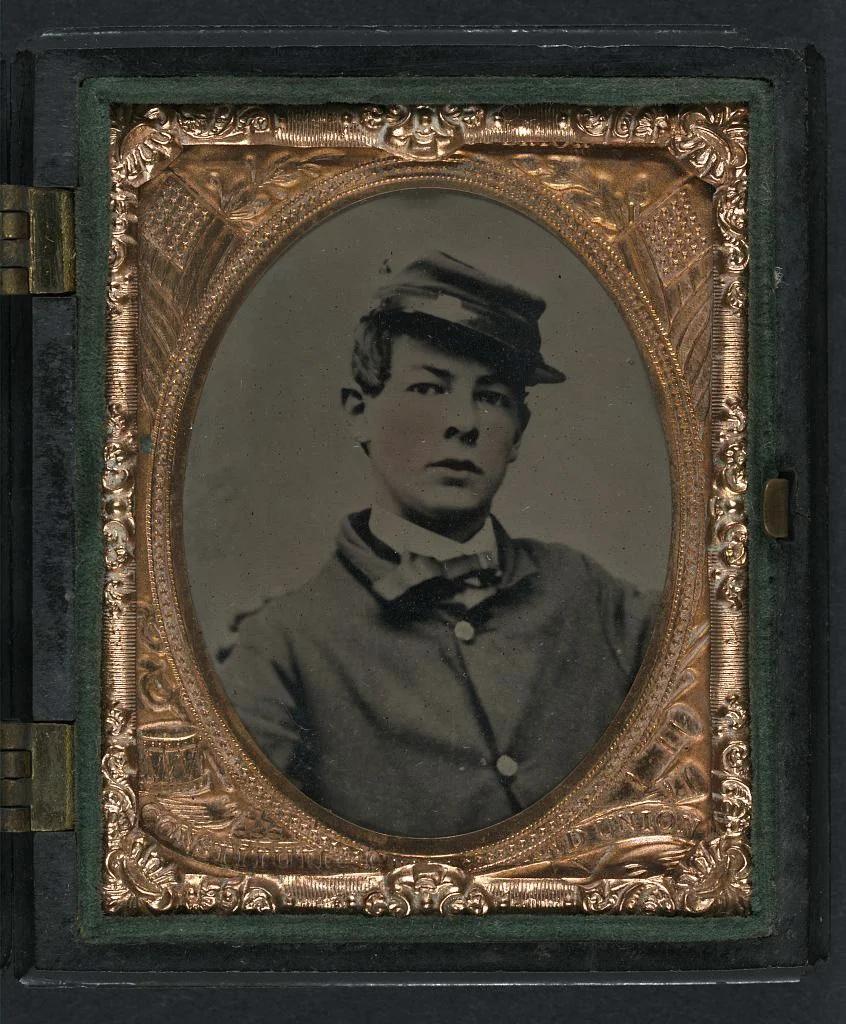
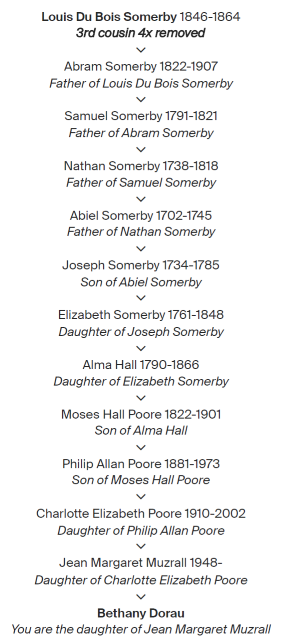
The image above is from the Library of Congress and is the same as the larger tintype given to us this week.
It all came back to me then. Several years ago, a woman from Connecticut, another Somerby descendant unconnected to the more recent donors (except by distant relation) contacted us about a letter that had passed down in her family, along with some other items and images she wanted to share with us. She was not ready to donate the letter - it is precious to her - but she shared a copy and a transcript with us. We had a lovely chat, and she has become a staunch supporter of the museum. Here is the letter.
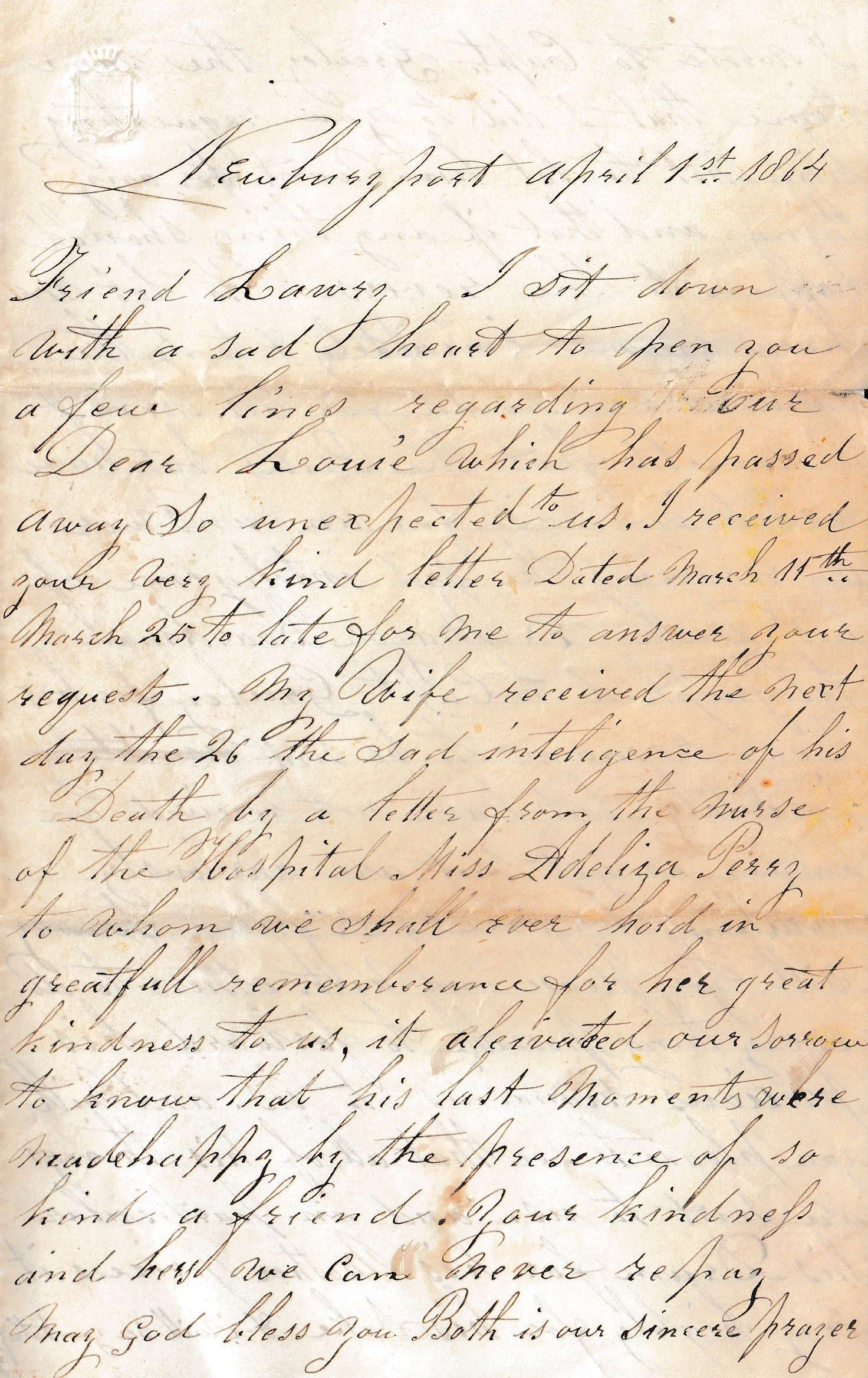
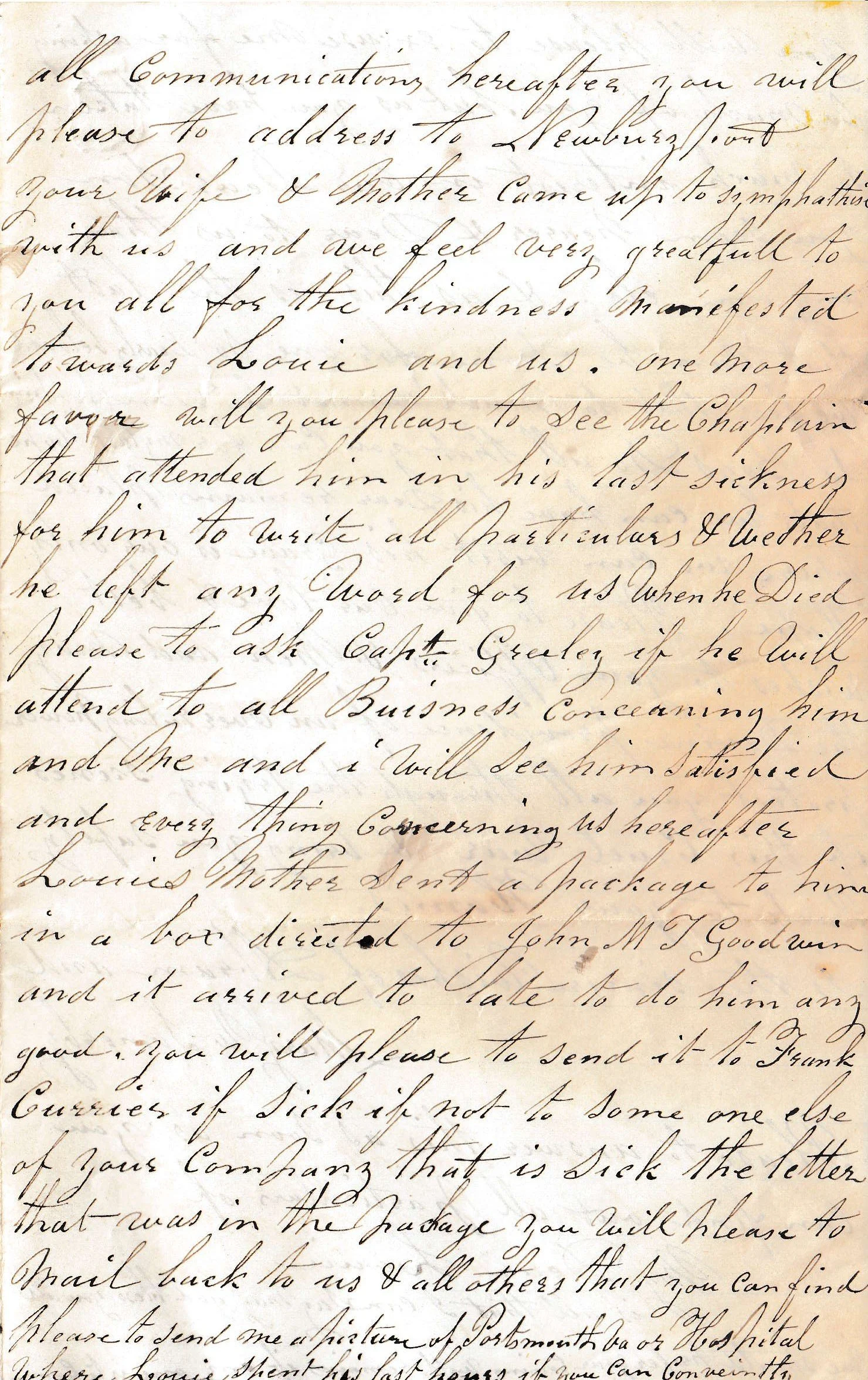
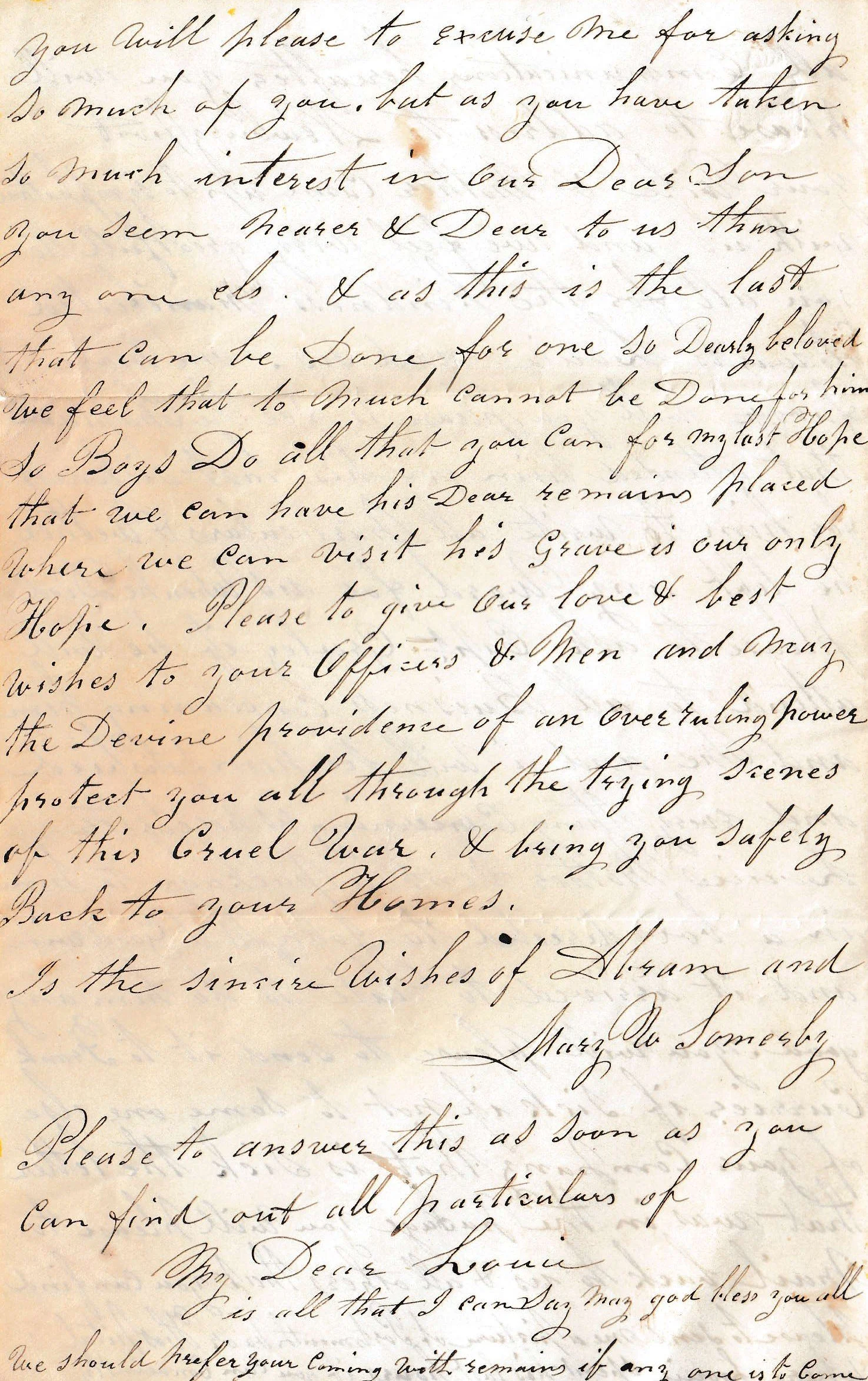
Newburyport, April 1st, 1864
Friend Lawry,
I sit down with a sad heart to pen you a few lines regarding our dear Louie which has passed away so unexpected to us. I received your very kind letter dated March 11th, March 25, too late for me to answer your requests. My wife received the next day, the 26, the sad intelligence of his death by a letter from the nurse of the hospital, Miss Adeliza Perry, to whom we shall ever hold in grateful remembrance for her great kindness to us; it alleviated our sorrow to know that his last moments were made happy by the presence of so kind a friend. Your kindness and hers we can never repay. May God bless you both is our sincere prayer.
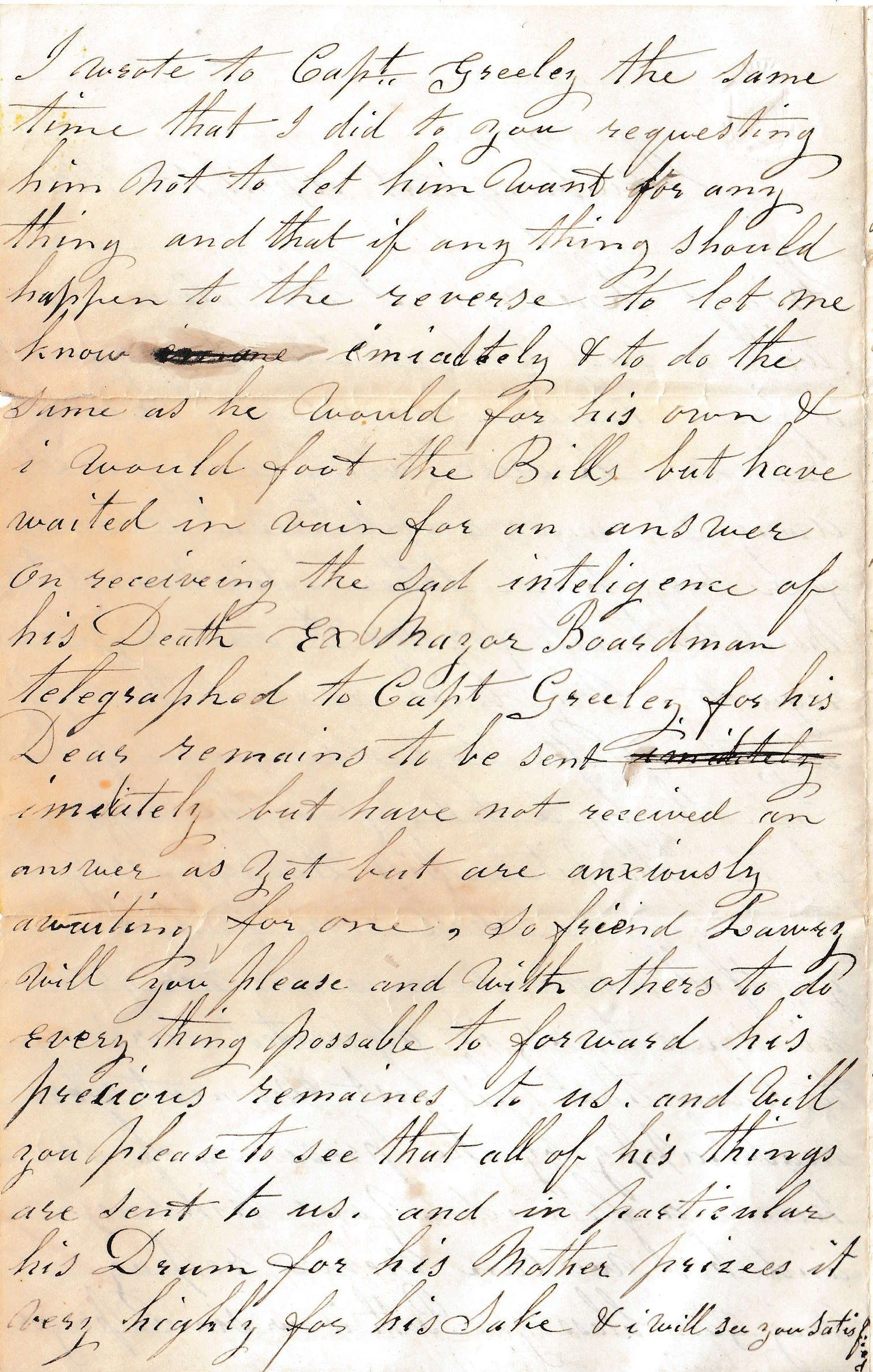
I wrote to Capt. Greeley the same time that I did to you, requesting him not to let him want for anything, and that if anything should happen to the reverse, to let me know immediately and to do the same as he would for his own, and I would foot the bills, but have waited in vain for an answer. On receiving the sad intelligence of his death, ex-Mayor Boardman telegraphed to Capt. Greeley for his dear remains to be sent immediately, but have not received an answer as yet, but are anxiously awaiting for one. So, friend Lawry, will you please and with others to do everything possible to forward his precious remains to us, and will you please to see that all of his things are sent to us, and in particular his drum, for his mother prizes it very highly for his sake, and I will see you satisfied.
All communications hereafter you will please to address to Newburyport. Your wife and mother came up to sympathise with us, and we feel very grateful to you all for the kindness manifested towards Louie and us. One more favor: will you please to see the chaplain that attended him in his last sickness for him to write all particulars and whether he left any word for us when he died. Please to ask Capt. Greeley if he will attend to all business concerning him and me, and I will see him satisfied, and everything concerning us hereafter.
Louie’s mother sent a package to him in a box directed to John M. T. Goodwin, and it arrived too late to do him any good. You will please to send it to Frank Currier if sick; if not, to some one else of your company that is sick. The letter that was in the package you will please to mail back to us, and all others that you can find. Please to send me a picture of Portsmouth, Va., or hospital where Louie spent his last hours, if you can conveniently.
You will please to excuse me for asking so much of you, but as you have taken so much interest in our dear son, you seem nearer and dear to us than any one else, and as this is the last that can be done for one so dearly beloved. We feel that too much cannot be done for him. So, boys, do all that you can, for my last hope that we can have his dear remains placed where we can visit his grave is our only hope. Please to give our love and best wishes to your officers and men, and may the divine providence of an overruling power protect you all through the trying scenes of this cruel war, and bring you safely back to your homes.
Is the sincere wishes of Abram and Mary W. Somerby.
Please to answer this as soon as you can find out all particulars of my dear Louie is all that I can say. May God bless you all.
We should prefer your coming with remains if any one is to come.
This letter was the prompt for my earlier research, the kind of letter that changed my life over a decade ago when I was given the gift of a lifetime and entrusted with the letters of Eben Bradbury, an equally sweet-faced boy who died in World War I. Eben’s father’s letters begging anyone who knew where his boy was, if he was alright, and once they had been given the terrible news, who could tell him anything about the circumstances of his death, inspired a book about the family that is really about a father’s search for answers and then the silence and anger that was its terrible aftermath.
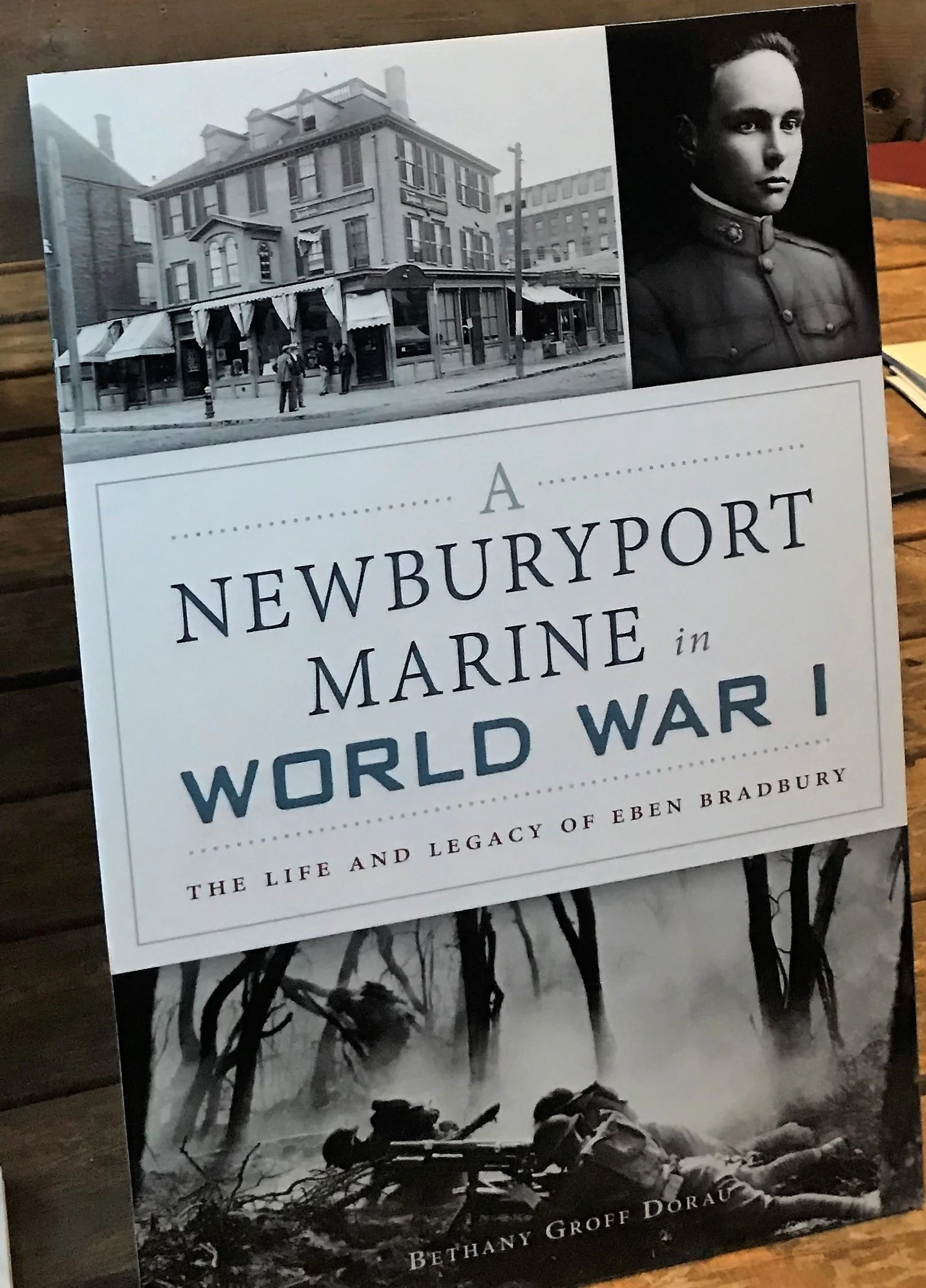
The letters of another bereft father, Eben Bradbury, inspired this book.
Abram Somerby’s pleas for information about his son’s death fifty years before the Bradbury tragedy, brought these terrible letters back to me.
This week’s donation included this newspaper clipping, and a full reprinting of the letter from nurse Adeliza Perry that Louis Somerby’s father mentions in the letter above. It is a heartbreaker. The description of his death seems both rather florid and rather gruesome, but as a mother, I can understand the desire to know every detail of my child’s last moments of life.
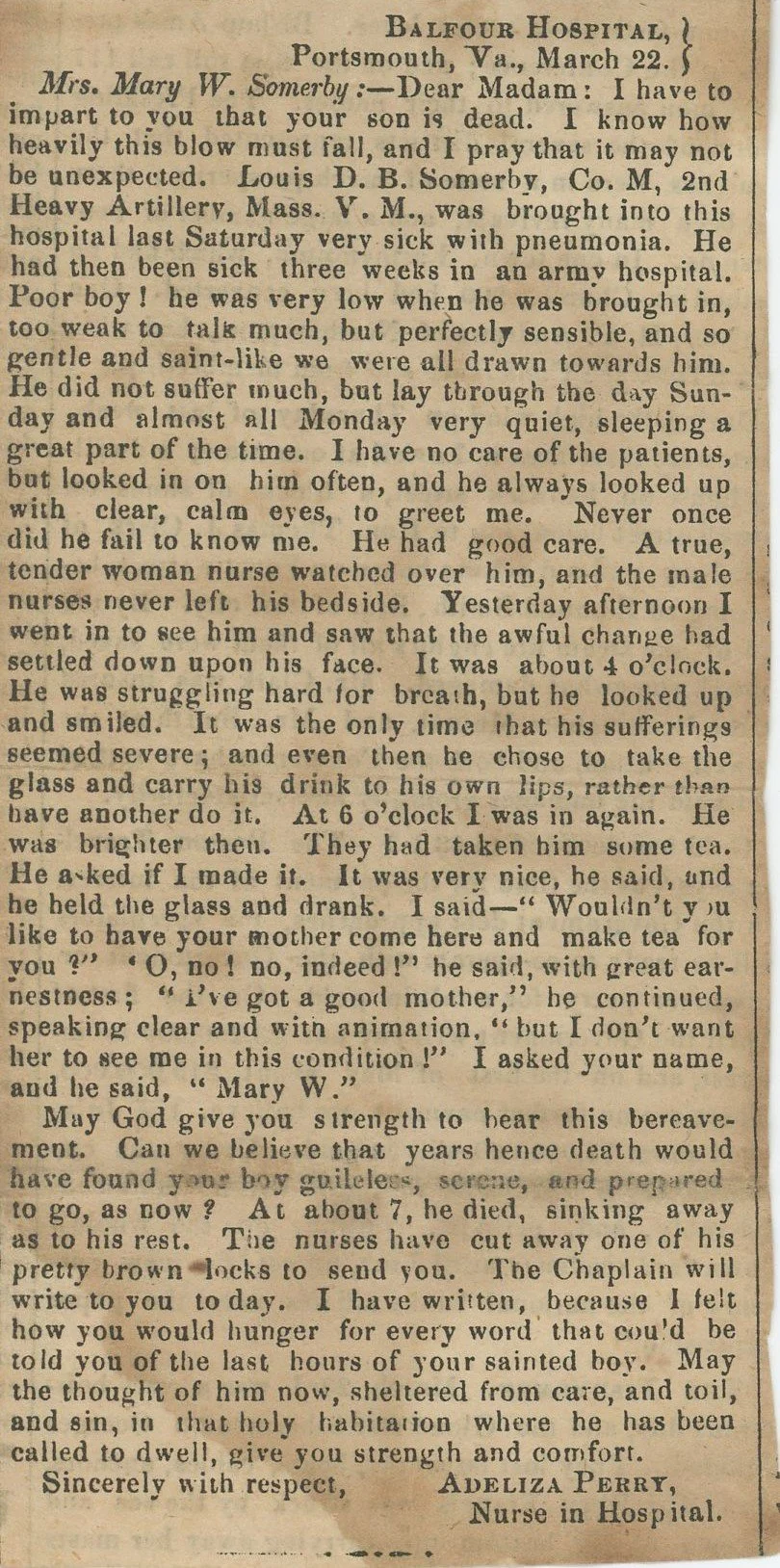
BALFOUR HOSPITAL,
Portsmouth, Va., March 22.
Mrs. Mary W. Somerby:—Dear Madam: I have to impart to you that your son is dead. I know how heavily this blow must fall, and I pray that it may not be unexpected. Louis D. B. Somerby, Co. M, 2nd Heavy Artillery, Mass. V. M., was brought into this hospital last Saturday very sick with pneumonia. He had then been sick three weeks in an army hospital. Poor boy! he was very low when he was brought in, too weak to talk much, but perfectly sensible, and so gentle and saint-like we were all drawn towards him. He did not suffer much, but lay through the day Sunday and almost all Monday very quiet, sleeping a great part of the time. I have no care of the patients, but looked in on him often, and he always looked up with clear, calm eyes, to greet me. Never once did he fail to know me. He had good care. A true, tender woman nurse watched over him, and the male nurses never left his bedside. Yesterday afternoon I went in to see him and saw that the awful change had settled down upon his face. It was about 4 o’clock. He was struggling hard for breath, but he looked up and smiled. It was the only time that his sufferings seemed severe; and even then he chose to take the glass and carry his drink to his own lips, rather than have another do it. At 6 o’clock I was in again. He was brighter then. They had taken him some tea. He asked if I made it. It was very nice, he said, and he held the glass and drank. I said—“Wouldn’t you like to have your mother come here and make tea for you?” ‘O, no! no, indeed!’ he said, with great earnestness; “I've got a good mother,” he continued, speaking clear and with animation, “but I don’t want her to see me in this condition!” I asked your name, and he said, “Mary W.”
May God give you strength to bear this bereavement. Can we believe that years hence death would have found your boy guileless, serene, and prepared to go, as now? At about 7, he died, sinking away as to his rest. The nurses have cut away one of his pretty brown locks to send you. The Chaplain will write to you to day. I have written, because I felt how you would hunger for every word that could be told you of the last hours of your sainted boy. May the thought of him now, sheltered from care, and toil, and sin, in that holy habitation where he has been called to dwell, give you strength and comfort.
Sincerely with respect,
ADELIZA PERRY,
Nurse in Hospital.
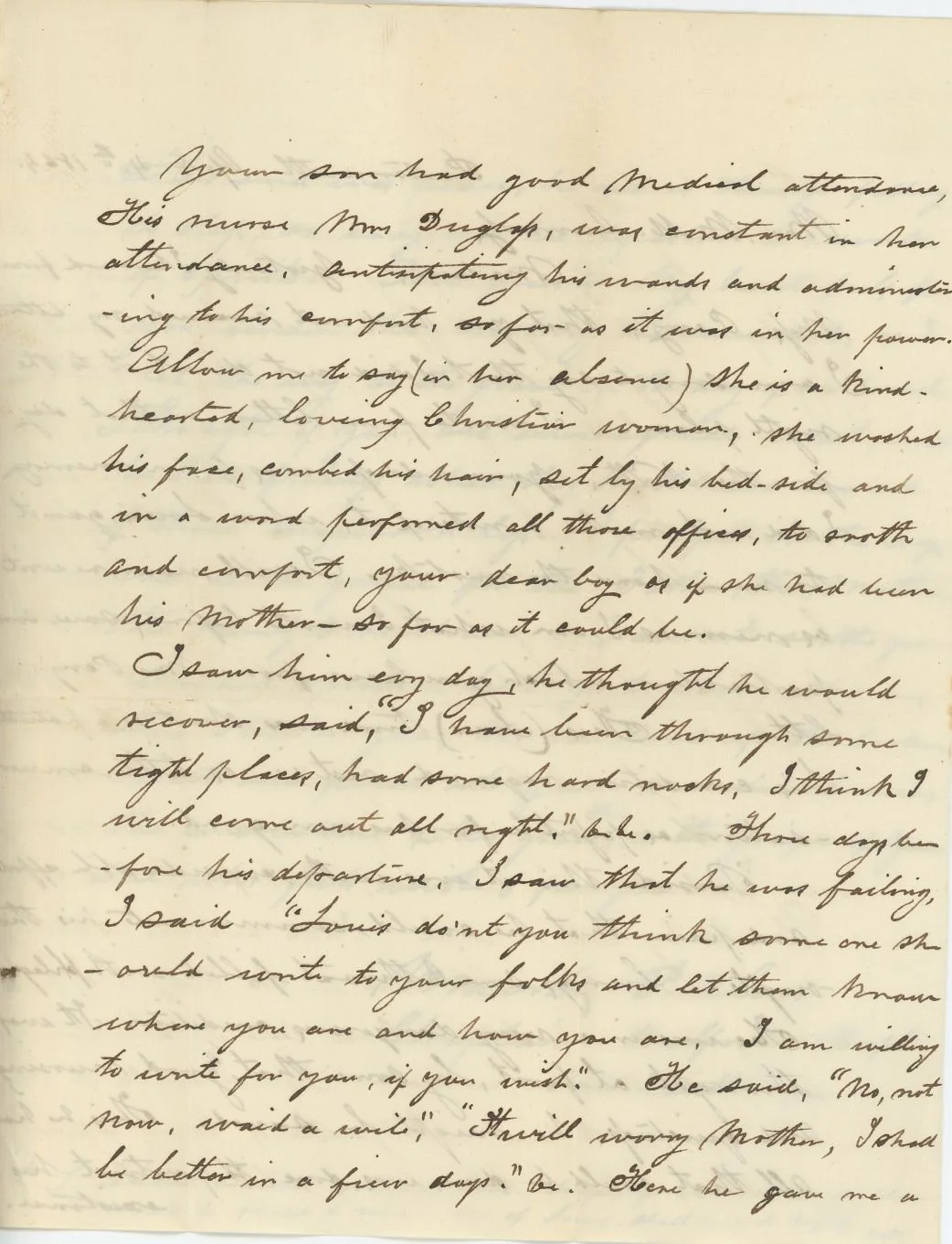
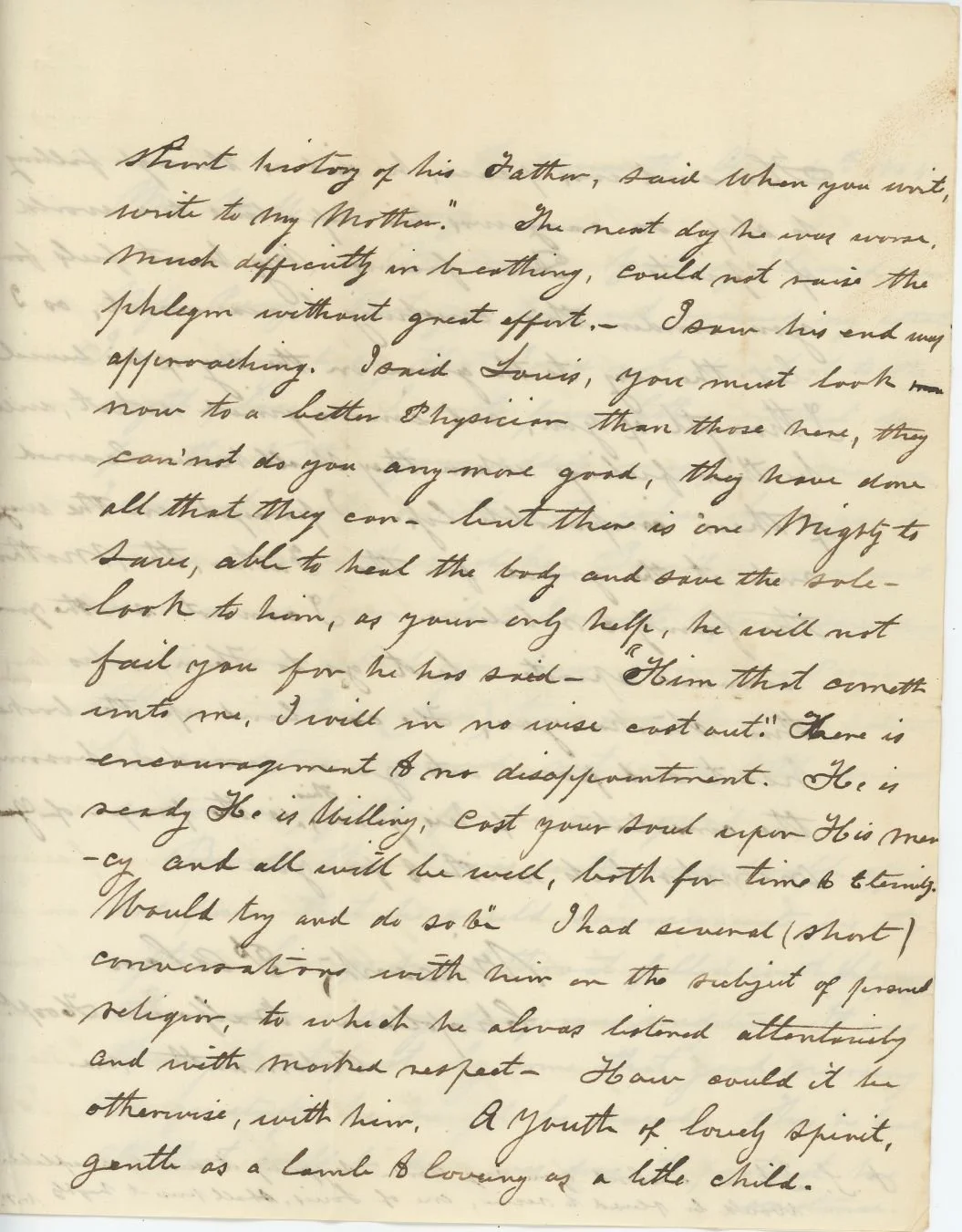
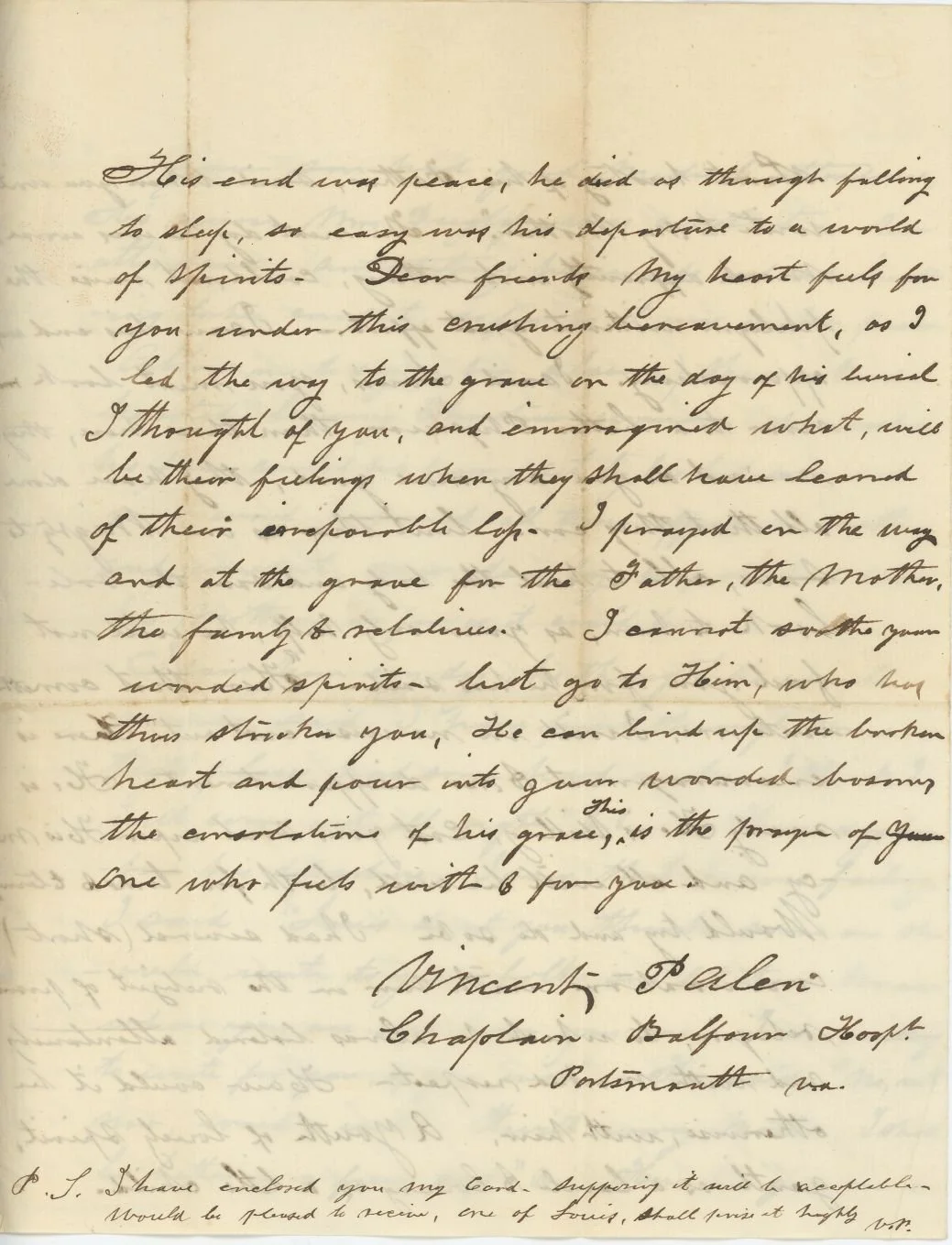
In his letter, Louis’ father Abram Somerby begs for the return of his boy’s drum, and asks his neighbor Lawry to “see the chaplain that attended him in his last sickness for him to write all particulars and whether he left any word for us when he died”. The letter that accompanied the tintypes donated this week was the answer to this request.
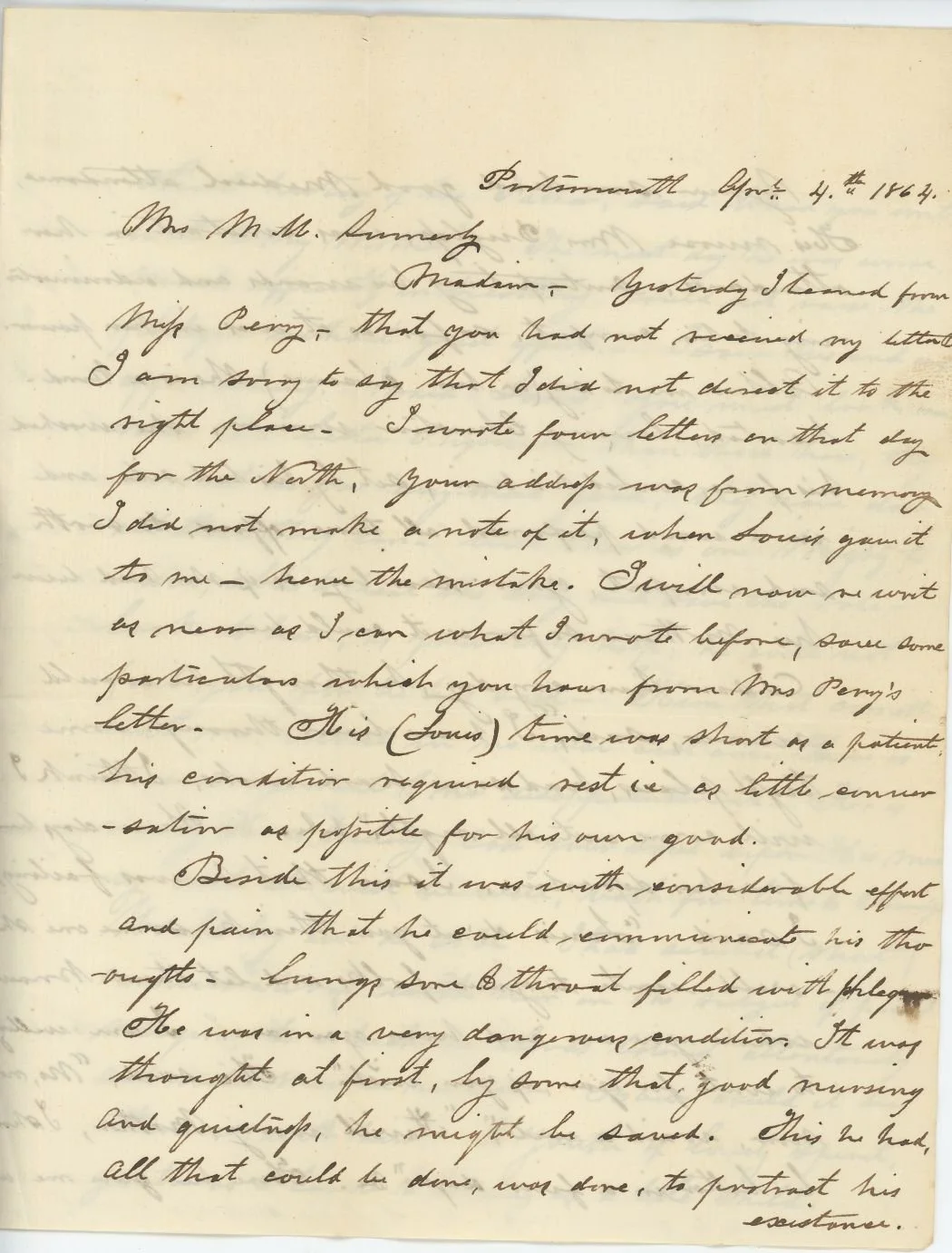
Portsmouth Aprl. 4th 1864.
Mrs M W. Somerby
Madam - Yesterday I learned from Miss Perry, that you had not received my letter. I am sorry to say that I did not direct it to the right place. I wrote four letters on that day for the North, Your address was from memory. I did not make a note of it, when Louis gave it to me - hence the mistake. I will now re write as near as I can what I wrote before, save some particulars which you have from Mrs Perry’s letter. His (Louis) time was short as a patient; his condition required rest & as little conversation as possible for his own good.
Beside this it was with considerable effort and pain that he could communicate his thoughts - lungs sore & throat filled with phlegm. He was in a very dangerous condition. It was thought at first, by some that good nursing and quietness, he might be saved. This he had. All that could be done, was done, to protract his existence.
Your son had good Medical attendance, His nurse Mrs Duglass, was constant in her attendance, anticipating his wants and administering to his comfort, so far as it was in her power. Allow me to say (in her absence) she is a kind-hearted, loving Christian woman, she washed his face, combed his hair, set by his bed-side and in a word performed all those offices, to sooth and comfort, your dear boy as if she had been his Mother - so far as it could be.
I saw him evry day, he thought he would recover, said, “I have been through some tight places, had some hard nocks, I think I will come out all right.” &c. Three days before his departure, I saw that he was failing, I said “Louis don’’t you think some one should write to your folks and let them know where you are and how you are, I am willing to write for you, if you wish.” He said, “No, not now, wait a wile,” “It will worry Mother, I shall be better in a few days.” &c. Here he gave me a short history of his Father, said When you write, write to my Mother.” The next day he was worse. Much difficulty in breathing, could not raise the phlegm without great effort, - I saw his end was approaching. I said Louis, you must look now to a better Physician than those here, they cannot do you any more good, they have done all that they can - but there is one Mighty to Save, able to heal the body and save the sole - look to him, as your only help, he will not fail you for he has said - “Him that cometh unto me, I will in no wise cast out.” Here is encouragement & no disappointment. He is ready He is Willing, Cast your soul upon His mercy and all will be well, both for time & Eternity. Would try and do so.” &c. I had several (short) conversations with him on the subject of personal religion, to which he always listened attentively and with marked respect - How could it be otherwise, with him. A Youth of lovely Spirit, gentle as a lamb & loving as a little child.
His end was peace, he died as though falling to sleep, so easy was his departure to a world of Spirits - Dear friends My heart feels for you under this crushing bereavement, as I led the way to the grave on the day of his burial I thought of you, and imagined what, will be their feelings when they shall have learned of their irreparable loss - I prayed on the way and at the grave for the Father, the Mother, the family & relatives. I cannot sooth your wounded spirits - but go to Him, who has thus stricken you, He can bind up the broken heart and pour into your wounded bosoms the consolations of his grace, This is the prayer of Your one who feels with & for you.
Vincent Palen
Chaplain Balfour Hospl.
Portsmouth Va.
P. S. I have enclosed you my Card - supposing it will be acceptable - Would be pleased to receive one of Louis, shall prize it highly
V. P.
These three letters - one still with the family, one printed in the newspaper, one in the collection of the Museum of Old Newbury, speak to each other across time and space. It is one of the great burdens and joys of my life that we become the place where fragments of the past come together again. It is our duty to preserve these artifacts and the stories, often painful, they tell.

Louis Somerby’s name on his birth record is spelled “Lewis”, and no middle name is recorded. By the time of his death eighteen years later, he is listed as Louis DeBloise or D.B. or Du Bois Somerby, a morphing name that has made some research difficult. Louis was the firstborn child of Abram Somerby, who worked as a shoe-maker, carpenter, and shipwright, and Mary Wheeler Somerby, who was just 18 years old at the time of his birth. They had married the year before, when she was 17 and he was 22. The 1850 census shows the young family living in Newbury, an area that became the west end of Newburyport when it became a city the following year. His name is still spelled “Lewis”, but a middle initial has been added.

Abram and Mary lived on Merrimac Street before moving to 12 Ashland Street. They would go on to have four more children. By 1862, Louis, age 16, had left home and was working as a clerk while going to school in Newbury. And then, in August, 1862, President Lincoln issued an impassioned plea, asking for 300,000 men to enlist for a term of 9 months. On September 13, 1862, having just turned 16 but claiming to be 17, as can be seen on the enlistment and muster records below, Louis D.B. Somerby joined the 48th Massachusetts as a drummer. He had photographs taken in his new uniform, in the confident poses of a boy who finds himself suddenly a soldier.
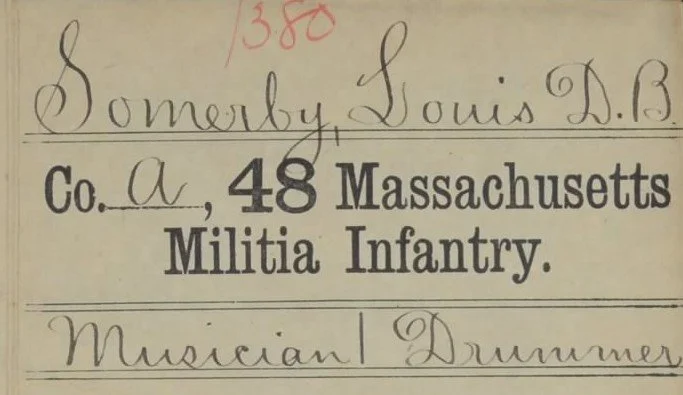
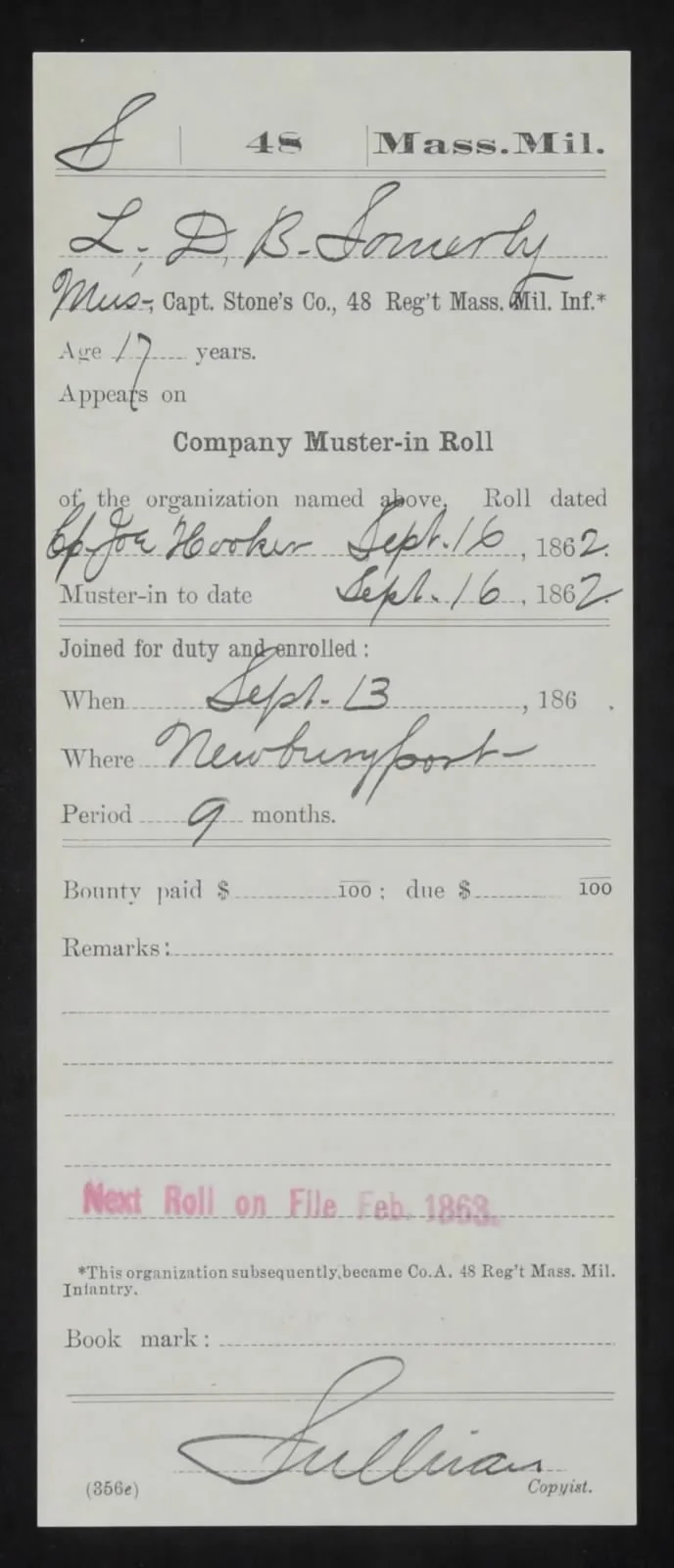
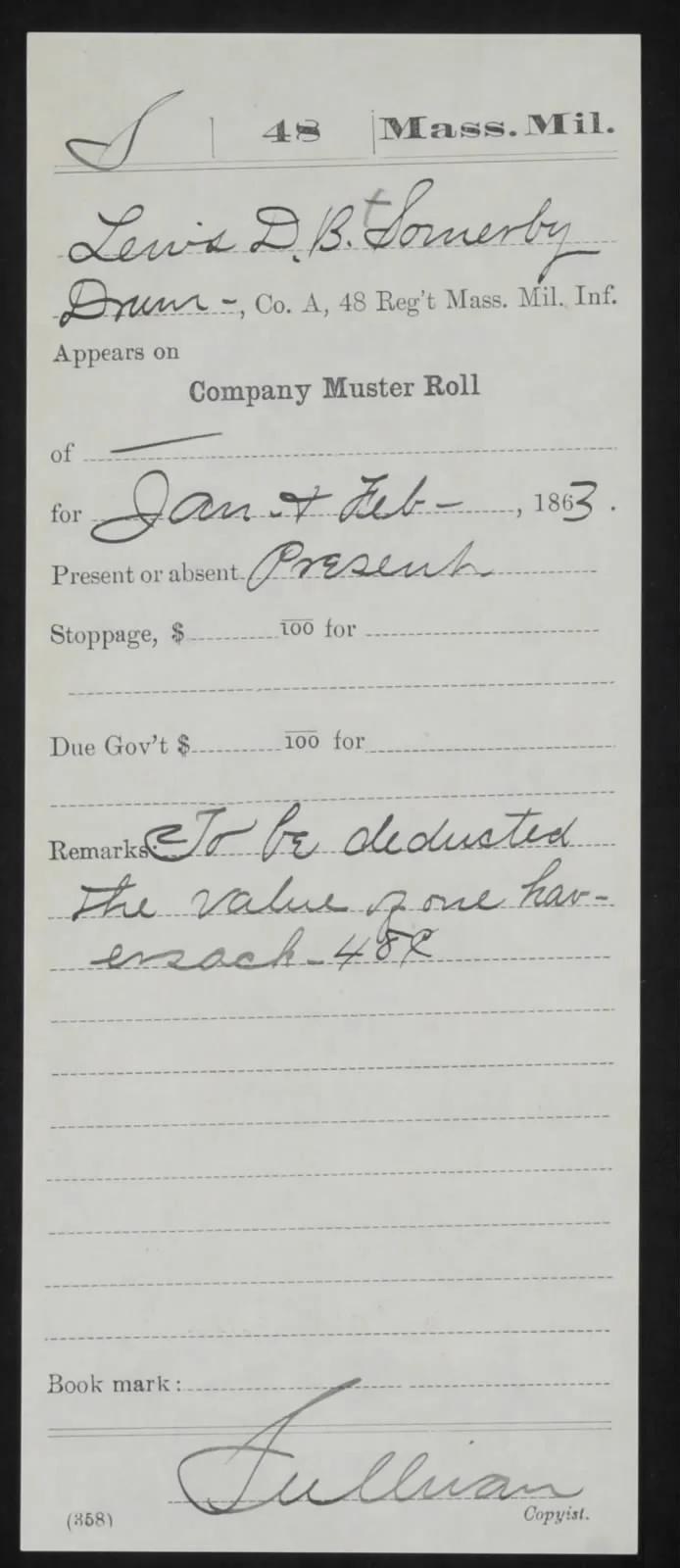
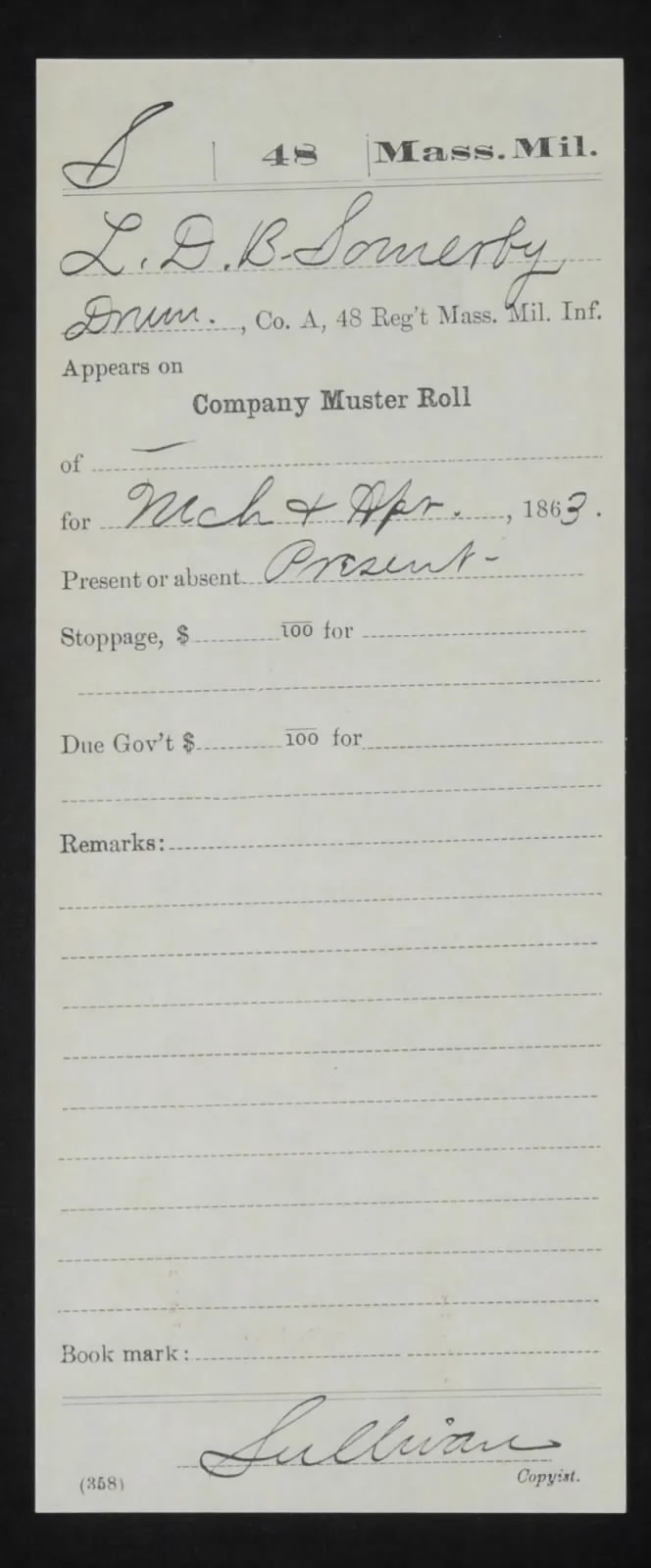
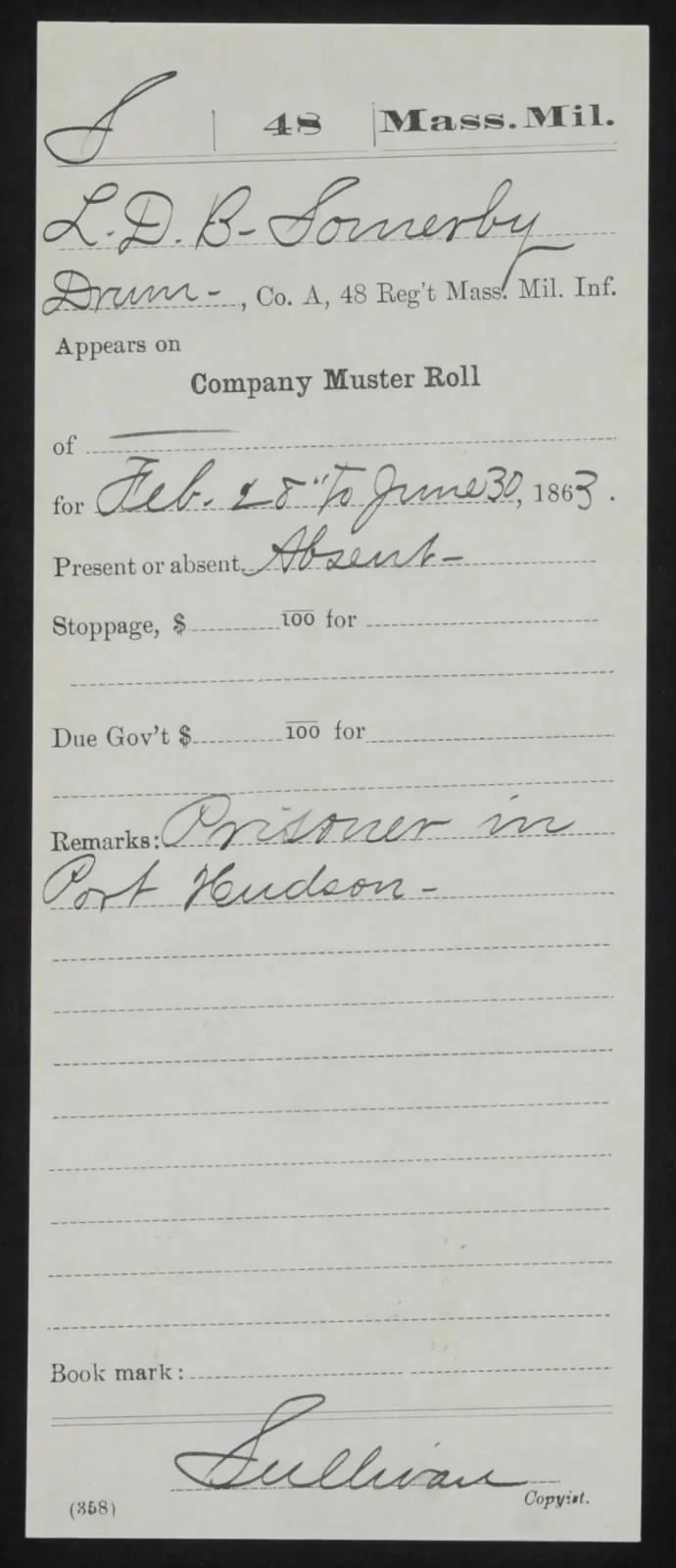
The 48th Massachusetts is worthy of a book of its own. It was originally conceived as an all-Essex County regiment, and mustered and trained beginning in September 1862 at Camp Lander in Wenham. Louis Somerby would have been there from the beginning, the first drummer of the 48th, among his neighbors and extended family. In the chaos and urgency of the war that fall, however, as fighting along the Mississippi River intensified, the Essex companies were combined with four Irish-American companies. The Essex men protested, but the merge was final, and in the end, the unit was led by Col. Eben Stone of Newburyport, with Lt. Col. James O’Brien of Charlestown as the second in command.
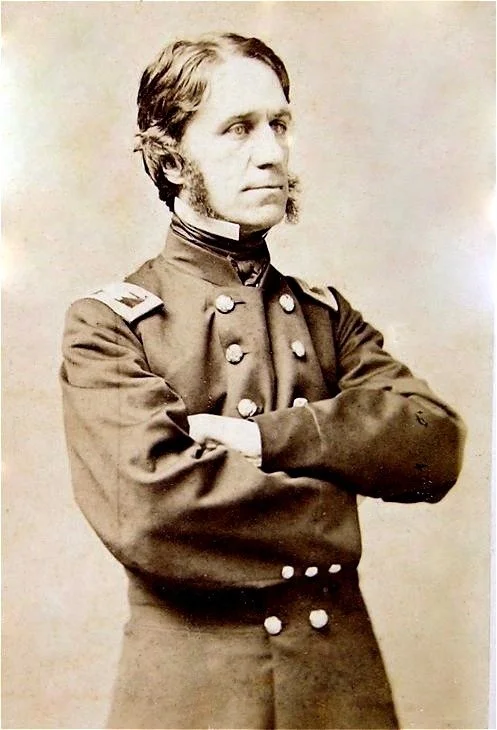
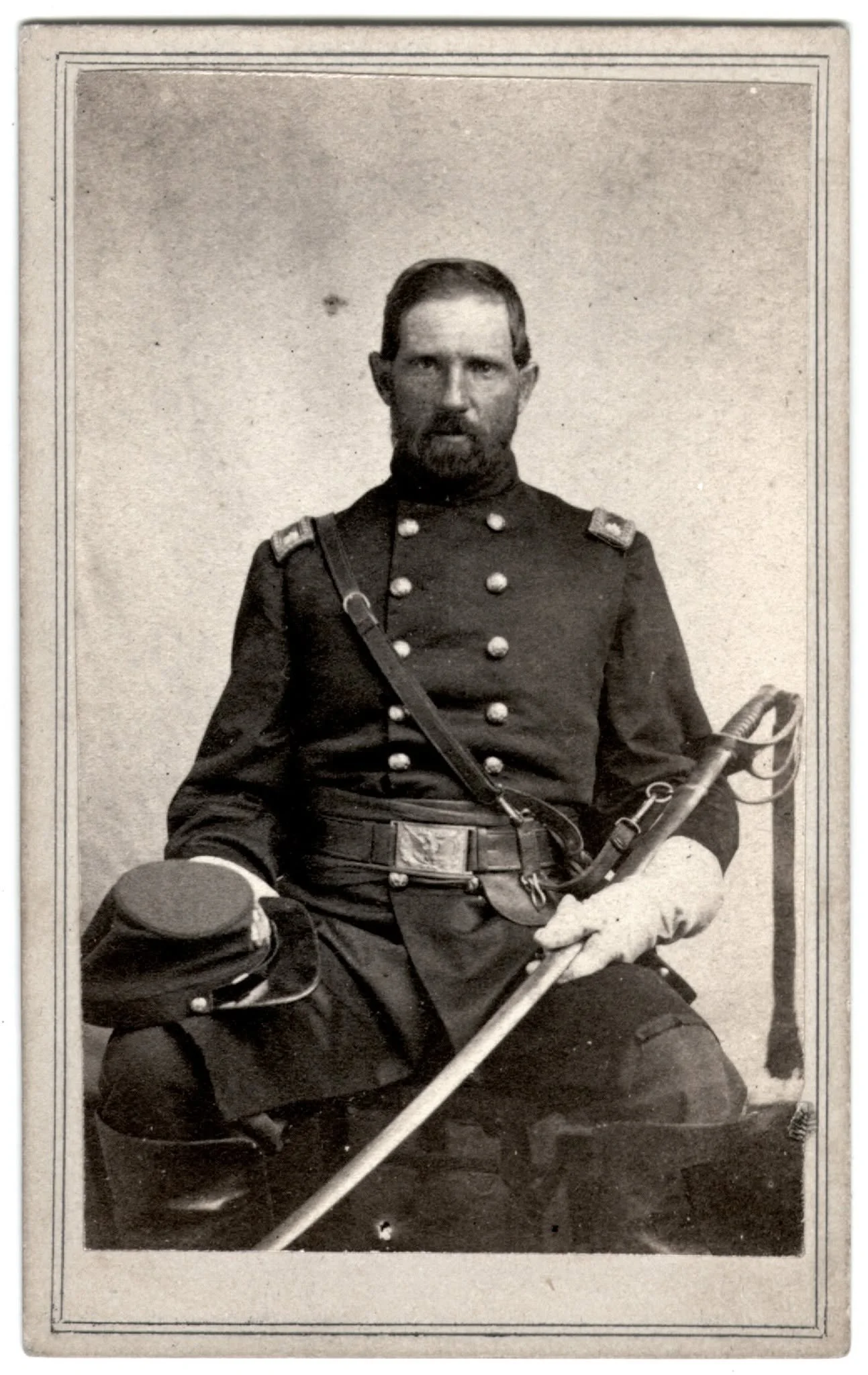
Eben Stone, left, and James O’Brien, right, commanded the 48th Massachusetts. Library of Congress
On December 17, Louis Somerby marched out with the 48th Massachusetts, bound for Louisiana. They arrived on February 1, 1863.
Louis and his comrades were stationed at Camp Banks in Baton Rouge, assisting with reconnaissance in March and April, but seeing little combat. On the night of May 21, after a day of bloody combat known as the Battle of Plains Store, a Confederate unit attacked the inexperienced 48th Massachusetts from behind. In the resulting chaos, 2 men were killed, 7 wounded, and 11 taken prisoner. Louis Somerby was one of those prisoners. The Confederates retreated to Fort Hudson (also known as Port Hudson), a heavily fortified position at a hairpin turn of the Mississippi River, taking their prisoners with them.
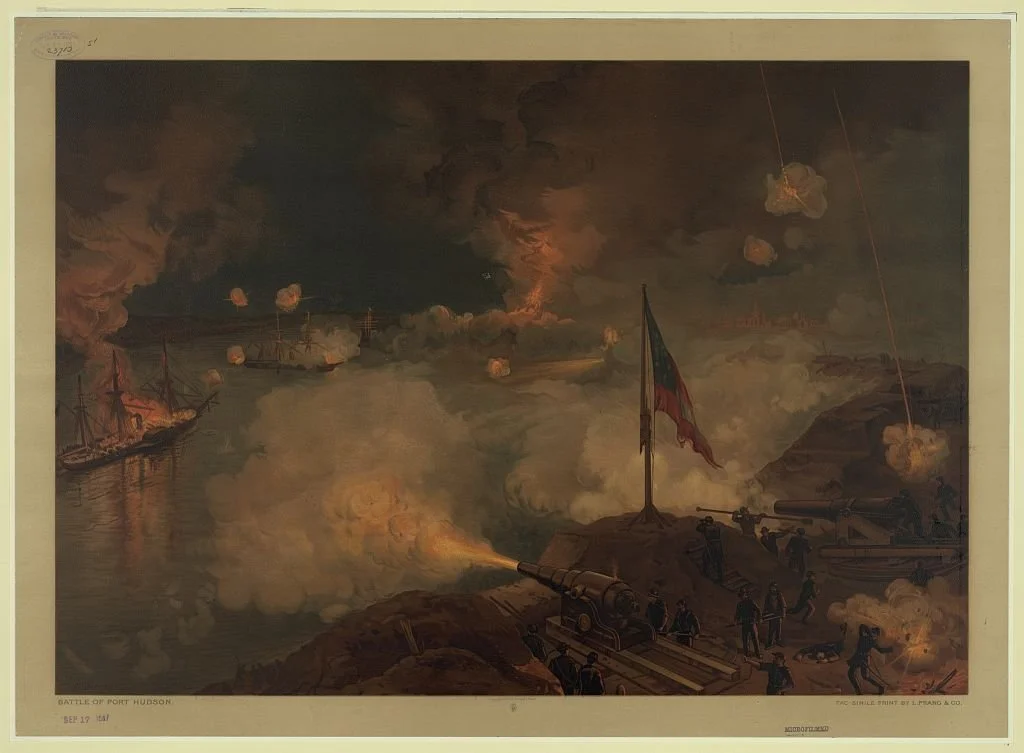
Battle of Port Hudson / J.O. Davidson ; Facsimile print by L. Prang & Co., Boston. Library of Congress
On May 27, Louis’ 48th Massachusetts attacked Fort Hudson with other Union troops. Lt. Col. James O'Brien was killed as he led a storming party against the fort where Louis was held. No meaningful progress was made, and a long siege was punctuated by bloody but futile attacks until the Confederate troops finally surrendered on July 9, 1863. Louis Somerby, who had withstood constant bombardment for 48 days, was finally freed. The prisoners were also starving - a Confederate soldier noted that “we ate…all the mules, all the Dogs, and all the Rats around us”. One shudders to think of the additional deprivations suffered by Union prisoners.
On August 1, 1863, Louis boarded a steamship for Cairo, Illinois and then travelled with the 48th Massachusetts by railroad to Boston. He was mustered out on September 3, having served three more months than the nine he had signed on for. Louis was 17, and a veteran, by the time he came back to Ashland Street late that fall.
What happens next is a bit of a puzzle for me. On December 14, 1863, 17-year-old Louis Somerby signed on for a three year enlistment with the 2nd Massachusetts Heavy Artillery company. As a historian, I can note that for some who saw minimal action before being taken prisoner, there was some pride, perhaps even a desire for revenge, at stake. It does not seem to me to be a coincidence that after withstanding the bombardment of Union heavy artillery from inside Fort Hudson, he signed onto a heavy artillery company. As a realist, I note the $325 bounty he received.
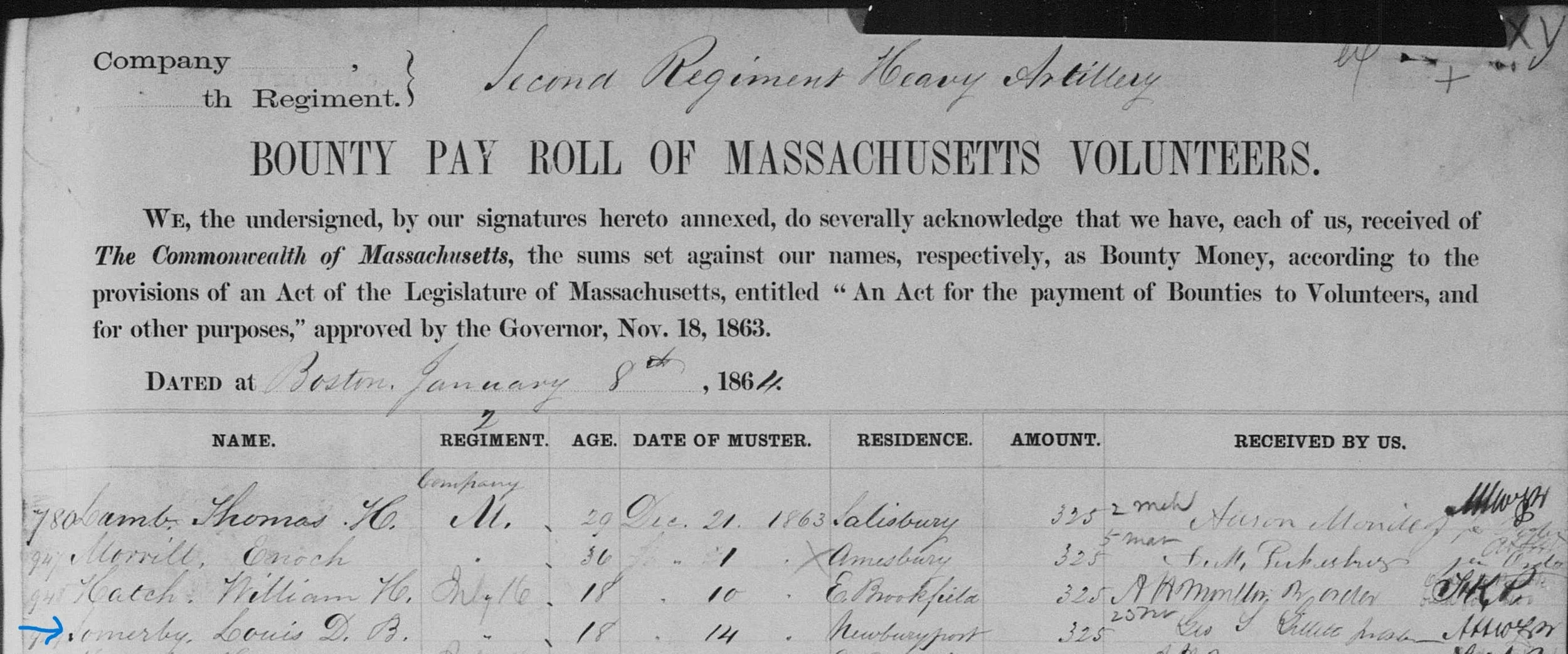
As a parent, though, I cannot quite wrap my head around his father lying about his son’s age so he can enlist again. Did this decision haunt Abram Somerby? It must have weighed heavily on him for the rest of his life. He went with his oldest son to the Ward Six recruiter in Newburyport, signed off on his being 18 years of age (chances are that anyone from Newburyport would have known this was a lie), and sent him off to war, and to his death.
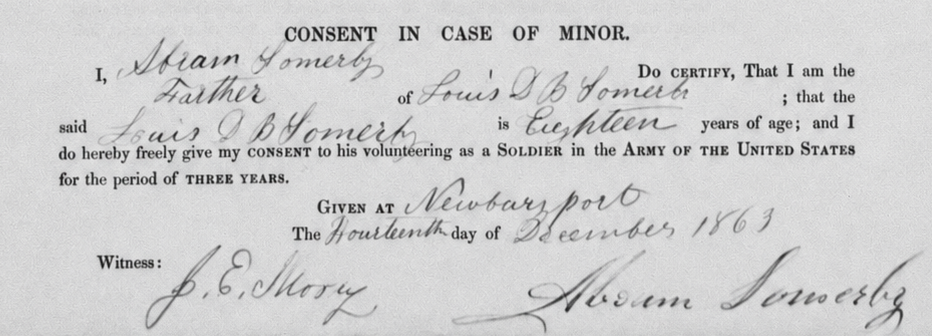
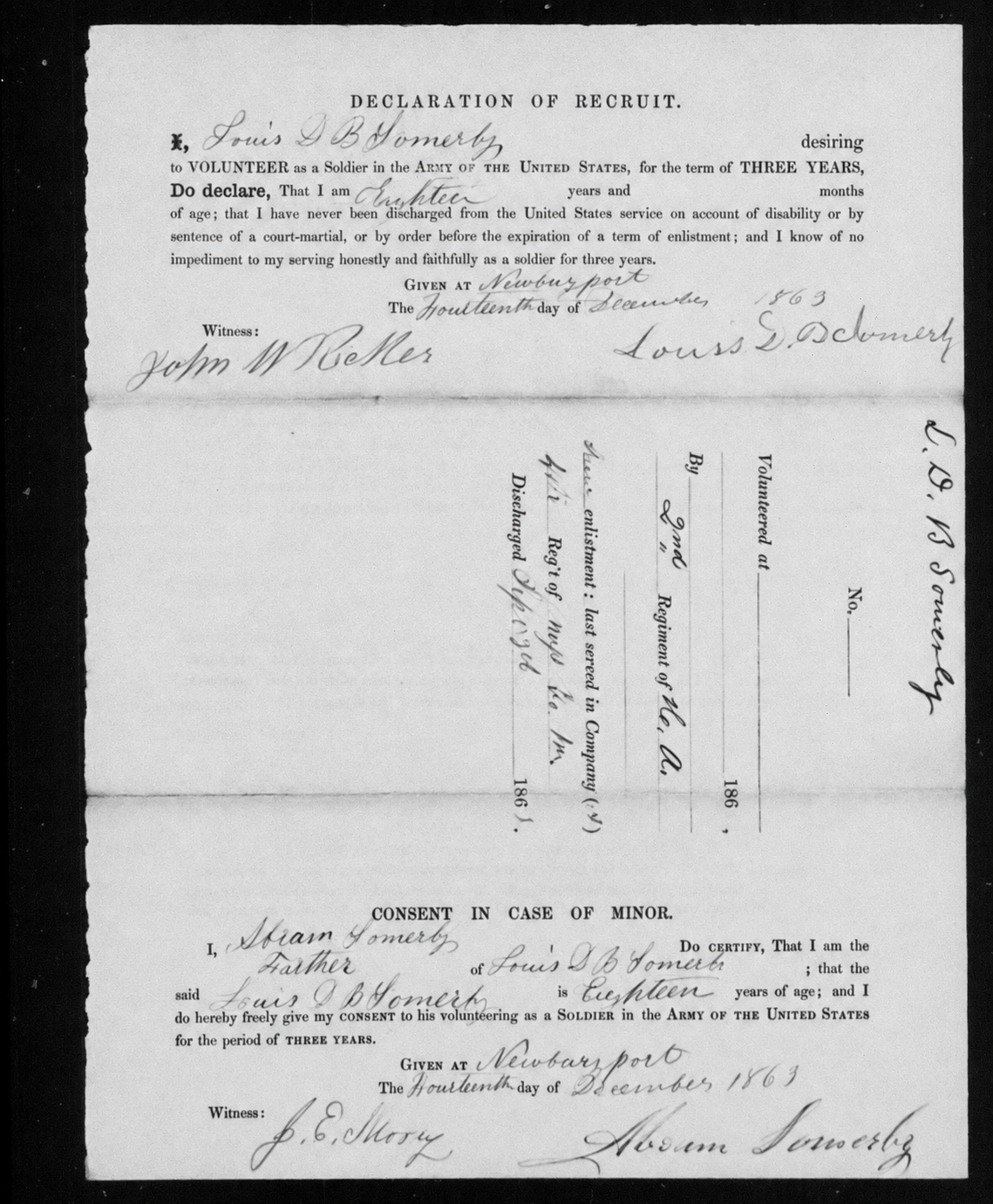
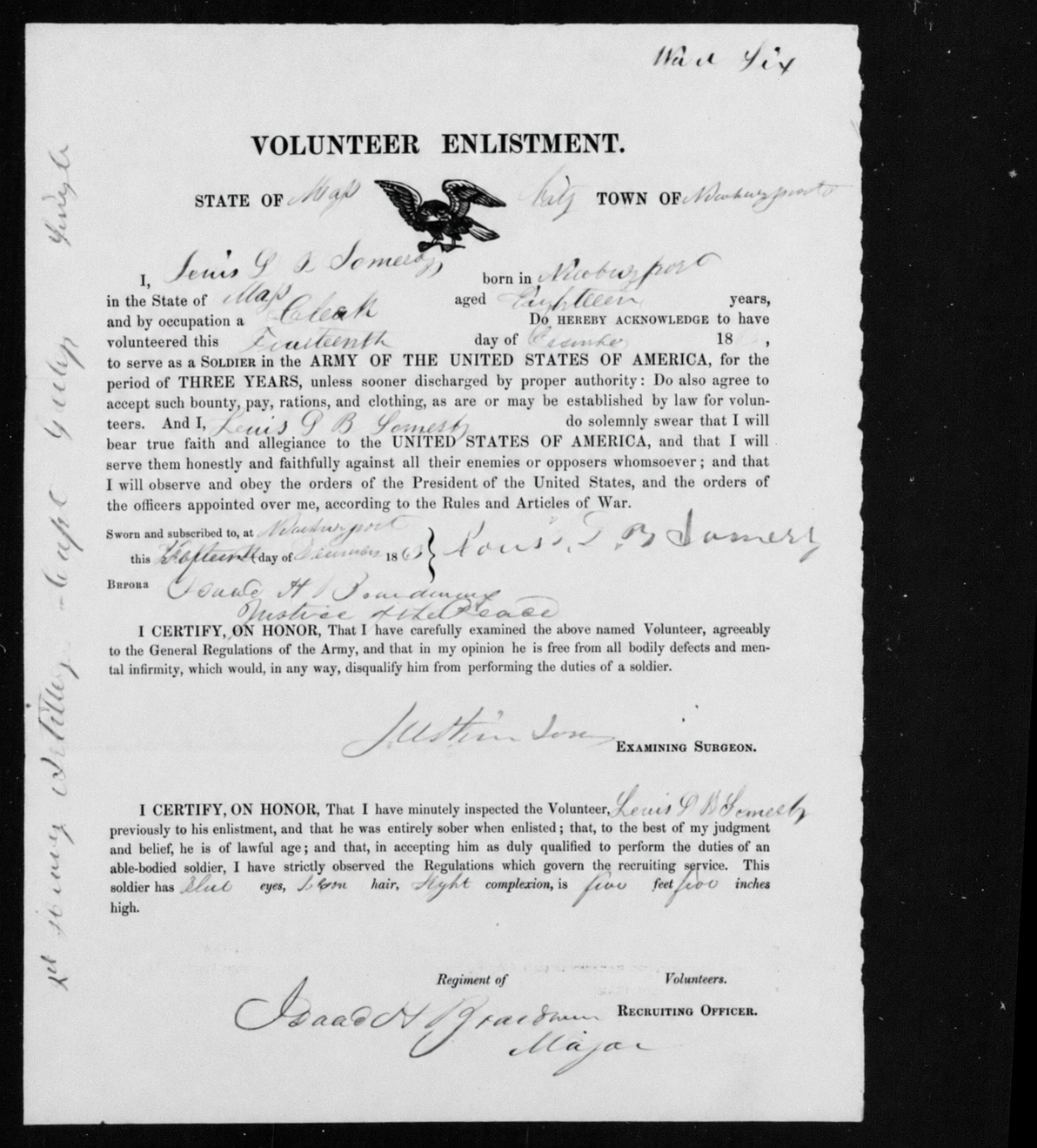
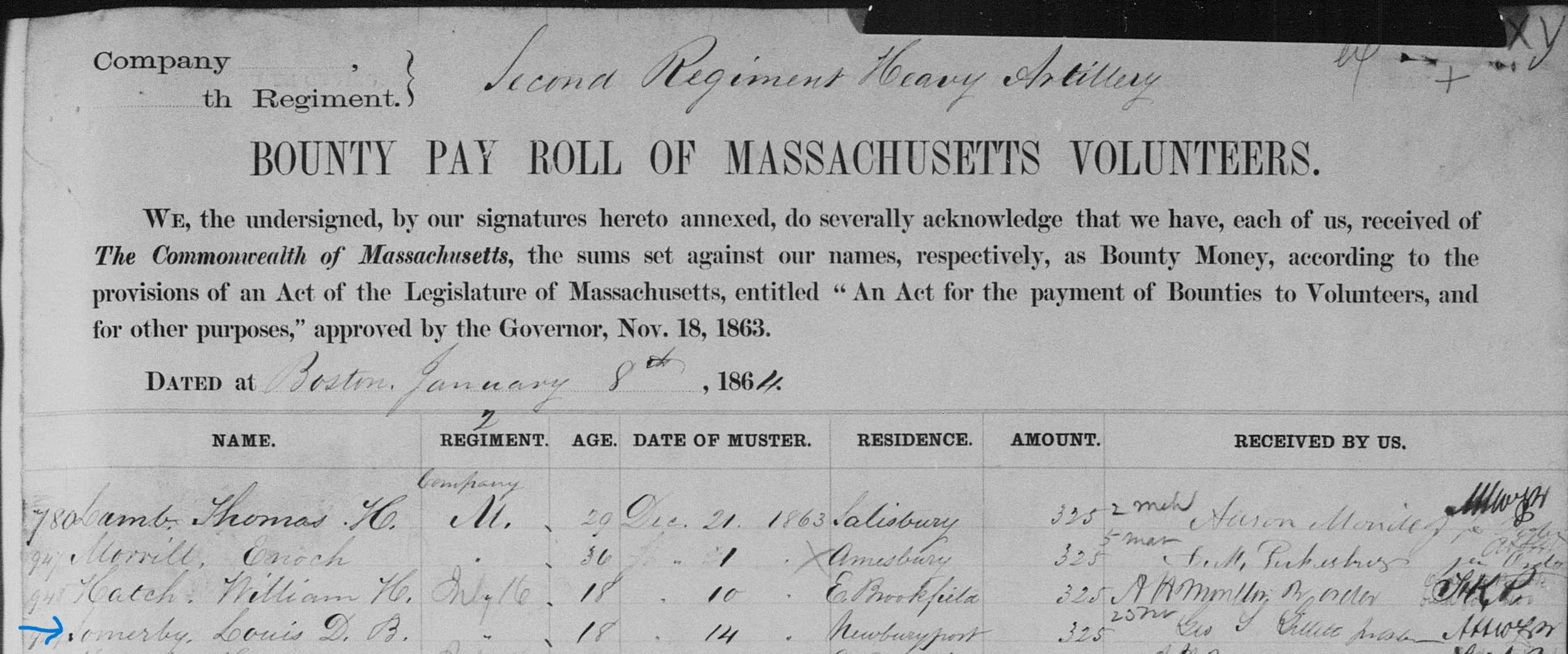
The 2nd Massachusetts Heavy Artillery, Company M, in which Louis enlisted, was commanded by Captain Jere A. Greely of Salisbury. The company went into service on December 24, 1863, serving as defenders of Union positions at Norfolk and Portsmouth, Virginia. The letter from Nurse Perry notes that he was brought to the Balfour Hospital after three weeks battling pneumonia in an army hospital. He saw only about a month of action in this second enlistment before falling ill, dying on March 21, age 17.
The last letter we have is the note to Abram and Mary from the chaplain who prayed over Louis’ grave in Virginia. It was sent on April 4.
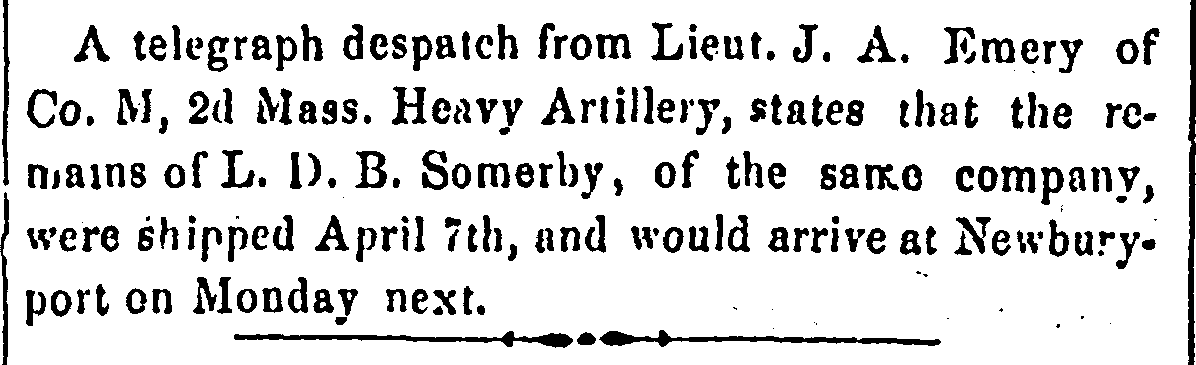
Louis Somerby was disinterred and sent home on April 7, according to a telegraph received and printed in the newspaper on April 9, 1864.
His official record is this:
On Friday, April 15th, Louis D. B. Somerby of Company A, 48th Massachusetts Infantry, and later of Company M, 2d Massachusetts Heavy Artillery, was buried from the Universalist Church, Middle Street. The services at the church were conducted by Rev. Willard Spaulding of Salem, Rev. D. T. Fiske, D.D., and Chaplain Samuel J. Spalding, of this city. The military escort was commanded by Capt. Luther Dame, and consisted of the City Cadets and members of Company A of the 48th Regiment formed as a battalion.
The newspaper described an overflowing church, with mourners spilling out onto the street, the young people mourning their friend, the long solemn procession to Belleville Cemetery, which took over an hour, the wreaths and flowers covering his coffin, and the volleys fired by the young men of the 48th Massachusetts.
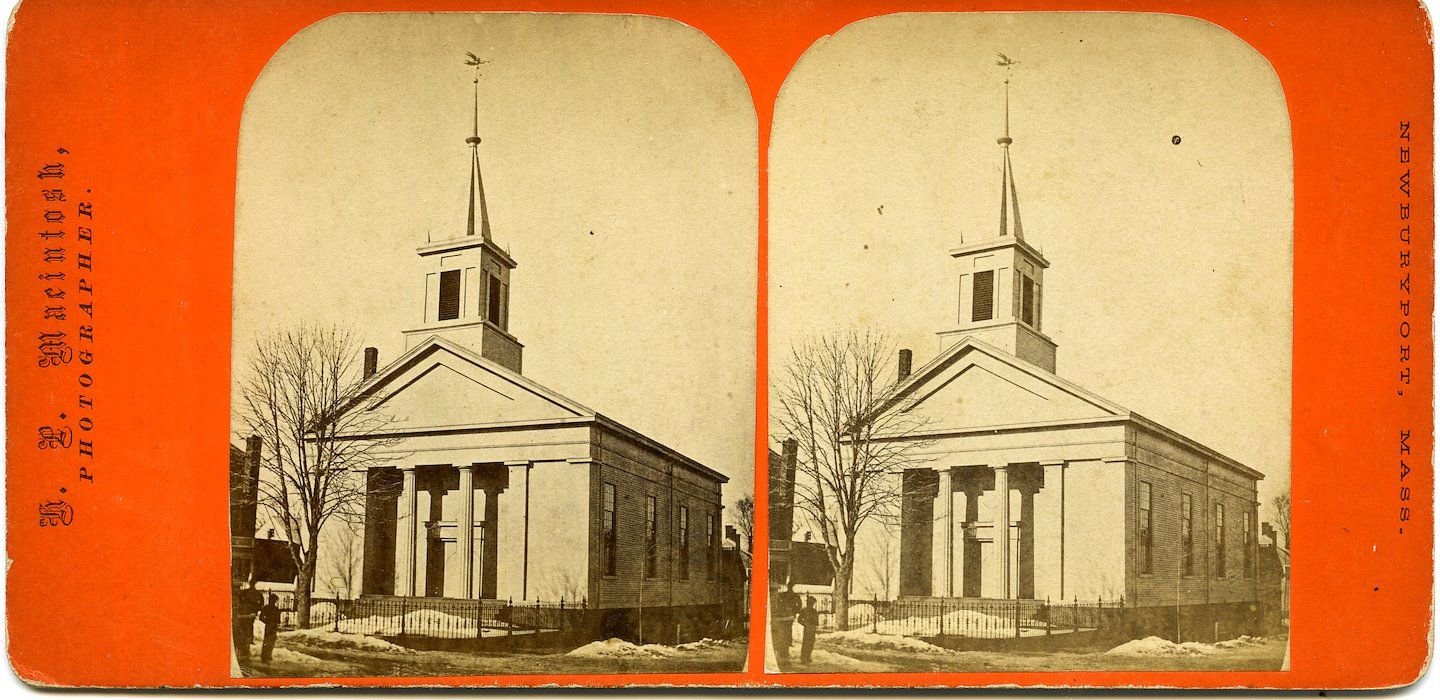
The Universalist Church, corner of Middle and Fair Street, where Louis Somerby’s funeral was held. By H.P. Macintosh, Museum of Old Newbury Stereoview Collection STE-0541, gift of Scott Nason.
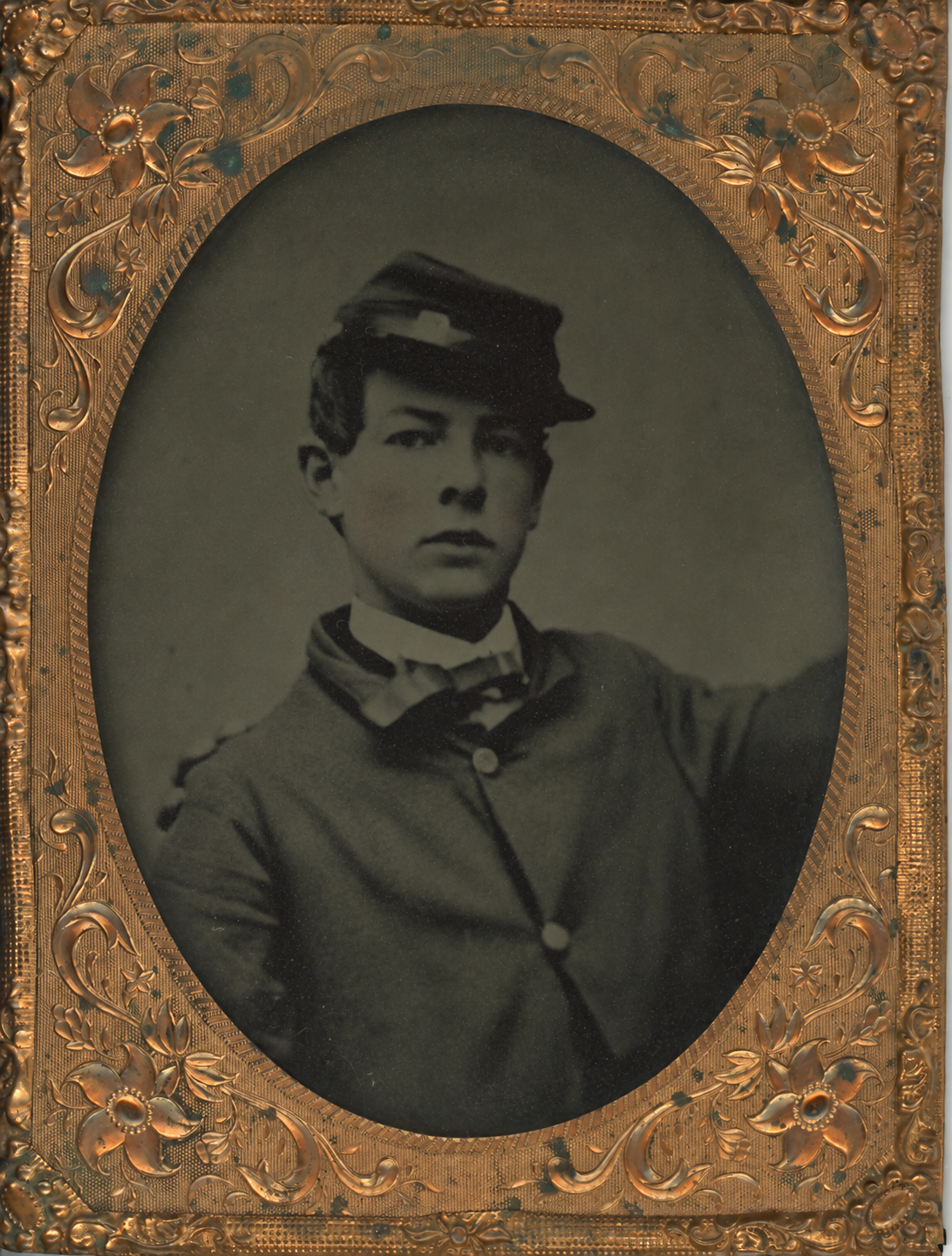
I believe this tintype to be from Louis Somerby’s second enlistment, as he is clearly a year older than the smaller ambrotypes. He is just month from the end of his life, and still just a child - a boy of 17, though he has now seen war and death and suffering. Look into his eyes. This boy will stay with me for the rest of my life.
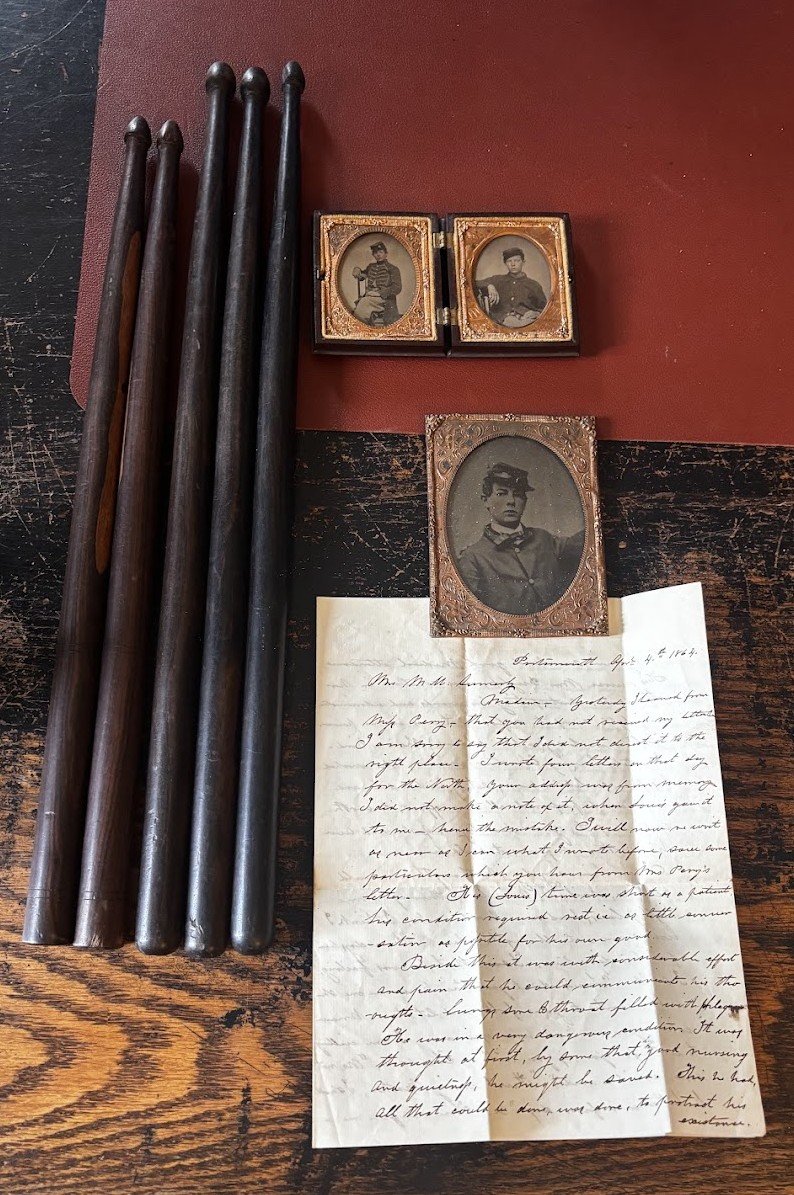
In his letter to “Friend Lawry”, Abram Somerby asks, “will you please to see that all of (Louis’) things are sent to us, and in particular his drum, for his mother prizes it very highly for his sake”. Nurse Perry also notes that the nurses attending Louis had cut a lock of Louis’ “pretty brown hair”, and would send it to the family. Perhaps these items will find their way back to us someday, but they point to how much meaning we find in personal objects, especially when we suffer a great loss. I picked up the pair of drumsticks on the left, worn to the core wood on the inside. I thought of Louis’ hands holding them, beating out orders amid smoke and shouting, how much his mother must have thought of her boy whenever she saw them. They are imbued with the loss of this young life, and forever part of the story of our community.
Two months after Louis Somerby’s death, the editor of the Newburyport Herald was still unsettled by his loss. He noted that Somerby “was one of the bravest lads that has entered the army, and much interest was felt in him by persons in the service and at home”. A friend had given him this poem, he said, which he felt captured his sense of loss. This sentimental poem, based on words spoken by a dying Union soldier, was printed in several different version and made into a popular ballad in 1863, and it is certainly not a piece of high literature. I share it with you because it captured an element of the grief in our community on the death of this boy.
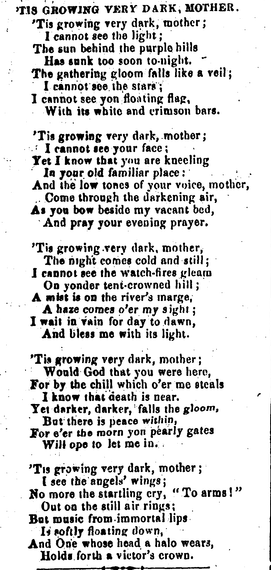
’Tis growing very dark, mother;
I cannot see the light;
The sun behind the purple hills
Has sunk too soon to-night.
The gathering gloom falls like a veil;
I cannot see the stars;
I cannot see yon floating flag,
With its white and crimson bars.
’Tis growing very dark, mother;
I cannot see your face;
Yet I know that you are kneeling
In your old familiar place:
And the low tones of your voice, mother,
Come through the darkening air,
As you bow beside my vacant bed,
And pray your evening prayer.
’Tis growing very dark, mother,
The night comes cold and still;
I cannot see the watch-fires gleam
On yonder tent-crowned hill;
A mist is on the river’s marge;
A haze comes o’er my sight;
I wait in vain for day to dawn,
And bless me with its light.
’
Tis growing very dark, mother;
Would God that you were here,
For by the chill which o’er me steals
I know that death is near.
Yet darker, darker, falls the gloom,
But there is peace within,
For e’er the morn yon pearly gates
Will ope to let me in.
‘Tis growing very dark, mother;
I see the angels’ wings;
No more the startling cry, “To arms!”
Out on the still air rings;
But music from immortal lips
Is softly floating down,
And One whose head a halo wears,
Holds forth a victor’s crown.
For my part, I will leave the last word to Louis Somerby. “I have been through some tight places, had some hard knocks…”
Thanks to the kind care and generosity of your family, and the commitment of this community to the mission of the Museum of Old Newbury, we will remember you, dear boy, a “youth of lovely Spirit, gentle as a lamb”.