
Marriage, Money and “Mercer Maids”: A Sort-of Stickney Story
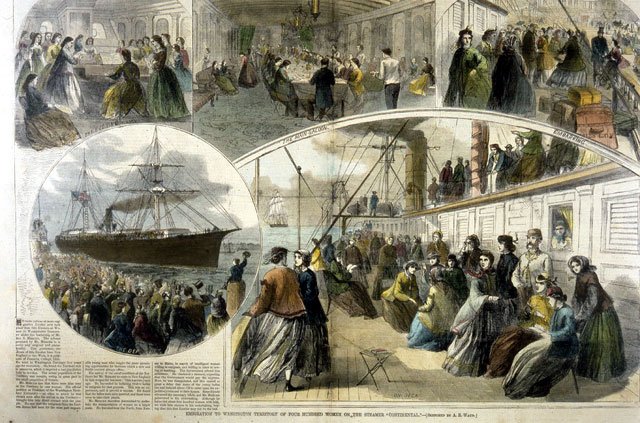
Hello, friends. In our last newsletter, I shared some connections with Seattle unearthed on a recent weekend trip. Several of these connections, a line-up of Newbury(port) names - Stickney, Coffin, Ordway, Pearson, led me to the so-called Mercer Girls, or Mercer Maids, two groups of (mostly) women brought to Washington Territory at the behest of the charismatic and entrepreneurial Asa Mercer.
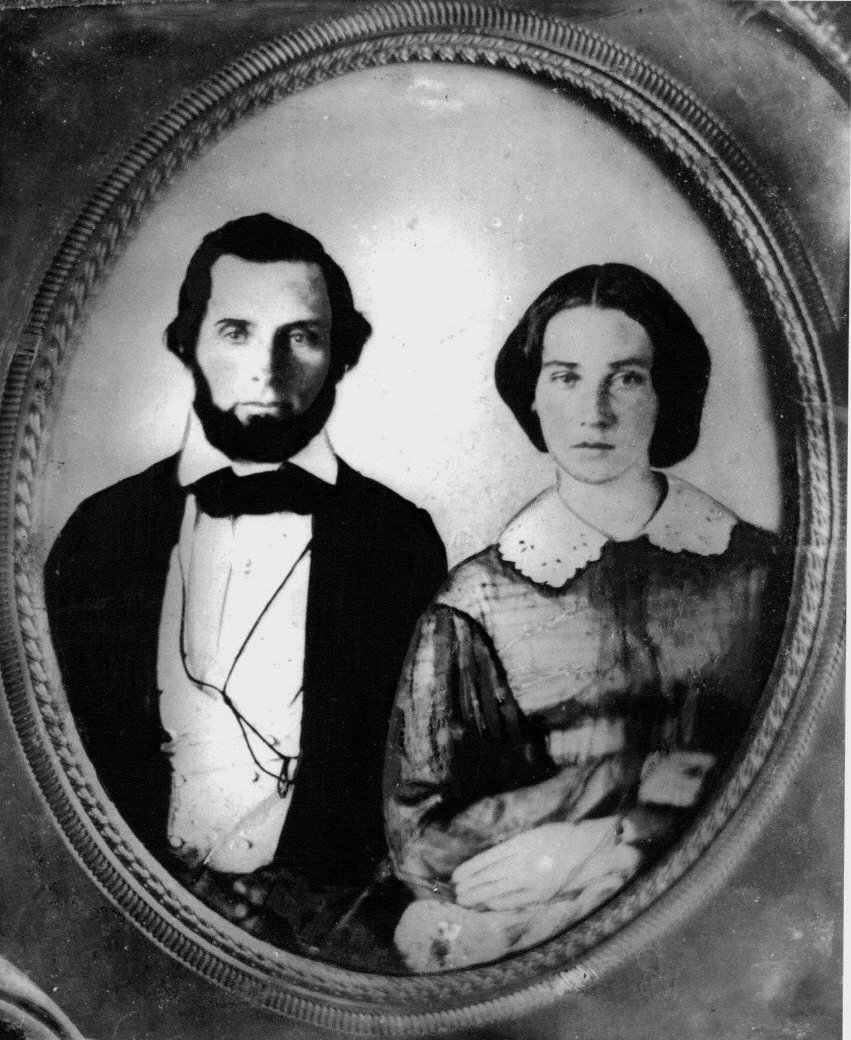
I will admit that the Stickney family is especially present in my life right now. From my research adventures with the lusty Widow Stickney in the 17th century to Stickney’s, the little shop around the corner from my house in Newburyport beloved by my children and now long gone, to my barn cat, Stickney, and heaps of emails and research requests from worldwide Stickney cousins, I fully expected that it would be Kate Stickney, the Lowell mill “girl” who made the journey in 1864 at Mercer’s behest, married widower Walter Graham (right), and died just five years later.
But oh, my friends, these stories do lead in some interesting directions. For a start, Kate Stickney is not a Stickney at all. She was born Catherine Adams…
And this is where a story that I thought was going to be a tidy tale of westward ambitions turns into something more complicated. But first, a brief recap of Mercer machinations is in order.
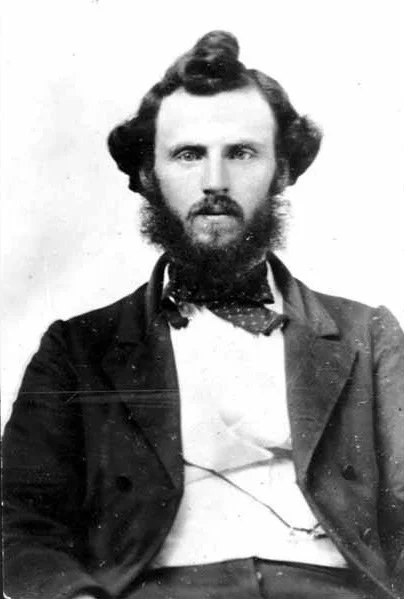
Illinois-born Asa Mercer, an ambitious 25-year-old tutor in the fledgling settlement of Seattle, had a problem, and it was the same problem as most of his friends. There were very few women in the area at the time, and quite a few men.
Mercer devised a solution to the problem that would also make him some money. Though he tried, and failed, to secure government funding for the importation of women, he was undeterred, and set off for Boston. Finding proper, marriageable Bostonians unwilling to follow him back to Seattle, Mercer went to Lowell, where the Civil War had decimated the economy and the male population. I’ll let the Lowell Daily Courier of January 27, 1864 take it from here.
“Mr. Mercer of Washington Territory gave his promised address last evening to a fair audience… His account of this young and rising territory, scarcely in its teens, but full of ample resources, only awaiting development, was listened to with evident interest. Mr. M. has resided some three years on the border of Puget’s Sound . . . Government has made liberal provision for educational purposes by grants of land, and considerable progress has been made, but there is a great want of teachers, and it is Mr. Mercer’s purpose about the middle of February to return with a company of recruits for this service, promising remunerative employment immediately on their arrival. Persons who are accepted will be required to pay their passage to San Francisco only. Beyond that point Mr. M. will be responsible for expenses…”
Mercer’s recruitment plan was quite specific. He spoke at the Mechanics Hall and Unitarian Church and emphasized teaching, a way to tilt the scale towards younger, well-educated, New England-born women. He was careful not to reveal his core mission, however. Note that marriage is not mentioned once in the above summary. One of the young women present at this speech, and who made a later journey with Mercer, Flora Pearson, noted that Mercer made no mention of “matrimonial advantage” as he recruited young women in Lowell. His “appeal was to the pocket,” she said. There was work and opportunity. We’ll get back to the Pearsons in a moment. For now, let’s return our gaze to Kate Stickney, a dressmaker from nearby Townsend, sitting in a pew (or perhaps a seat in Mechanic’s Hall) in Lowell in 1864. You may imagine her as a fresh-faced young school-teacher, eager for adventure. In the image above, Kate is young and pretty, sitting with her new husband after the long journey west. It came as a bit of a shock to me, therefore, that the widower Walter Graham was her THIRD husband, and that both of her previous husbands were still alive.

Here’s where Catherine Adams becomes Kate Stickney. On February 27, 1856, age 20, she married 23-year-old Alvah Stickney, a cooper, in Lowell. Her mother had died when she was 2 years old, and so her father Samuel is listed as her only parent.
It is not clear when things went wrong, but in his divorce petition, filed in the Middlesex Court in October, 1861, Alvah Stickney declared that although he was a “faithful, chaste, and affectionate husband”, Kate had deserted him just two months after their marriage, last sharing his bed on April 28, 1856. He does mention that she returned between April and August of 1861, and then, when she took off again, he filed for divorce.
Kate Stickney’s second marriage is a phantom. Several months after her divorce, claiming, dubiously, that she had “conducted herself with chastity and propriety”, she “prays this Court to authorize her to marry again”. This petition was granted in October 1862. I was not able to find any information about her second marriage, though the Mercer Girls chapter of the DAR notes that her second marriage was confirmed, and her return to her first married name before her trek to Seattle two years later seems to bear out that this second marriage, too, ended in divorce or separation shortly after its inception.
I wonder if Kate was a romantic, a dreamer, flighty, unreliable, or a hard-working striver who had repeatedly hitched herself to disappointing men, a sinner or a saint, or more likely, as with most of us, an unstable mix of all of these. As much as we can gather of her brief and eventful life, we know that after her father died and she was truly an orphan, she sold a piece of property she had inherited from him to pay the steep $250 that Asa Mercer was charging his passengers, and then Kate and ten other women and two men made their way to New York.
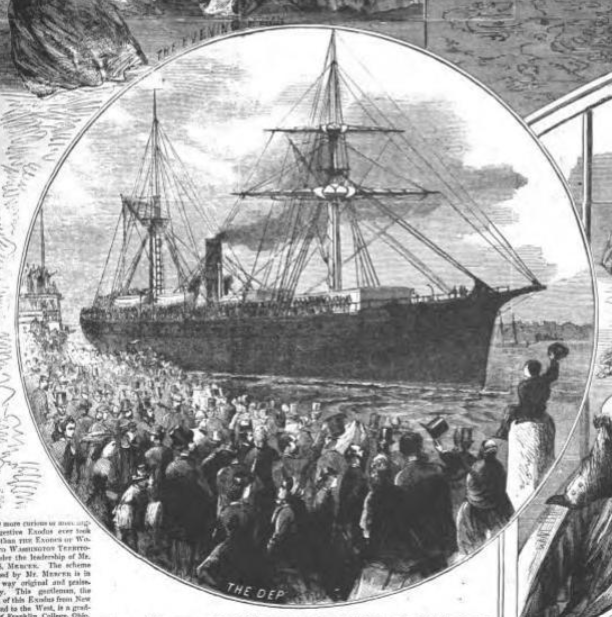
This illustration, from Harpers Weekly, is of the New York departure of Mercer’s second group of travelers in 1866. There are no images of the first voyage.
According to historian Peri Muhich, Kate Stickney was joined in New York by the ten other women and two of their fathers. Mercer’s passengers read like an Old Newbury phone book, all but two descended from families with ancestral ties to Newbury(port) and Salisbury. In addition to Kate Stickney, age 28, the group included:
Antoinette Josephine Baker, age 25
Sarah Cheney, age 22
Aurelia Coffin, age 20
Sara Jane Gallager, age 19
Ann Murphy, age unknown
Elizabeth (Lizzie) Ordway, the oldest at age 35
Georgianna (Georgia) Pearson, age 15
Josephine (Josie) Pearson, age 19
Daniel Pearson, age 46
Catherine Stevens, age 21
Rodolphus Stevens, age 45
If Kate Stickney was looking for adventure, she certainly found it, as the group landed in Panama, crossed the isthmus by train, and then were delayed by a week in Panama City before arriving at last in San Francisco. Mercer hired a lumber transport there, and a schooner for the last leg of the journey. At long last, Kate Stickney and her weary companions arrived in Seattle at 11 p.m. on May 16, 1864.
Whatever else we could say about Kate Stickney, she was an optimist - or, more likely, a pragmatist, and she married widower Walter Graham within two months. Though she lived for another five years, there is scant record of how she spent those years or how (or when) she died. Her headstone, which she shares with Walter Graham’s first wife, gives her death as 1868. Other genealogies give her death as January, 1869. She is buried in Seattle as Catherine Graham.
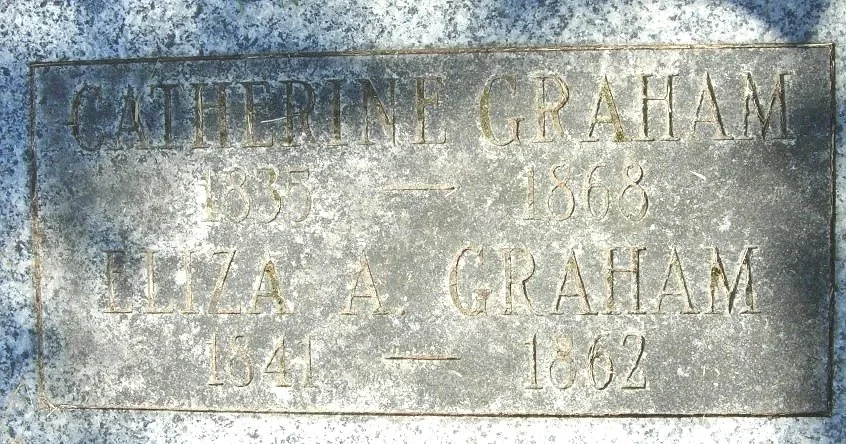
Kate Adams Stickney, now Catherine Graham’s memorial stone in Lake View Cemetery, where it was moved from the Old Seattle Cemetery.
This, as I have said before, is the beauty and the sorrow of research for me. I began this article thinking only that I would do a little bit on the genealogical connections between Kate Stickney and the Stickneys of Newbury, but two days and a blown newsletter deadline later, she is not a Stickney, nor a Newbury Adams even. She is no relation of mine, but her abandoned Stickney husband, Alvah, is my 5th cousin, 3x removed, several times over.
Still, I have loved following this restless, motherless dressmaker across the continent as the Civil War raged. I am sad that her life ended without remark in the historical record. I crave some closure, and given her track record, I can fantasize that she didn’t die after all, but tired of being housekeeper and stepmother to a family she had joined in haste, she skedaddled from Seattle with a husky lumberman, the story of her death concocted to save face. It doesn’t bear scrutiny, of course.
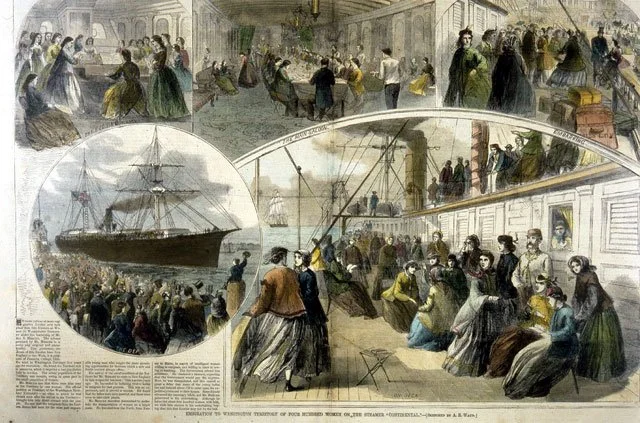
On Thursday, July 27, 1865, the Newburyport Daily Herald had a lot more to say about the machinations of Asa Mercer than it had the year before. The news of the first Mercer journey had spread. In the tumult that followed the bitter end of the Civil War (Confederate General Robert E. Lee had surrendered his army just three months earlier), with over 600,000 dead, mostly men, Mercer’s second recruiting drive had more female takers. He had also worked out how to make money on both sides, taking a paid subscription back home from men eager to make the acquaintance of New England women, and then charging these women for passage back to Washington Territory. The women on this second voyage were recruited from all over the East Coast from New England, New York, and Philadelphia.
Though the spread in Harper’s Weekly above called the endeavor “in every way original and praiseworthy,” the Newburyport newspaper was downright nasty about the entire affair.
“Through the agency of a Mr. Mercer of Washington Territory, aided by Governor Andrew of this State, the government has granted the use of the steamer DeMolay to transport three hundred lady passengers to Aspinwall, whence they will be taken across the Isthmus and up the coast to Washington territory, the whole voyage to be entirely free. The steamer will sail from New York, on the 20th of August. The emigrants are promised when they get to Washington, good wages to be paid in gold, and have the added endorsement of probable marriage within three months, if they wish. We are not sorry that such a cargo of live stock is to be taken to Washington territory, for those who would volunteer to go, under such circumstances, are of the class that can well be spared, and might be put to a better use there than here. We are somewhat surprised, however, that President Johnson should loan a government steamer for such a purpose.” (emphasis mine)
In addition to being insulting on many levels, the article is inaccurate, but the sentiment was shared widely. The New York Herald reported that women were being lured under false pretenses and were actually doomed to a life of prostitution or marriage to old men when they disembarked in Seattle. Mercer later blamed this story for scaring off two-thirds of his prospective recruits. Others pointed out the logical flaw in asking women to journey west to teach children while at the same time arguing that there were not enough children in Washington Territory because there were no women. Mercer had hoped to bring 700 women west, but in the end, only 34 unmarried women made the full trek. There were constant delays, storms at sea, and the long 96-day voyage around Cape Horn, rather than the shorter, if also harrowing, journey across Panama that Kate Stickney and company had faced. By the time his party reached San Francisco, Mercer was broke, and the group stalled there as Mercer tried to find transport. In the end, some women stayed in California, others were put aboard lumber vessels in small groups, and made the journey up the coast scandalously unchaperoned.
What is clear from the original source material of the first voyage is that, though marriage was often the result, Mercer’s successful pitch was not that he would help women find a husband, but that he would help them find a job. By the second voyage, though he still leaned into the message of economic opportunity, Mercer was also willing to offer matrimony as a side benefit, should the women wish it.
The much-publicized, much derided 1866 journey of the “Mercer Girls” or “Mercer Maids” has sparked the American imagination ever since, often playing hard into the assumption that young women had only young men on their mind when setting out from the East Coast. The experience of these women is much more complex, of course, and worthy of more individual study. I’m looking forward to learning more about the Pearson women, who wound up as lighthouse keepers, Lizzie Ordway, who toured with Susan B. Anthony, and Antoinette Josephine Baker, the first female school superintendent of Cowlitz County, Washington. For now, here are hilariously and wholly inaccurate renditions of this story from 1957’s “Death Valley Days” television program, and the promo for the 1968 show “Here Come the Brides”. Enjoy!