
Debility and Responsibility in the 1671 Death of Elizabeth Poore Jackson
by Bethany Groff Dorau

This undated Newbury winter scene is part of the Fran Dalton Collection. I am using Dalton’s images throughout this piece to set the scene for this case.
On Sunday, November 8, the Purinton family allowed us to open the doors of the Pearson Tavern one more time for Tales & Ales, a follow-up to the incredible adventure of Cocktails in the Colonies a month earlier. At that event, I had intended to present an interactive reading of 17th century court cases, which, though it may sound a bit dry and academic, is about the most fun I think I ever have. I pulled records from the Byfield area, tried to find any juicy cases involving the Pearson clan (they were surprisingly well-behaved), and was ready to stage a court session, but the party was spread out, everyone was chatting, and the decision was made to let the evening roll at its own pace.
I mentioned to the Purintons that I was a little sad not to have shared my research with them, and thus the second event was born, structured entirely around witness statements from 17th century Essex County. This event is for you, our members, of course, but selfishly, it’s also for me. I love going back into 17th century court records from this area. I have been doing this work for so long that it is easy for me to read 17th century handwriting and suss out their often hilarious phonetic spelling.
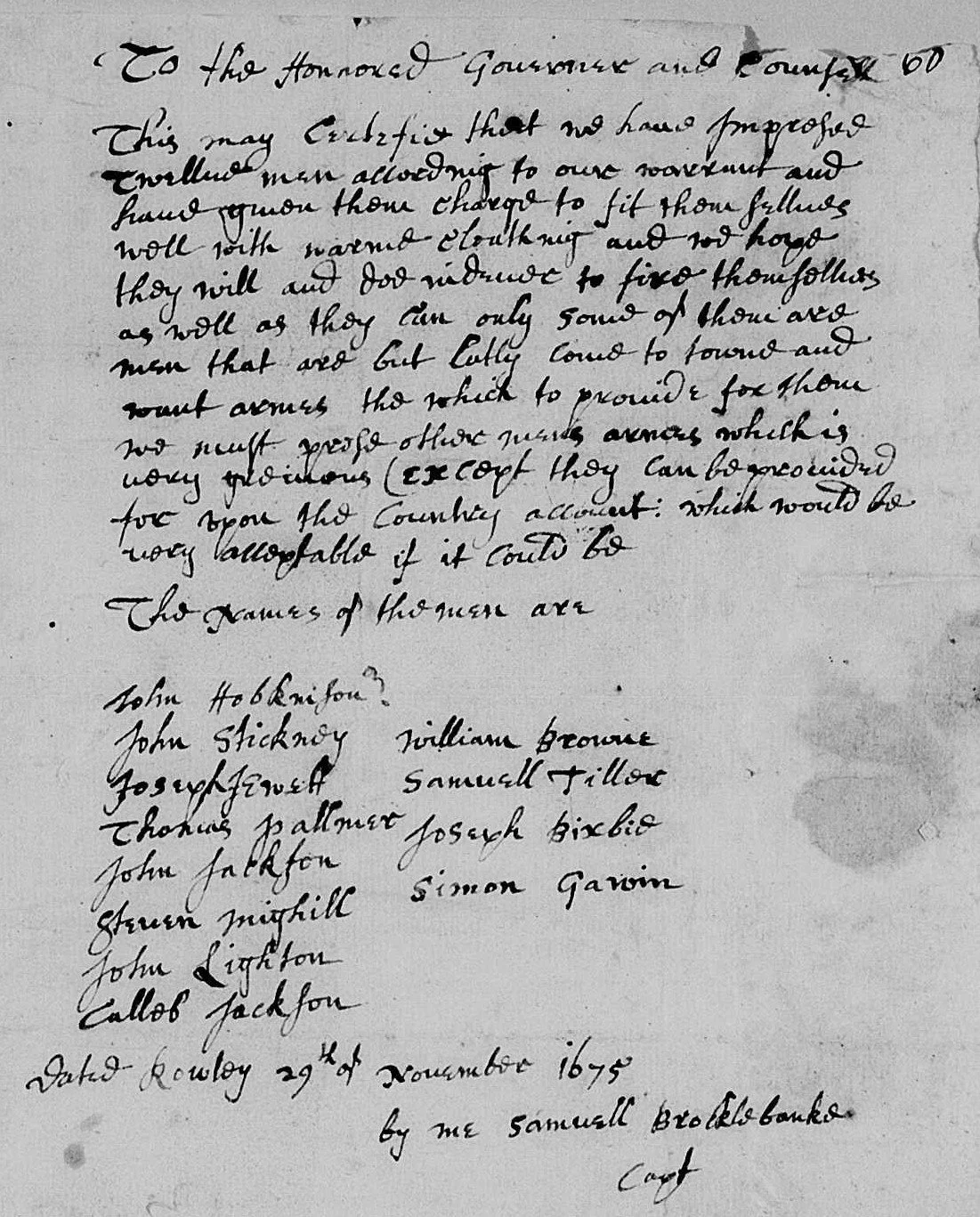
This 1676 document, a verification that twelve men were impressed into military service in Rowley, is a typical 17th century record. Note the spelling of “Caleb” as Callob”, and “Counsell” for “Council”.
It reads: “To the Honored Govirnure and Counsell
This may Certifie that we have impresed
Twellue men according to oure warrant and
have given them charge to fit them sellves
well with warme Cloathing and we hope
they will and doe indever to fit themsellves
as well as they can only some of them are
men that are but lately Come to towne and
want armes the which to provide for them
we must presse other mens armes which is
very grievous (except they can be provided
for upon the Countrys account: which would be
very acc[e]ptable if it could be.
Note that John Jackson, long a resident of Rowley, is one of the twelve men that cannot afford a weapon.
I generally begin with the blessedly transcribed volumes of the Essex County Quarterly Court records, which were compiled, transcribed, and edited by George Francis Dow between 1911 and 1921 and published through the Essex Institute in Salem. Though the typed records are far easier to read in most cases, the original spelling was kept, along with the often disjointed testimony and proceedings of a particular case.
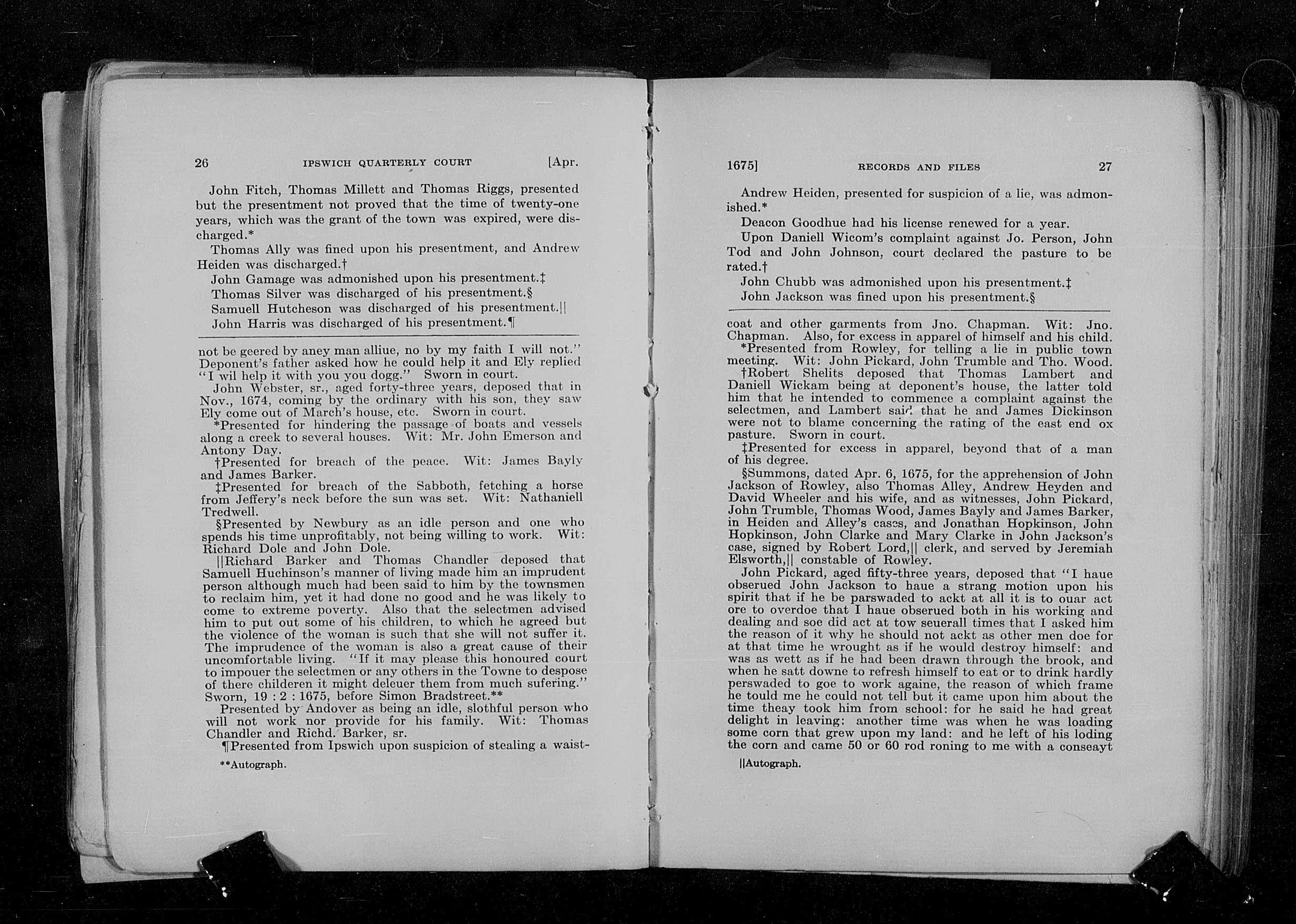
Over the twenty years I have been perusing these records, I have a system down. I read everything quickly, often pausing to laugh out loud or savor a particularly tender or illuminating detail. Every page is a wonderland for me. On this one page, we find people testifying about Samuel Hutchinson’s “manner of living”, which “made him an imprudent person”. When he was told to send his children out to work as servants, he said he would but “the violence of the woman (his wife) is such that she will not suffer it…” High-five to Mrs. Hutchinson for protecting her children. Someone called someone else a “dogg”. John Chubb’s clothes were too fancy, and he was fined. Liquor licenses were renewed, Sabbath breaking and clothing theft and lying were punished, all rather typical stuff for these sessions. On page 27, I saw John Jackson being issued a fine. In this case the story began with the punishment, which always piques my curiosity about the crime. The rest of the case unfolds in more-or-less chronological order, beginning with the summons.
“Summons, dated Apr. 6, 1675, for the apprehension of John Jackson of Rowley, also Thomas Alley, Andrew Heyden and David Wheeler and his wife, and as witnesses, John Pickard, John Trumble, Thomas Wood, James Bayly and James Barker in Heiden and Alley’s cases, and Jonathan Hopkinson, John Hopkinson, John Clarke and Mary Clarke in John Jackson’s case, signed by Robert Lord, clerk, and served by Jeremiah Elsworth, constable of Rowley.”
I knew immediately that this case would be a memorable one. The first witness statement (I have updated the spelling for ease of reading), is a fascinating description of a person whose behavior is puzzling and worrying to their friends and neighbors.
“I have observed John Jackson to have a strange motion upon his spirit, that if he be persuaded to act at all, it is to overact or to overdo. That I have observed both in his working and dealing, and so did act at two several times that I asked him the reason of it, why he should not act as other men do. For at that time he wrought as if he would destroy himself, and was as wet as if he had been drawn through the brook, and when he sat down to refresh himself to eat or to drink, hardly persuaded to go to work again. The reason of which frame he told me he could not tell, but it came upon him about the time they took him from school, for he said he had great delight in leaving.
Another time was when he was loading some corn that grew upon my land, and he left off his loading the corn and came fifty or sixty rod running to me with a conceit that I would be persuaded to abate him two shillings of that for which we had agreed. To my wonderment at him so to leave his oxen and corn, and in the meanwhile the oxen threw the cart over and ate part of the corn. All which considered, to me it appears he hath not the use of his reason as other men.”
As an opening statement in a case, this was terribly intriguing. John Jackson seemed to be exhibiting some odd behavior, and the closing line, “it appears he hath not the use of his reason as other men”, set the stage for the unfolding of a case I will never forget.

The next witness statement, jointly given by brothers Jonathan, 32, and John, 28, Hopkinson (really? Are there really no other names available?) began with this ominous line. “The day that John Jackson’s wife was lost…”
John Jackson had gone to the Hopkinson brothers, who were connected to Jackson by marriage, in a howling snowstorm, to look for work. Astonished and concerned that Jackson was out in the terrible weather, they told him that he should go home to his wife. Jackson said she wasn’t there. The brothers pressed him - how he knew that she had left the house? He said he had looked around in the barn. Had he looked in the chamber or cellar? He said he had, but they did not believe him. Jackson waved them off, saying that his wife was “distempered in her head, and she had gone home to her father Poor(e).”
As many of you know, I am a Poore of Poore’s Lane, spelled with and without an “e” through the centuries. Elizabeth’s name in her marriage record is spelled Poore, so I use that here. Our family, though it has many branches, inherited this name, this identity, most recently from our Newbury forebears. I went to the family tree, and found John Jackson’s wife, Elizabeth Poore, and my heart sank.
Does the fact that the woman “lost” (I did not yet know what this meant) was a Poore matter in the grand scheme of things? Of course not. A life is a life, but we humans like to make connections, and a family name is a powerful thing. Elizabeth Poore is my first cousin, albeit eight generations ago, and I immediately knew exactly where she was headed when she set off in the storm to seek the safety of her father’s house, even the possible route she had taken.
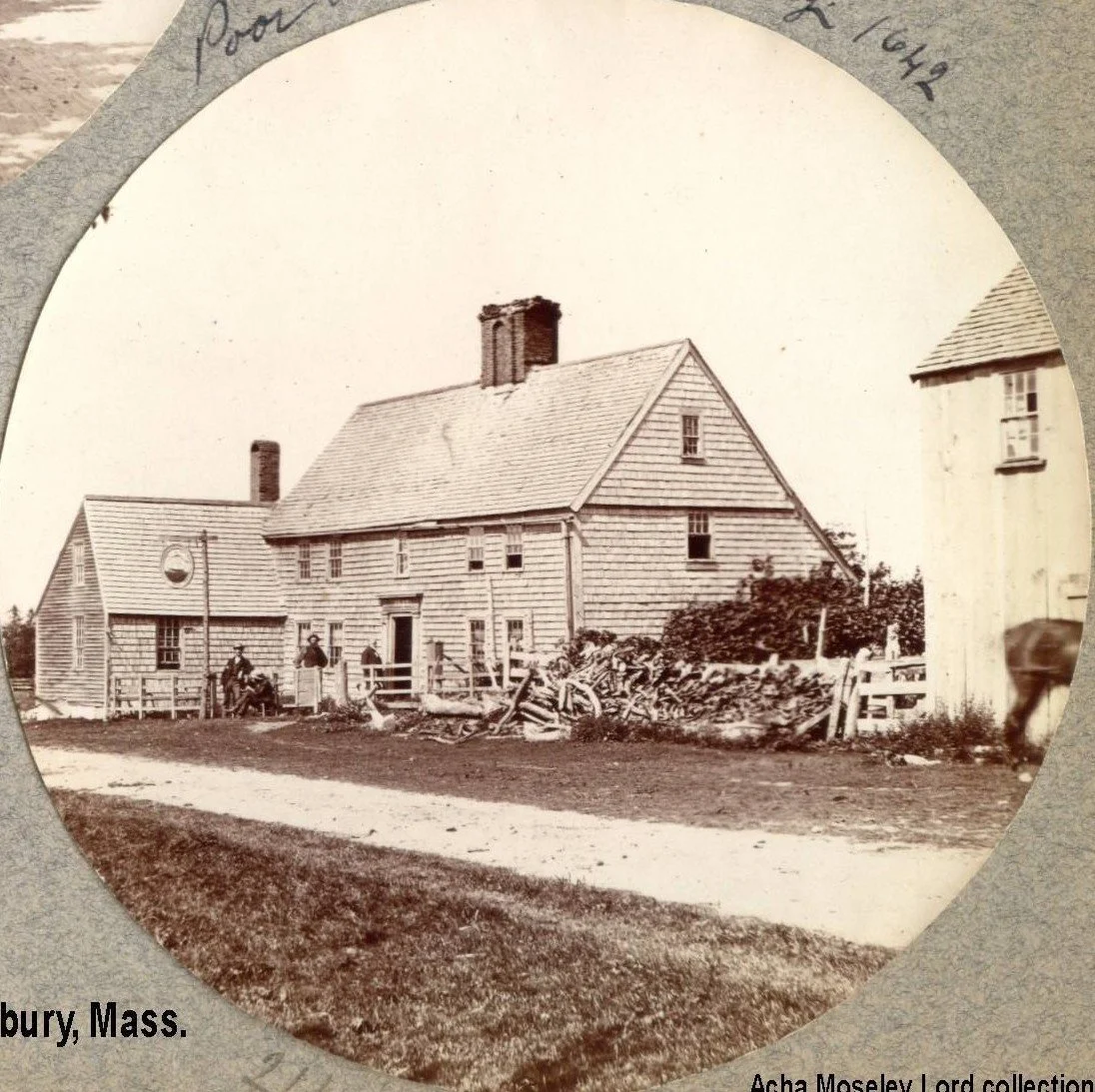
Elizabeth Poore set off from her house in Rowley bound for this house, the Poor house on Newbury Neck, later the Poor Tavern. It was a walk of 4.5 miles, the last mile or so through the frozen marsh.
Image c. 1895, from the collection of the Museum of Old Newbury, Lord/Cole gift
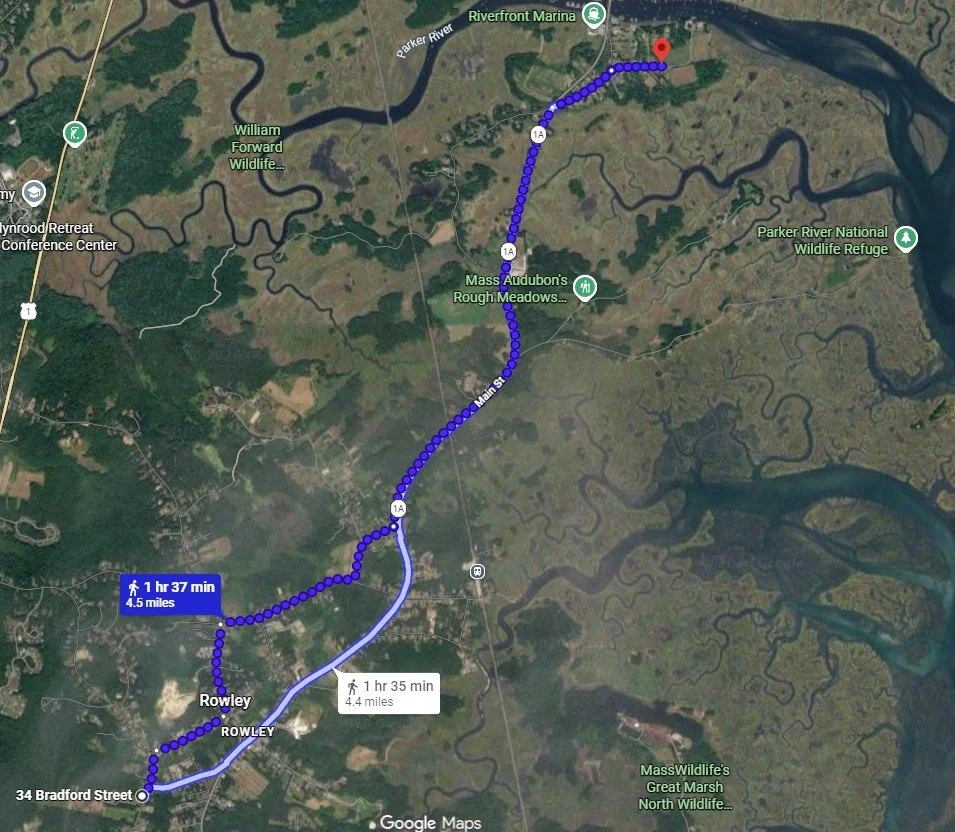
A modern map shows the route from Elizabeth Poore Jackson’s home on the Bradford Road (approx. 34 Bradford St today) to her father’s house off present-day Marsh Ave. It would take a person 95-97 minutes to make the trip today on modern roads. Elizabeth’s journey, on rutted tracks and through the snow, would have taken much longer.
The next witness statement, from thirty-six-year-old John Trumbull, step-brother of the Hopkinson brothers, returns to the odd behavior of John Jackson. Trumbull found his behavior at meals very disturbing. Jackson would “eat after all others had done, and…lick the crumbs left upon another man’s trencher (plate), to my shame, twenty persons looking on. Though of this and all other of his foolish tricks I never could perceive he was at all ashamed. All which saith to me, surely he hath not the use of his reason as other men.”
The picture was becoming more clear. John Jackson had some role in the loss of his wife, either because he failed to look for her or because of something more sinister. His extended family was appearing in court to argue that he did not have the capacity, and therefore was not able to bear the responsibility, for what had happened to his wife.
Mary (Poore) Clark, Elizabeth’s twenty-two-year-old sister, who lived on the Ipswich side of the Jackson home, testified next. John Jackson came to her house looking for Elizabeth. He mentioned that she might have gone to Newbury Neck. Mary, alarmed, told Jackson that he needed to go after her right away. Jackson said he had not eaten all day so he couldn’t possibly go look for his wife. Mary gave him some bread and pushed him out the door, telling him to get on his horse and find her sister. Jackson said he would, but Mary did not believe him. When her husband, twenty-four-year-old John Clark returned home two hours later, Mary told him to make sure Jackson had found her sister.
John Clark found John Jackson at home, having made no effort to look for Elizabeth, and telling Clark, the missing woman’s brother-in-law, that he had “other (things) to look after than to look for his wife’. Clark, in disbelief, said Jackson had to find Elizabeth, “the weather being so extreme”, and asked Jackson what people would think of him if he allowed his wife to come to harm. Jackson said he didn’t care what anyone thought. He was going to leave his wife and their infant son and hire himself out as a servant. Clark asked him who would take care of Elizabeth and their child, and Jackson told him essentially to get lost - “not to stand prating about his business”.
John Clark gave up on Jackson and set off into the storm to ensure that Elizabeth had made it safely to her father’s house. She was not there. John Clark, panicked, rode to her brother John Poor’s house, but he had not seen her either. The Poor(e) family gathered a search party of “ neighbors at the Neck”, led by Elizabeth’s brothers Henry and John Poor.

Elizabeth Poore Jackson’s brothers found their sister in the Rowley salt marsh. She had fallen, “upon her back with her arms spread out”, frozen stiff and barely breathing. Her brothers picked her up, but after they had carried her a short way, she died. They decided that rather than bring the young mother’s body home to Rowley, where she would have been laid out, washed, dressed, and mourned under normal circumstances, they would bring her to her father John Poor’s house in Newbury, the house where she was born twenty-four years earlier.
The last recorded statement to the court in this haunting case is more information from John Jackson’s parents.
“William Jackson and wife Joanah (Joanna) deposed that about fourteen or fifteen years since, their son was taken with an illness in his head and was struck with such a melancholy that it was thought that he was dead, and he spent one summer in this condition, acting as if bereaved of his understanding. Further, that he had never recovered fully, and Mr. Crosbie said that whatever he set about to do, no one could convince him to the contrary. Also that he had not the capacity to work at his calling.”
I was a little heartbroken by all of it, and went in search of answers. Some terms that are familiar to us were used in different ways in the 17th century, so I had to consider a variety of options. An “illness in his head” could be a fever, “melancholy” could be depression in the modern sense, but was also used to denote extreme lethargy, and he was so catatonic that “it was thought that he was dead”. Armed with these symptoms, I consulted with a few friends in the medical field. The diagnosis is a guess from a three century remove, of course, but the consensus seems to be that John Jackson had likely suffered from a meningitis or encephalitis that had caused a permanent brain injury. One friend, an outlier, insists that these symptoms follow adolescent-onset schizophrenia.
Whatever the cause, the community seems to have understood that John Jackson was impaired. It took four years for this case to catch the attention of the judges of the Essex County Quarterly Court, indicating to me that his neighbors in Newbury and Rowley had decided to let Elizabeth’s tragic death be left alone, even though it seems clear that Jackson had, if not caused her death, at least done nothing to prevent it. Perhaps a simmering feud or continuing gossip brought the case to light.
I wondered why, if John Jackson had been debilitated in this way since he was a teenager, he was able to marry and have a child. Wouldn’t his impairment have made him less appealing as a husband? I always look first at the date of the birth of the first child when evaluating a troubled marriage in the 17th century. A brief encounter between unmarried people, if it produced a pregnancy, often resulted in marriage in order to avoid a punishment for fornication, no matter how ill-suited the pair later proved to be. Their only recorded child was their son John, baptized on May 22, 1671. John and Elizabeth had been married for just over a year at the time, so a surprise pregnancy did not explain their union. The smoking gun, if there is one, may perhaps be found in the will of John’s father, William Jackson, in 1681.
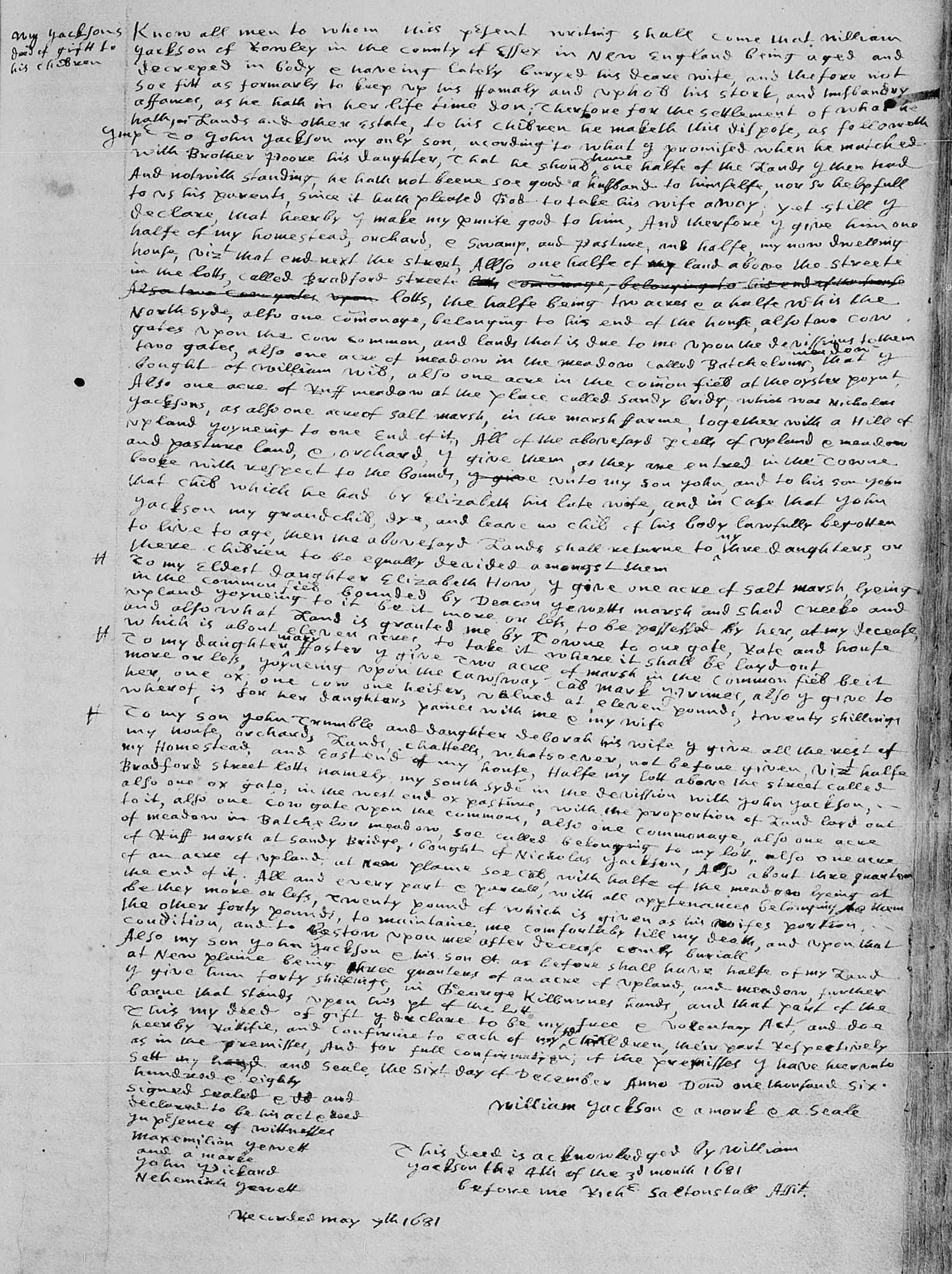
William Jackson, though not wealthy, was a man of significant property. John Poor(e) and his wife Sarah had property as well, but also had thirteen children, nine of them daughters. The Poores may have been eager to make a match for their middle daughter, Elizabeth with a well-connected and established family, even if their son was a tricky choice for her. Perhaps they loved each other and had made their own declaration, despite his challenges. Whatever the case, William Jackson had promised John Poor, who he calls Brother Poore in this record, that his daughter would be well provided for.
“To John Jackson my only son, according to what I promised when he matched with Brother Poore his daughter...he should have half of the movables and utensils standing...it hath pleased God to take his wife away, yet still I declare, that hereby I make my promise good to him, & give him one half of my homestead, orchard, & swamp, and pasture, and half my now dwelling house...one half of my land above the street in the little field, called Bradford street lots, the half whereof is that Northerly end...,also one acre of meadow in the meadow called reeds meadow, which I bought of William Wild, also one acre of meadow in the common field at the oyster point...Also one acre of Ruff meadow at the place called Sandy bridge, which was Nicholas Jacksons, as also one other salt marsh, in the marsh farm, together with a little upland joining to one End of it, All of the abovesaid parcels of upland & meadow and pasture lands, & orchards...I give unto my son John, and to his son John, that child which he had by Elizabeth his late wife...”
After the death of his wife, Jackson was called before the court periodically. On February 4, 1672, he was censured for breaking the Sabbath by cutting branches. On March 28, 1676, a grand jury accused him of a more serious crime. Jackson had stolen a neighbor’s hay by raking it into his field. When the owner confronted him, he beat him with a hay pole, a long stick used in a pair to transport hay stacks. One of the two witnesses named was Jonathan Hopkinson, who had told Jackson to stay home with Elizabeth on the day she died.
On July 19, 1692, John Jackson’s sister, Elizabeth Howe, was executed for witchcraft, dying on the gallows alongside Sarah Good, Rebecca Nurse, Susannah Martin, and Sarah Wildes. A month later, John and his son, John Jackson Jr., perhaps prompted by John Sr’s odd behavior and suspicious reputation, were accused of witchcraft along with another Rowley laborer, John Howard. By this time, John Jackson and his son were poor laborers, despite their inheritance.
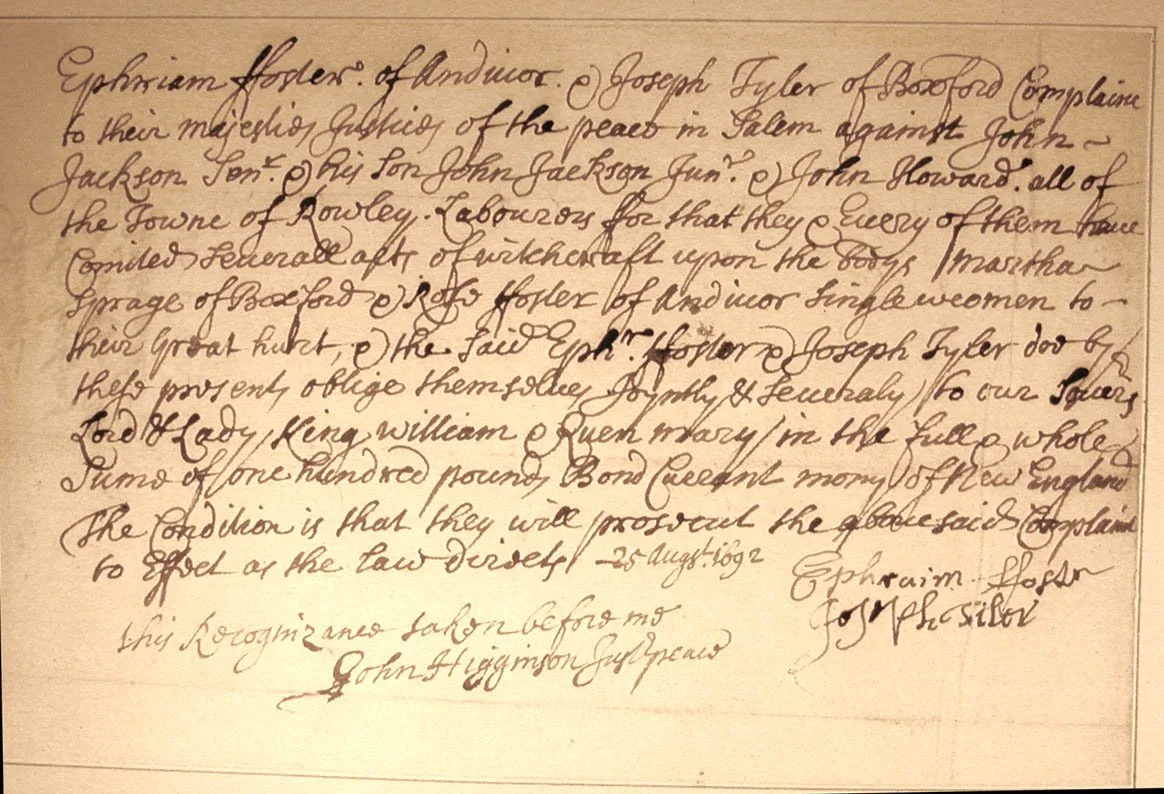
John Jackson Jr., just an infant when his mother died on the marsh, was about twenty-two when he and his father were arrested, was accused with his father of afflicting Martha Sprague and Rose Foster. When his examiners asked the elder Jackson why he afflicted these people, he denied it. He had been at work at Captain Wicom’s farm in Rowley, he said, when the girls said they were being tormented. Despite an alibi, father and son were imprisoned for more than four months. John Jackson Jr. confessed under terrible psychological, if not physical pressure, to practicing witchcraft, claiming that his aunt Elizabeth Howe had bewitched him. John Jackson Sr. maintained his innocence throughout the ordeal. In January 1693, as the hysteria began to wane, both men were released.
As I read through the transcripts of John Jackson’s witchcraft trial, I thought of all the people who weighed in on his mental state and culpability for the death of his wife. In Salem, as he listened to the accusations against him, it was Jackson’s turn to judge the state of the people around him. As his accusers screamed and fainted, claiming he was hurting them, Jackson argued that there was only one possible explanation for their behavior. “These persons was not in their Right mind,” he said.