
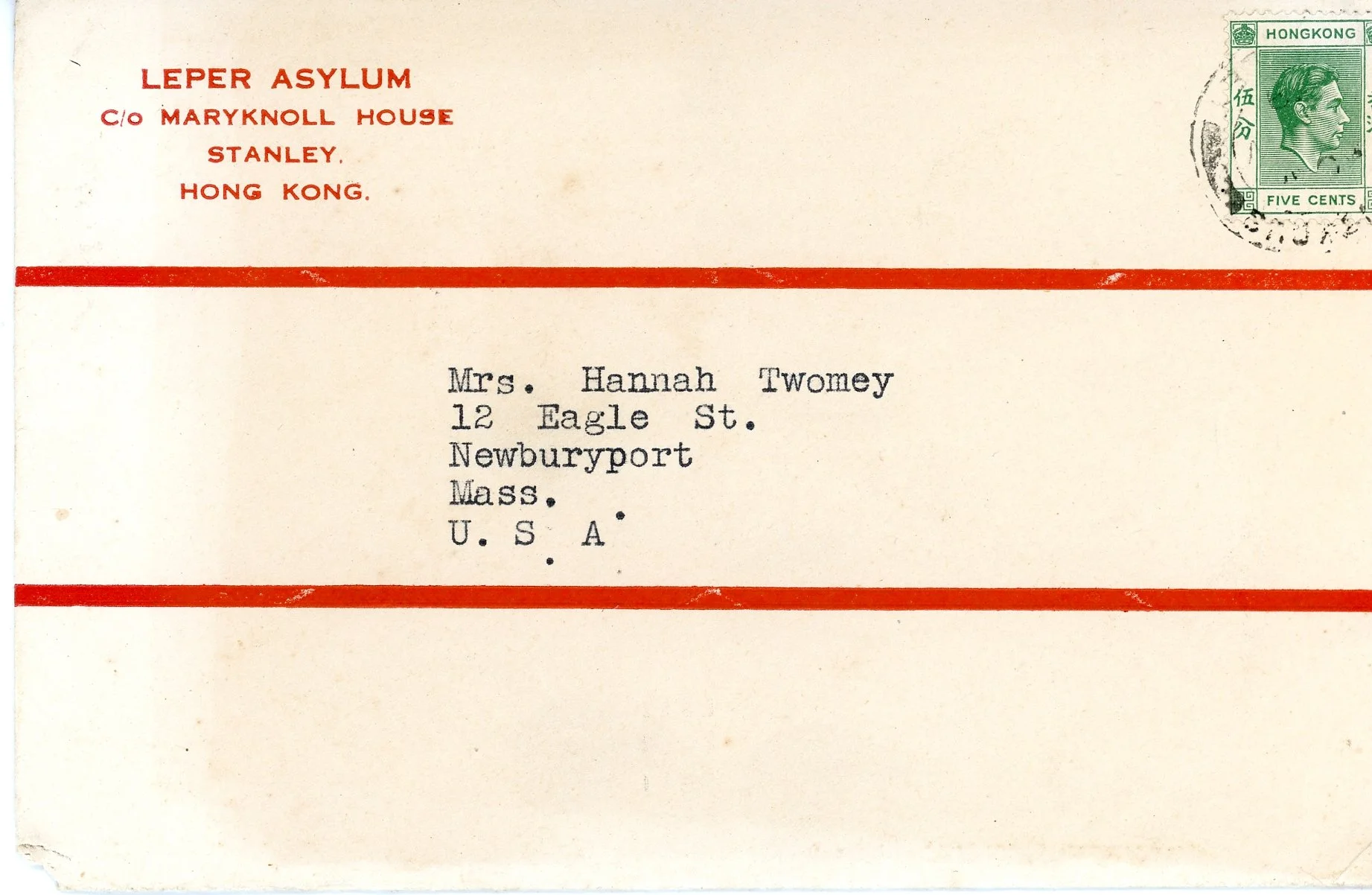
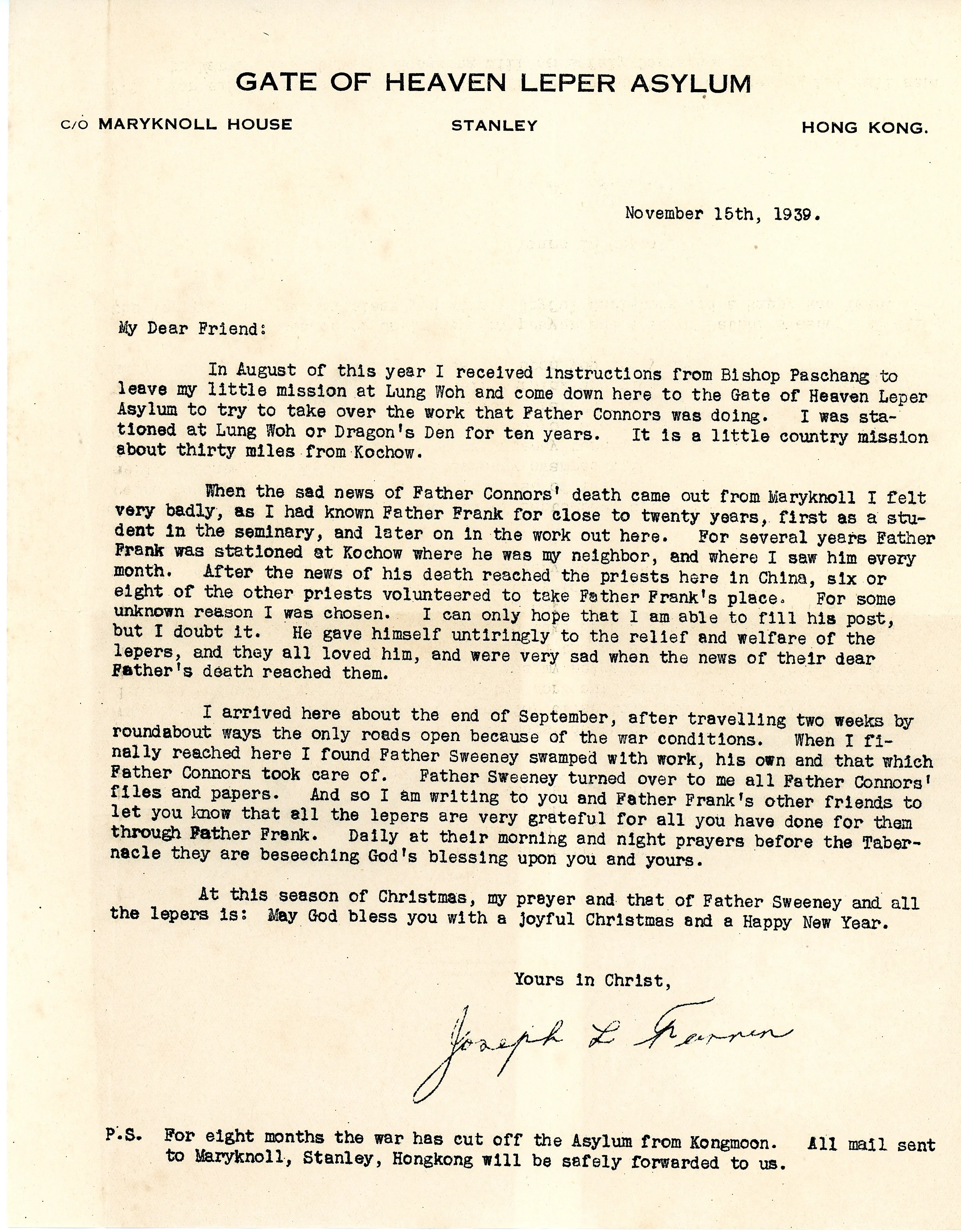
As a former MOON intern, I am used to mysterious items always finding their way to our doorstep. On one of my first days as a summer intern years ago an early 19th century sampler arrived from an unknown source, leading me to learn that from day one this place is always full of suprises. Once again I have been witness to the arrival of some surprising items to the museum. A few weeks ago the museum received an email about a collection of early 20th century Newburyport postcards and letters. A kind samaritan of Waltham noticed a trunk that had been on a trash pile outside her apartment building. She had gone through the mouse-ridden trunk and salvaged a small collection of postcards, photographs, and envelopes related to the Twomey and Cashman families. After contacting her local historical society, they directed her to the Museum of Old Newbury, due to the strong presence of those names in our town. We happily accepted the donation of various postcards and letter pieces. Amongst the saved pieces was one letter kept in pristine condition that stood out from the rest. The stationary immediately intrigued me, as the letter was typed on “Gate of Heaven Leper Asylum” marked paper. Of course, this find should have been no surprise as Newbury is the center of the world, no matter how far away. However, it was immediately interesting to me that someone in Newburyport had connections with humanitarian work occurring across the world, at a time of war no less.
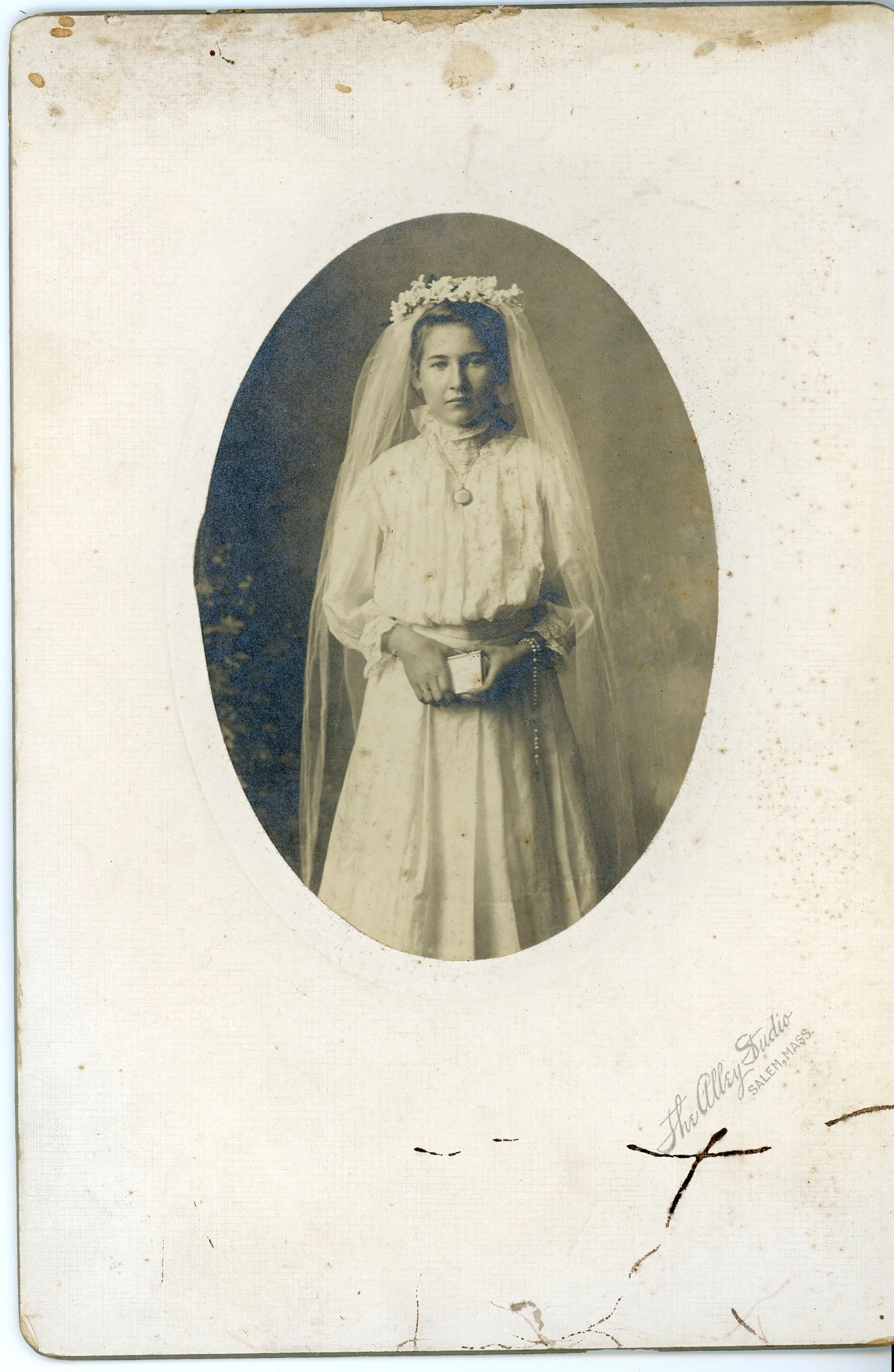
The letter was addressed to Hannah Twomey of 12 Eagle Street Newburyport from Joseph L Farnen, dated November 15, 1939. A brief genealogical search led me to find that she was born Hannah Cavin in 1865 in Salem to Irish immigrants. She married James Twomey of Newburyport in 1890 and they went on to live at Eagle Street in Newburyport. The collection of items included a photograph, signed Salem, MA depicting a woman in a wedding dress. This photograph potentially depicts Hannah Twomey herself, or another relative. Although, it is difficult to say for certain without further research.
In his letter Joseph explains he has recently arrived at the Gate of Heaven Leper Asylum to take over after Father Connors after his death. The death of his superior greatly affected Joseph, who hoped he would be able to “fill his post” well. The Gate of Heaven Asylum was operated by the catholic missionary group Maryknoll. The organization had been founded in New York and operated both a women’s and men’s organization, in addition to various charitable organizations.
The Gate of Heaven Leper Asylum occupied the the Maryknoll House In Stanley, Hong Kong. The asylum was dedicated to the treatment of those with leprosy (Hansen’s Disease), a debilitating though not highly contagious disease. The tradition of segregated leprosy hospitals or even separated colonies dates back to the Medieval era. These organizations existed until the 1940s and the discovery of a cure for the disease with the drug Promin.
Hannah appears to be a friend of another leader at the asylum, Father Frank. Joseph writes to thank Hannah for the work she has done for them. He closes the letter by wishing Hannah a “joyful Christmas” and “Happy New Year.” What intrigued me most about the letter was the hints Joseph gives to the ongoing war. Joseph comments on his travels throughout China, writing he arrived in Stanley after several weeks of travel due to only being able to journey through “roundabout ways” because of the “war conditions.” Joseph closes his letter stating that for eight months the war has cut off the Asylum from the city of Kongmoon (Jiangmen).
On July 7, 1937 Japan launched a full invasion of China after seizing Manchuria years prior in 1931. This conflict existed as part of the Second Sino-Japanese War, which later became a part of the greater series of conflicts during the Second World War. News of how Farnen and the asylum fared during the war is unknown until the very end. A New York Times article “Japanese Occupy Maryknoll Colony” was published on April 25, 1945 tells more of the story. According to the article by 1945, Rev. John Joyce of Scarsdale led the colony, assisted by a Rev. Joseph Farnen of Baltimore. What had been a small operation decades prior had now grown to caring for about 450 patients.The article states that “when the war and famine came, epidemics spread over the countryside.” Farnen likely found his care needed more than ever before at the asylum during a time of war.
The asylum was not spared from the war, as “Japanese troops have crossed the Ngai Moon River in southern Kwangtung Province to occupy and barricade the Maryknoll leper colony there, according to word reaching the Maryknoll fathers here.” Furthermore, according to the article “many of the lepers were slain by the invading troops.” However, Farnen appears to have lived up to his predecessor’s dedication to his patients, as it is claimed that “two American priests in charge of the colony and a group of lepers escaped into the mountains.”
While Farnen heroically evacuated and potentially saved the lives of his patients, it became difficult to treat the diseased in exile with limited resources. The NYT article continues to tell the story of the heroic missionaries as “[they] battled to control the epidemics but three-quarters of the lepers died of disease and undernourishment. There has been no complete check of the remaining patients who were slain by the Japanese or who found refuge in the mountains.” Further research led me to discover Maryknoll House was occupied by the Japanese and residents were moved to an internment camp in Stanley that housed almost 3,000. Farnen’s letter to Hannah in Newburyport shows a brief glimpse into this real heroic and also tragic story. Farnen had little idea of what was to come, or how great his impact might truly be.
No other letters survive from Joseph to Hannah that might help to understand more of the war’s impact on this organization or how they had come to know eachother.. This letter alone is still an incredible find and a valuable insight into a connection in history that would’ve otherwise gone unknown. Thanks to the work of an astute eye rescuing this letter from the trash we have one more story to tell about Newburyport and its connections around the world!