
As a newcomer to Newburyport, I began volunteering at the Museum of Old Newbury in the fall of 2024. I wanted to explore the history of this charming community that the ancestors of my late husband, Daniel Mason Huse, had helped to settle. Not long into my time at the museum, I heard rumors of a trove of Huse family material that had been donated to the Museum in 2016. I asked if I could explore and catalogue the contents of these boxes, and when the staff gave me permission, I dug in.
I had learned some of the Huse family history in the past. My husband had told me that Abel Huse, 10 generations back, had been among the first settlers of Newbury, arriving in 1635 on the ship John and Mary. On a trip together to Newburyport, we toured the City Hall, and discovered that two Huse family members had been Newburyport mayors in the late 1800s. And I knew that somewhere along the line, a Fred Huse had married an Emma Mason, giving my husband his middle name and my father-in-law, Mason Webster Huse Jr., (1928-2003) his first name.
Sometime before his death, my husband had also copied out a Wikipedia article on the notorious traitor of family and country - Caleb Huse (1831-1905) - which I had read with amazement. I learned that he was a former commissioned member of the U.S. Army and a West Point graduate, with armaments expertise, who had been tasked by top leaders of the Confederacy, including Jefferson Davis, its president, himself, to buy armaments for the Confederate army in Europe. And he had done just that. This despite the fact that he was born and raised in Newburyport, and had members of his family, including, among others, his half-brother Ralph Cross Huse Jr. (1843-1892) and a distant cousin Webster Day Huse (1828-1864), the latter a direct ancestor of my husband, serving in the Union Army.
I wondered what would induce this young man – he was just 30 in 1861 when he snuck out of a northern port to travel to Europe on his errand for the leaders of the Confederacy – to work for the Confederacy? I knew that he had been teaching at the University of Alabama at the time the war broke out, and it was rumored that he had married a southerner. Maybe that was it? His alliance with his wife and her family led him to throw his lot in with the South?
As I pulled documents out of the Huse family boxes in Perkins Archival and Research Center, suddenly I found myself holding a letter written by Caleb Huse himself! It was written in May of 1892, long after the end of the war, in his home in Highland Falls, NY, near West Point. Caleb Huse was at that time 62 years old. The letter was addressed and written to his half-brother Ralph Cross Huse, 12 years younger, a doctor, at his home in Georgetown, MA. Apparently, I learned from the opening lines of the letter, word had traveled to Caleb that his half-brother was ill and feared to be nearing death. Maybe this letter would help me understand what lay behind Caleb Huse’s actions during the war?
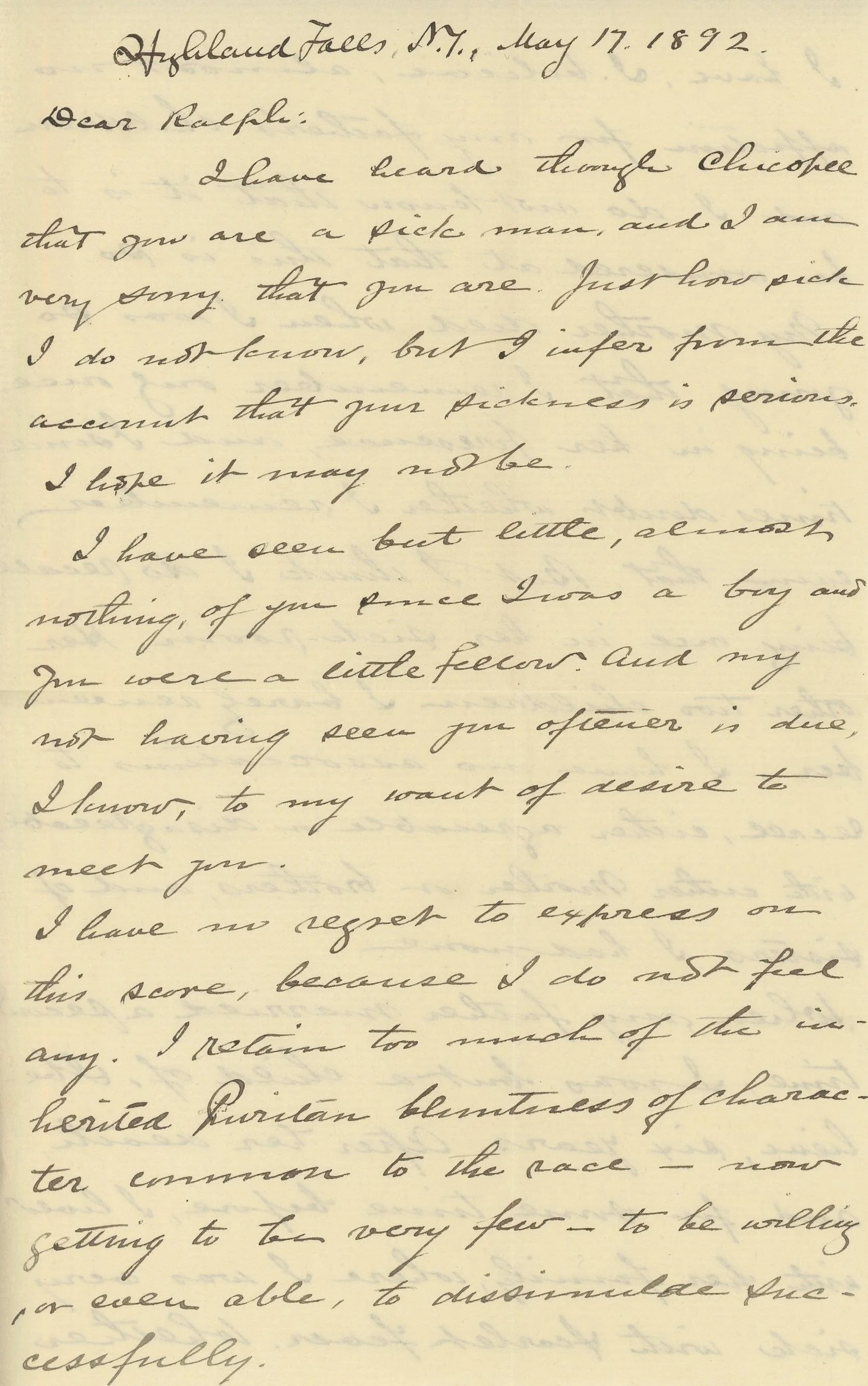
“I have seen but little, almost nothing, of you since I was a boy and you were a little fellow. And my not having seen you oftener is due, I know, to my want of desire to meet you. I have no regret to express on this score, because I do not feel any. I retain too much of the inherited Puritan bluntness of character common to the race - now getting to be very few – to be willing, or even able, to dissimilate successfully.”
Ouch, I think. These are the words of Caleb to his brother on his death-bed? These lines, granted, do at least come after he has expressed that he does hope Ralph will soon rebound from his illness.
The letter continues:
“I have, I believe, almost no affection for my father’s children, and I do not know that it is to be wondered at that this is so”
Wow. One wonders how these words came across to poor Ralph, if in fact he received it before his death.
Caleb continues by recounting to his brother the story of his childhood in Newburyport, which does not sound like it was a happy one. He states that he has no memories of his actual mother, Caroline Evens Huse, his father Ralph Cross Huse Sr.’s first wife, who died when he was 4. At age 6, in 1837, his father remarried, to Margaret E. Coffin. She died a year later, and when his father remarried a third time, to Sarah Stickney Barnard, his half-brother Ralph’s mother, Caleb went to live with the Coffin family in the Coffin house. He remembers that house, and his time with the Coffins, with fondness, he claims. But one wonders, reading between the lines, where his father was in all this, and whether young Caleb had any real relationship with him at all. In fact, Caleb acknowledges that he was shuttled from household to household in his childhood and youth:
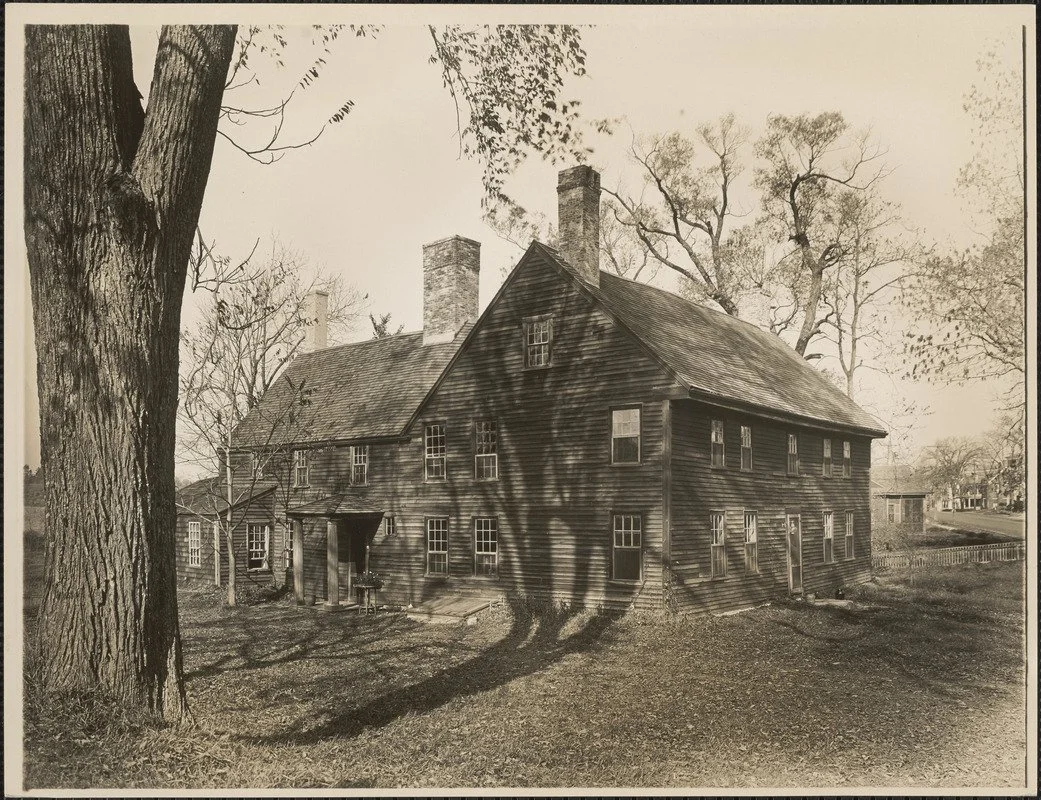
Coffin House, High Street, Newburyport, MA
Digital Commonwealth
“The years that I spent in I-do-not-know-how-many different houses, till I finally left the town for good, a boy of sixteen, do not now seem to me a home in any sense that boys with mothers and sisters to love regard home. I do not feel that I really know any of what made up my father’s household. Pardon my saying the truth; but I have never felt that I had a brother.”
Further in the letter, the reader learns of another life-long slight from his father that Caleb feels he has endured:
“My half-brother has a name that ought by right to have been mine, instead of the awkward harsh Biblical name that that strong willed woman, our common grandmother, required should be put upon me. I dare say that fact has stood up between him and me to lessen my regard for the relationship of half-brother.”
Ouch again. I am no psychologist, but this letter’s contents begin to illuminate why Caleb Huse likely felt little attachment to his family or hometown of Newburyport. I see a wounded individual, with a chip on his shoulder, who at age 16 left a town and family that he perhaps felt didn’t value him enough, never looking back.
At the end of the letter, Caleb does eventually throw a bone to his ill half-brother, suggesting that if his health improves enough to allow travel, he should come visit them at their home in Highland Falls, NY. But the good doctor Ralph Cross Huse Jr. never recovered from his illness. A sympathy letter to his wife Cora Huse in the manila file next to the one containing Caleb Huse’s letter in the archives is dated May 11th, 1892, so the letter from half-brother Caleb Huse, postmarked May 18th, was never received before his death. Maybe that’s just as well.
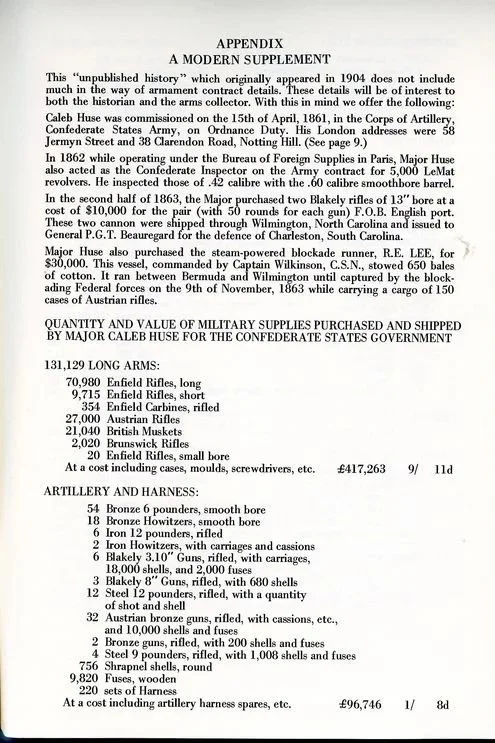
After reading Caleb’s letter, I came upon a bound copy of his personal account of his work obtaining supplies and armaments for the Confederate Army during the Civil War, published in Boston in 1904, a year before his death. It is entitled “The Supplies for the Confederate Army: How They Were Obtained in Europe and How Paid For.” It is a fascinating read, and another historical gem from the Huse family boxes in the Perkins archives.
The details of Caleb’s time as a young cadet at West Point, his subsequent years as a West Point instructor, which coincided with Robert E. Lee’s time there, his journey to Europe for the U.S. Army in 1860 as an artillery expert to learn about European arms manufacture, his route from the U.S. Army to professor at the University of Alabama, and finally, his decision to join the Confederate cause, sneaking out of the country and across the sea to Europe in spring of 1861, all of which he outlined in this account, are the subject of another, more in-depth article. Though particularly intriguing from the point of view of the Museum of Old Newbury, which is housed in the home of Honorable Caleb Cushing, former Attorney General of the United States and storied diplomat, is a meeting between Caleb Huse and Cushing that took place when Huse was enroute to New York City in spring of 1861, to obtain funds for his clandestine trip to Europe. Cushing and Huse came face to face on a boat bound for New York City, despite Huse’s best efforts to avoid Cushing, whom he had viewed earlier on the boat from afar. “You’re here for the South,” Cushing stated, once they had greeted each other. Cushing went on to opine that he didn’t think there was any way the South could prevail in the war, a statement that Huse seems to have taken as almost a personal dare, as it comes up several more times in Huse’s account.
Overall, what struck me was the dispassionate and unapologetic tone with which Caleb Huse recounted his story in this book. He seems to have taken great pride in his work for the Confederates. There is an Appendix at the end of this publication, added much later by James B. Hughes, Jr. of Houston, Texas, which lists all of the supplies purchased by Huse in Europe during the war. According to James B. Hughes, the figures are taken from a report dated the 3rd of February, 1863 made by Colonel Gorgas, Chief of Ordnance to the [Confederate] Secretary of War. The list is staggering. One wonders if the Confederate Army would have held out as long as it did if Huse had not done his work so well. As James B. Hughes says in the foreword to the Appendices:
These additional notes should, if nothing else, show the wide variety of goods purchased by Major Huse for the account of the Confederate Government. It is interesting to note that in addition to arms, he purchased medical supplies, clothing, flags, and raw material. The tremendous quantity of supplies involved, the steadily declining purchasing power of the Confederate dollar, the risk of shipping - both across the Atlantic and through the blockade, and the great number of obstacles placed in his way by Federal agents made this truly a labor of love.”
A labor of love – his work for the Confederates was considered a labor of love. Wow. What I’ve learned about Caleb Huse and the greater Huse family of Newbury, West Newbury, and Newburyport from the Perkins archives has been profoundly moving and somewhat upsetting for me. It’s made me think a lot about accountability, and the wounds in the moral fabric of the country that occur when people aren’t held responsible for their crimes against their fellow citizens. Caleb Huse was penniless after the Civil War, but he returned to the U.S. from Europe in 1868, and not to the south, but to the north. It turns out that his wife wasn’t southern at all. Harriet Pinckney, whom he married in 1852 soon after graduating from West Point, was a native of Highland Falls, New York, just south of West Point. After the war, they settled their family there and opened and ran a successful preparatory school called “The Rocks” for boys interested in attending West Point. Caleb lived out his life enjoying the relative prosperity of the north, never being forced to account for his betrayal of country. But it is he among all other Huses that lives on into this, the digital age, with his Wikipedia account!
Meanwhile, Webster Day Huse, my husband’s great-great-grandfather, fought honorably for the Union Army. He never did return to greet his wife Mary Ann Wormwood Huse and young son Fred Burton Huse (1859-1932), having been captured in Virginia in 1864, not long before the war ended. He was sent to the notorious Confederate prisoner-of-war camp Andersonville - reputedly more of a death camp - and died there. His son was 5 years old at the time of his father’s death in 1864. Had young Fred not been born before his father’s enlistment, my own life certainly would have been radically different, as my husband would never have been born. Similarly, Caleb’s half-brother Ralph Cross Huse Jr. served as a contract surgeon with the Union Army’s Third Regiment, New York Infantry. To him would have fallen the unenviable and soul-searing task of mending the gruesome wounds inflicted on the young Northern soldiers by armaments his own brother had likely supplied to the enemy. He himself suffered serious wounds from an exploding magazine in January of 1865, though he survived this injury. Although he was much beloved in his day, and celebrated in his community for his excellent work as a doctor, his life and work are unremembered.
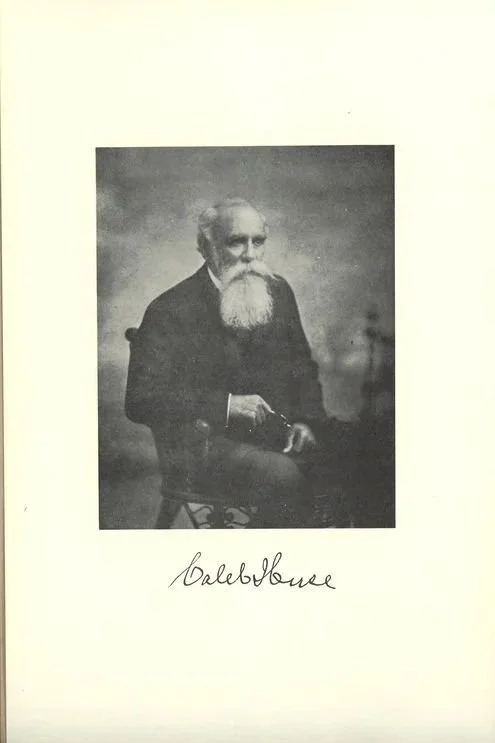
As I was finishing reading this account, I flipped back to the beginning of the book, and a page opened to reveal a photo of Caleb Huse as an old man. It was familiar to me – I had seen the same photo years back when I first read through the Wikipedia entry that my late husband had printed out. But as I glanced again at it, something I hadn’t noticed before caught my eye. It was his hands – Caleb Huse’s hands. My heart lurched and I stopped breathing for a moment. Suddenly the years fell away and the decades separating me from this despicable man collapsed like a dusty accordion folding in on itself – because I knew those hands! They were exactly the same hands that my beloved father-in-law Mason Webster Huse Jr. had had! Like it or not, I had to accept that this hateful man whose actions will always be abhorrent to me, was family.
Sources: Archival materials from the Perkins Art and Research Center, Museum of Old Newbury, Huse document collection donated by Katharine Foster; “Newburyport and the Civil War” by William Hallett, 2012, The History Press, pgs. 75-78; the Author’s Personal Huse Family Records; Wikipedia, Caleb Huse entry.