
Adventures in the Archives: Benjamin Colman and Revolutionary Emancipation
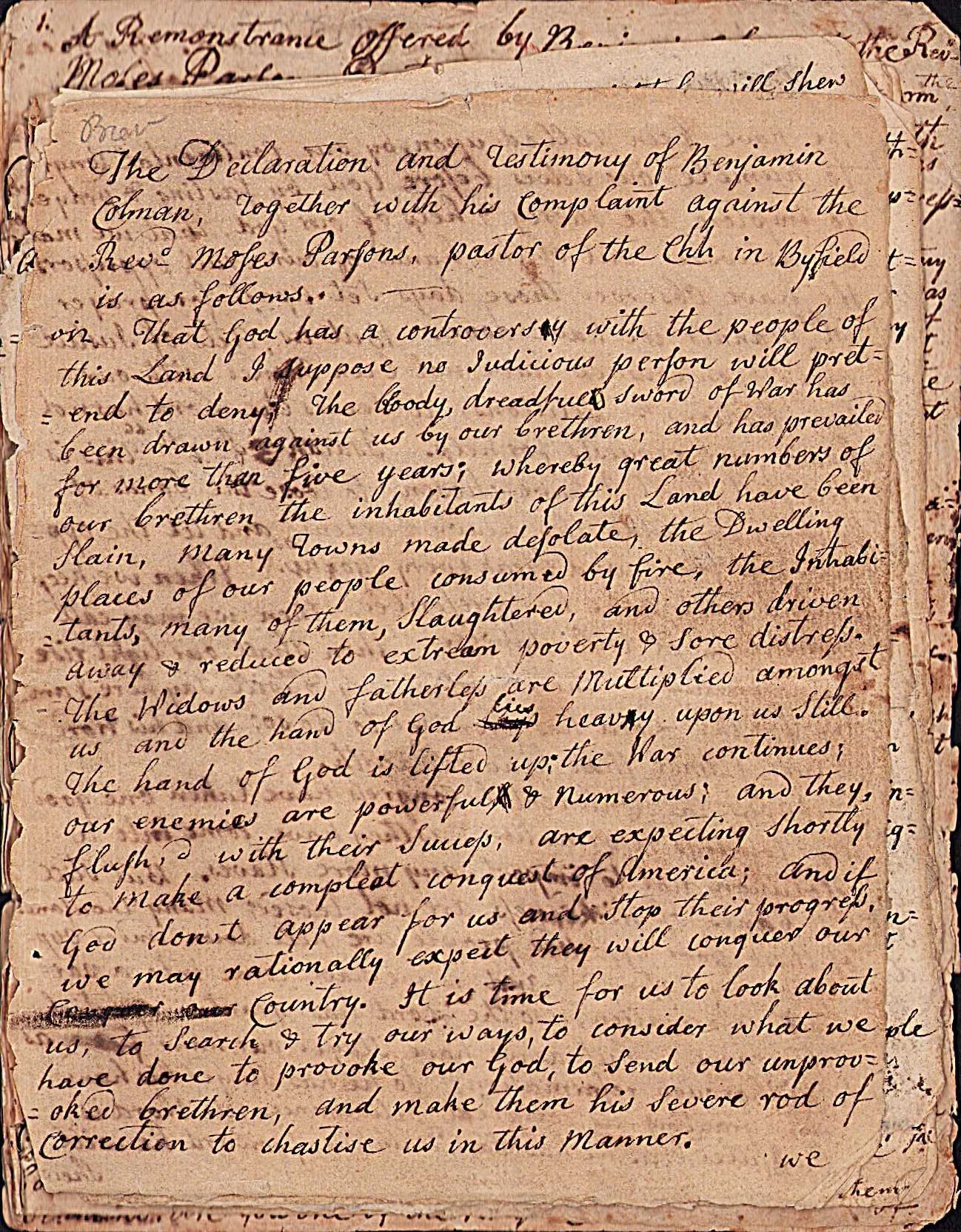
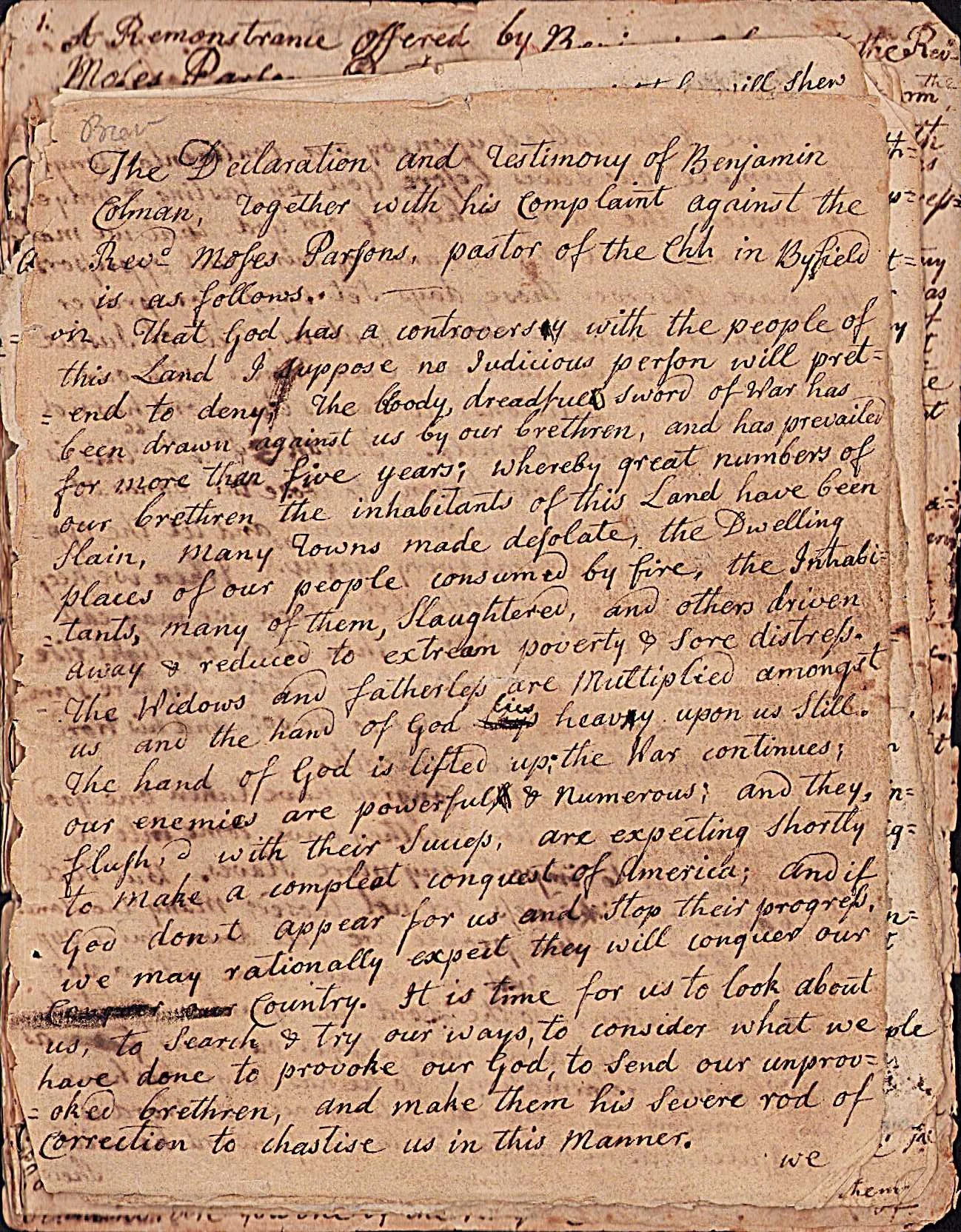
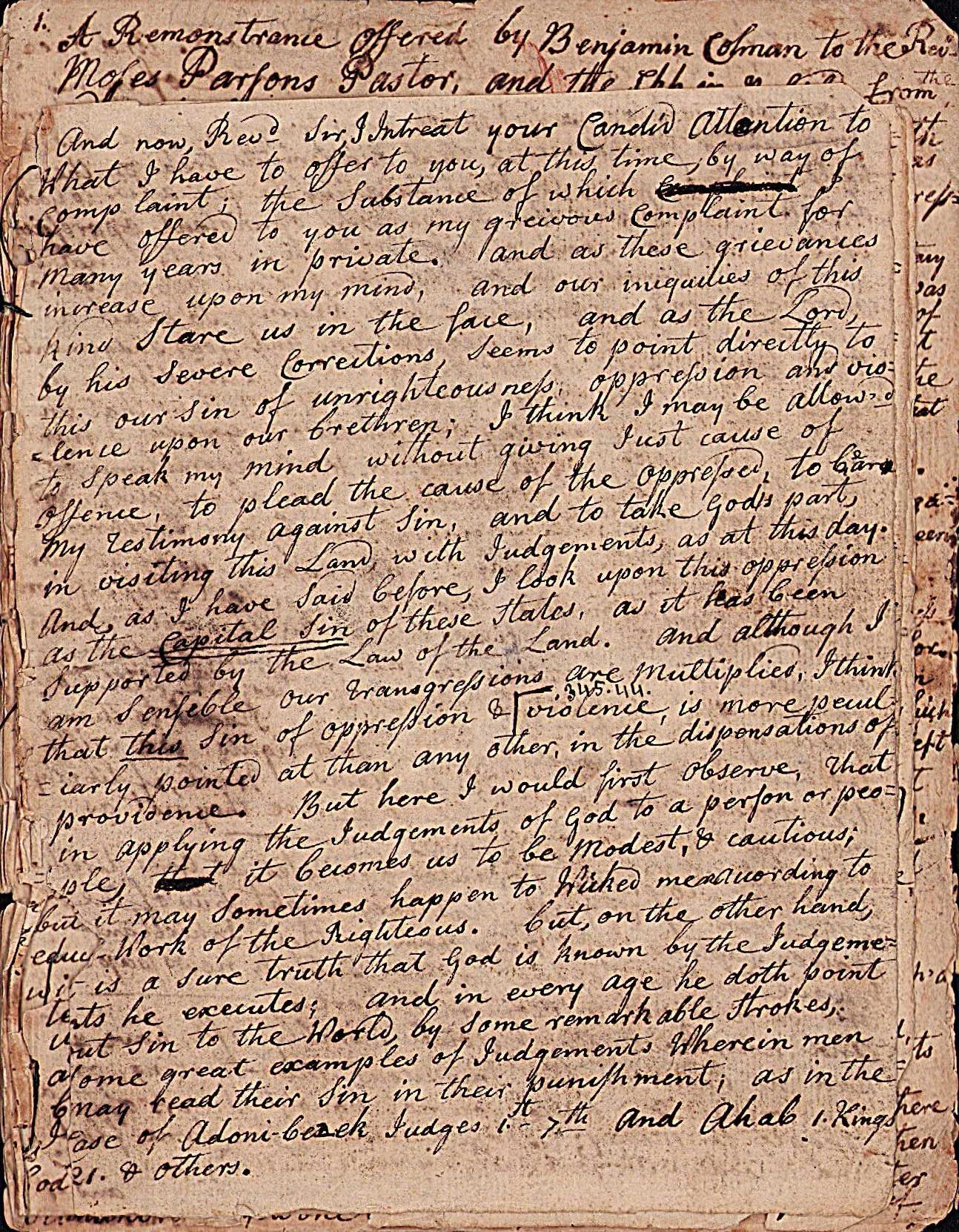
The first page of Benjamin Colman’s “Declaration and Testimony, Together with his Complaint Against the Revd Moses Parsons…” from the Museum of Old Newbury’s Churches Collection: Byfield and West Newbury Churches.
by Sam Clewley, Intern
As we celebrate our country's two-hundred and fiftieth anniversary, it is easy to find ourselves buried in the major events of the conflict that our nation was born from. The Battles of Lexington and Concord, the signing of the Declaration of Independence, the Siege of Yorktown - all of these pivotal moments become the central focus of our collective remembrance. While all of these events are important, our singular focus on them often misses an important question: What was the experience of those who lived through the war? These addresses help us answer that question.
In 1780, Benjamin Colman, a member of the Byfield Parish church in Newbury, wrote his own declaration against slavery and against his pastor, Reverend Moses Parsons. In Colman’s view the American Revolution’s violence; its “…bloody, dreadful sword…” were evidence of God’s punishment for the continued practice of slavery in the United States. As Colman put it, “Our Land is defiled with blood…and our fingers with inequality…”
While it is sometimes difficult for us to imagine, our Revolutionary moment was a fractious period not only among Britain and its colonial subjects, but also among those subjects themselves. Varying ideas of loyalty, freedom, and righteousness existed across the fledgling United States. Colman exemplifies this when he criticizes the Continental Congress for its limited efforts to end the practice of slavery or what he terms “…the capital sin of these states…” Colman proceeds to criticize his pastor, Reverend Parsons for his remaining silent on the issue of slavery amidst the war and his failure to identify the conflict as God’s wrath against the practice.
In 1783, Colman addressed his pastor, arguing that he had been “…shut up from the society of fellowship…” by Reverend Parsons for addressing the issue of slavery. In other words, Colman had been excluded from the church. Colman’s writings provide important windows into the revolutionary experiences of those who lived through our founding conflict. Even in the birthplace of the American Revolution, not everyone was of one mind.
Colman shows us that individuals utilized revolutionary language and the war itself to speak about issues that mattered to them and that were relevant to their communities. At the same time, doing so could have real and lasting impacts on one’s position in their community - a truth that Colman discovered. Benjamin Colman is a reminder for us all to find the nuance in our collective past.
If you’d like to read through Colman’s entire testimony, we welcome you to do so! Visit us at the Perkins Art & Research Center on Fridays and Saturdays from 10 am - 2 pm.
The Declaration and Testimony of Benjamin Colman, November 7, 1780
The Declaration and Testimony of Benjamin Colman, Together with his Complaint against the Rev'd Moses Parsons, pastor of the Chh in Byfield is as follows:
In That God has a controversy with the people of this Land I suppose no Judicious person will pretend to deny. The bloody, dreadfull Sword of War has been drawn against us by our brethren, and has prevailed for more than five years; whereby great numbers of our brethren the inhabitants of this Land have been Slain, many Towns made desolate, the Dwelling places of our people consumed by fire, the Inhabitants, many of them, Slaughtered, and others driven away & reduced to extream poverty & Sore distress. The Widows and fatherless are Multiplied amongst us and the hand of God lies heavy upon us Still. The hand of God is lifted up; the War continues; our enemies are powerfull & numerous; and they, flush'd with their Success, are expecting Shortly to make a compleat conquest of America; and if God don't appear for us and Stop their progress, we may rationally expect they will conquer our Country. It is time for us to look about us, to Search & Try our ways, to consider what we have done to provoke our God, to Send our unprovoked brethren, and make them his Severe rod of Correction to chastise us in this Manner.
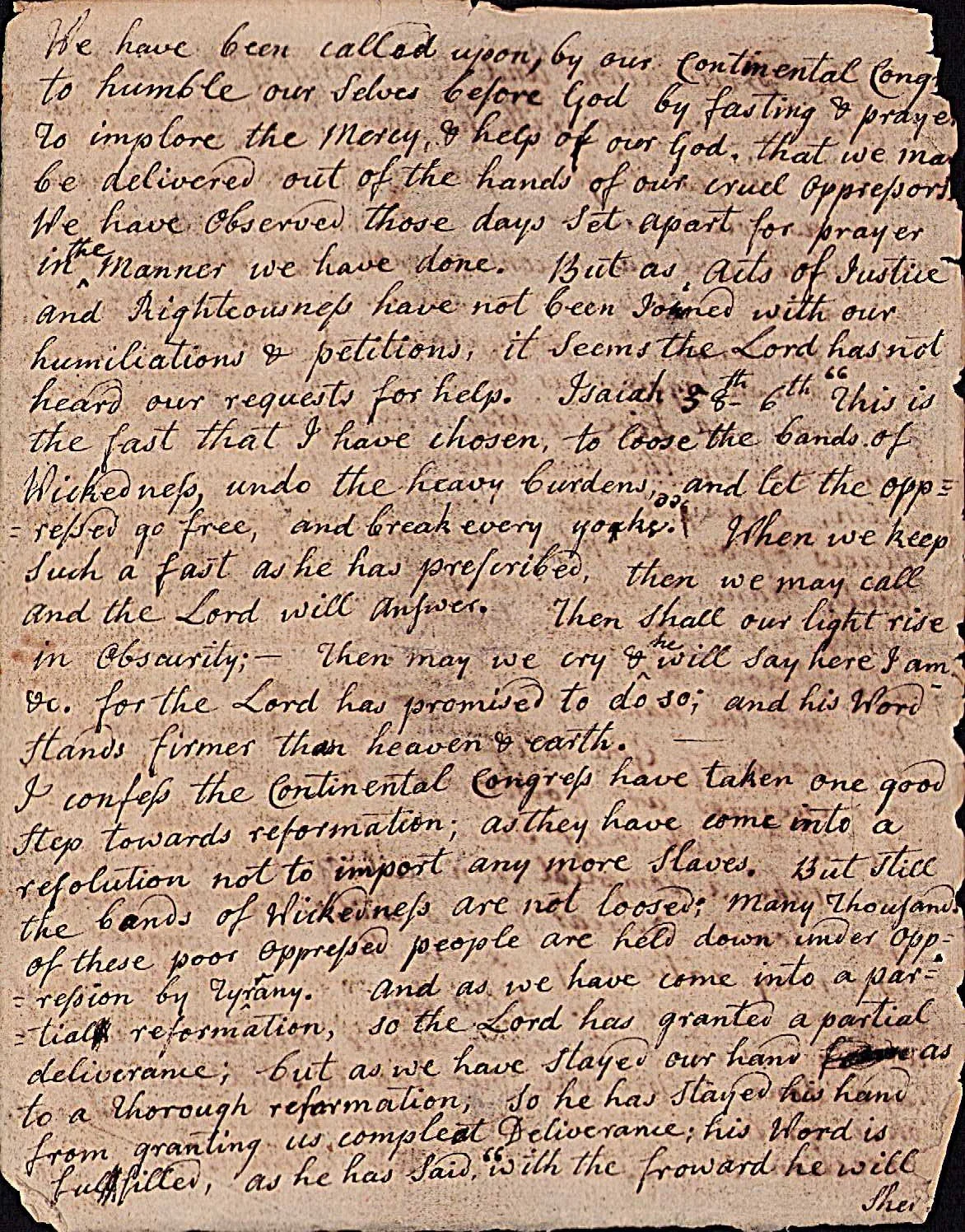
We have been called upon, by our Continental Congress, to humble our Selves before God by fasting & prayer; To implore the Mercy, & help of our God, that we may be delivered out of the hands of our cruel Oppressors. We have Observed those days Set apart for prayer in the manner we have done. But as Acts of Justice and Righteousness have not been Joined with our humiliations & petitions, it Seems the Lord has not heard our requests for help. Isaiah 58th. 6th. This is the fast that I have chosen, to loose the bands of Wickedness, undo the heavy burdens, and let the oppressed go free, and break every yoke. When we keep Such a fast as he has prescribed, then we may call and the Lord will Answer. Then Shall our light rise in Obscurity; Then may we cry & he will Say here I am &c. for the Lord has promised to do So; and his Word Stands firmer than heaven & earth.
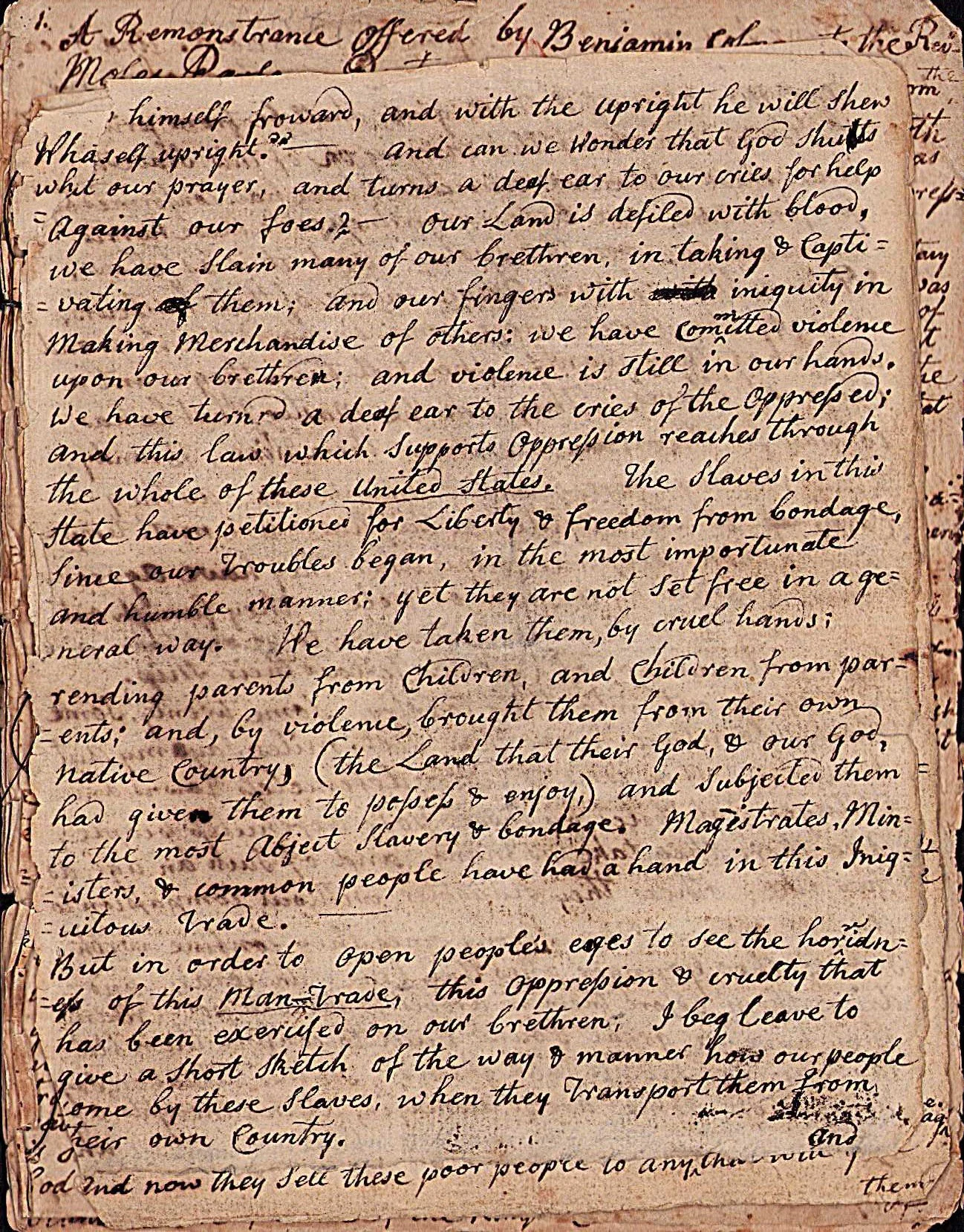
I confess the Continental Congress have taken one good Step towards reformation; as they have come into a resolution not to import any more Slaves. But Still the bands of Wickedness are not loosed; many Thousands of these poor Oppressed people are held down under Oppression by Tyrany. And as we have come into a partial reformation, So the Lord has granted a partial deliverance; but as we have Stayed our hand as to a thorough reformation; So he has Stayed his hand from granting us compleat Deliverance; his Word is fulfilled, as he has Said, with the froward he will Shew himself froward, and with the upright he will Shew himself upright.
And can we Wonder that God Shuts out our prayers, and turns a deaf ear to our cries for help against our foes? Our Land is defiled with blood, we have Slain many of our brethren, in taking & Captivating them; and our fingers with iniquity in Making Merchandise of others; we have committed violence upon our brethren; and violence is Still in our hands. We have turn'd a deaf ear to the cries of the Oppressed; and this law which Supports Oppression reaches through the whole of these United States. The Slaves in this State have petitioned for Liberty & Freedom from bondage, Since our Troubles began, in the most importunate and humble manner; yet they are not Set free in a general way. We have taken them, by cruel hands; rending parents from Children, and Children from parents; and, by violence, brought them from their own native Country, (the Land that their God, & our God, had given them to possess & enjoy,) and Subjected them to the most Abject Slavery & bondage. Magistrates, Ministers, & common people have had a hand in this Iniquitous Trade.
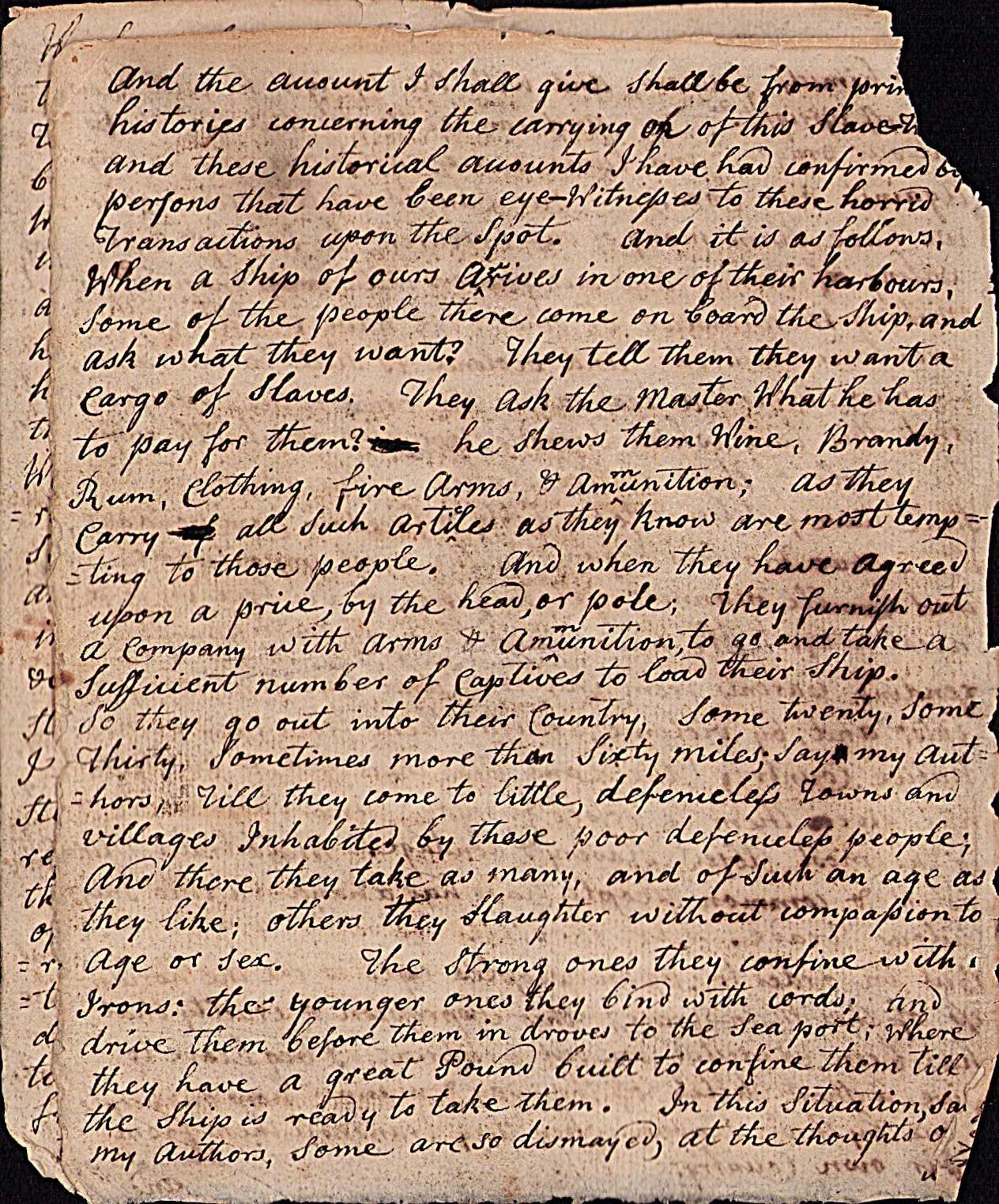
But in order to Open people's eyes to See the horridness of this Man-Trade, this Oppression & cruelty that has been exercised on our brethren, I beg leave to give a Short Sketch of the way & manner how our people come by these Slaves, when they Transport them from their own Country.
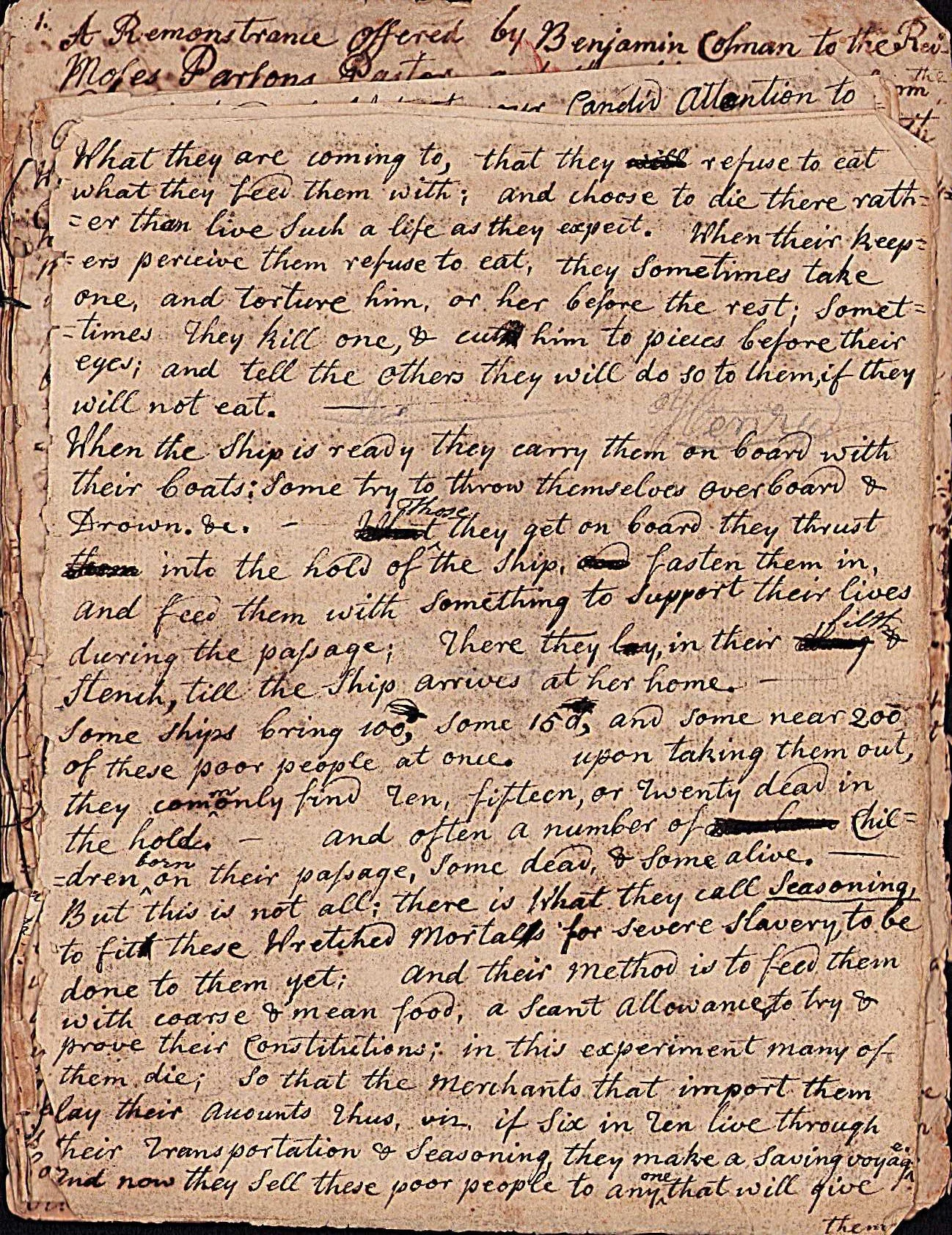
And the account I shall give shall be from printed histories concerning the carrying on of this Slave-Trade; and these historical accounts I have had confirmed by persons that have been eye-witnesses to these horrid transactions upon the Spot. and it is as follows, When a Ship of ours Arrives in one of their harbours, Some of the people there come on board the Ship, and ask what they want? They tell them they want a Cargo of Slaves. They Ask the Master What he has to pay for them? he Shews them Wine, Brandy, Rum, Clothing, fire Arms, & Ammunition; as they Carry all Such Articles as they know are most tempting to those people. And when they have agreed upon a price, by the head, or pole; They furnish out a Company with Arms & Ammunition, to go and take a Sufficient number of Captives to load their Ship. So they go out into their Country, Some twenty, Some Thirty, Sometimes more than Sixty miles; Say my Authors; till they come to little, defenceless Towns and villages Inhabited by those poor defenceless people; And there they take as many, and of Such an age as they like; others they Slaughter without compassion to Age or Sex. The Strong ones they confine with Irons. the younger ones they bind with cords, and drive them before them in droves to the Sea port; where they have a great Pound built to confine them till the Ship is ready to take them. In this Situation, Say my Authors, Some are So dismayed, at the thoughts of What they are coming to, that they refuse to eat what they feed them with; and choose to die there rather than live Such a life as they expect. When their keepers perceive them refuse to eat, they Sometimes take one, and torture him, or her, before the rest; Sometimes they kill one, & cut him to pieces before their eyes; and tell the others they will do So to them, if they will not eat.
When the Ship is ready they carry them on board with their boats; Some try to throw themselves overboard & Drown, &c. When they get on board they thrust them into the hold of the Ship, fasten them in, and feed them with Something to Support their lives during the passage; There they lay, in their filth & Stench, till the Ship arrives at her home. Some Ships bring 100, Some 150, and Some near 200 of these poor people at once. upon taking them out, they commonly find Ten, fifteen, or Twenty dead in the hold. and often a number of Children, born on their passage, Some dead & Some alive.
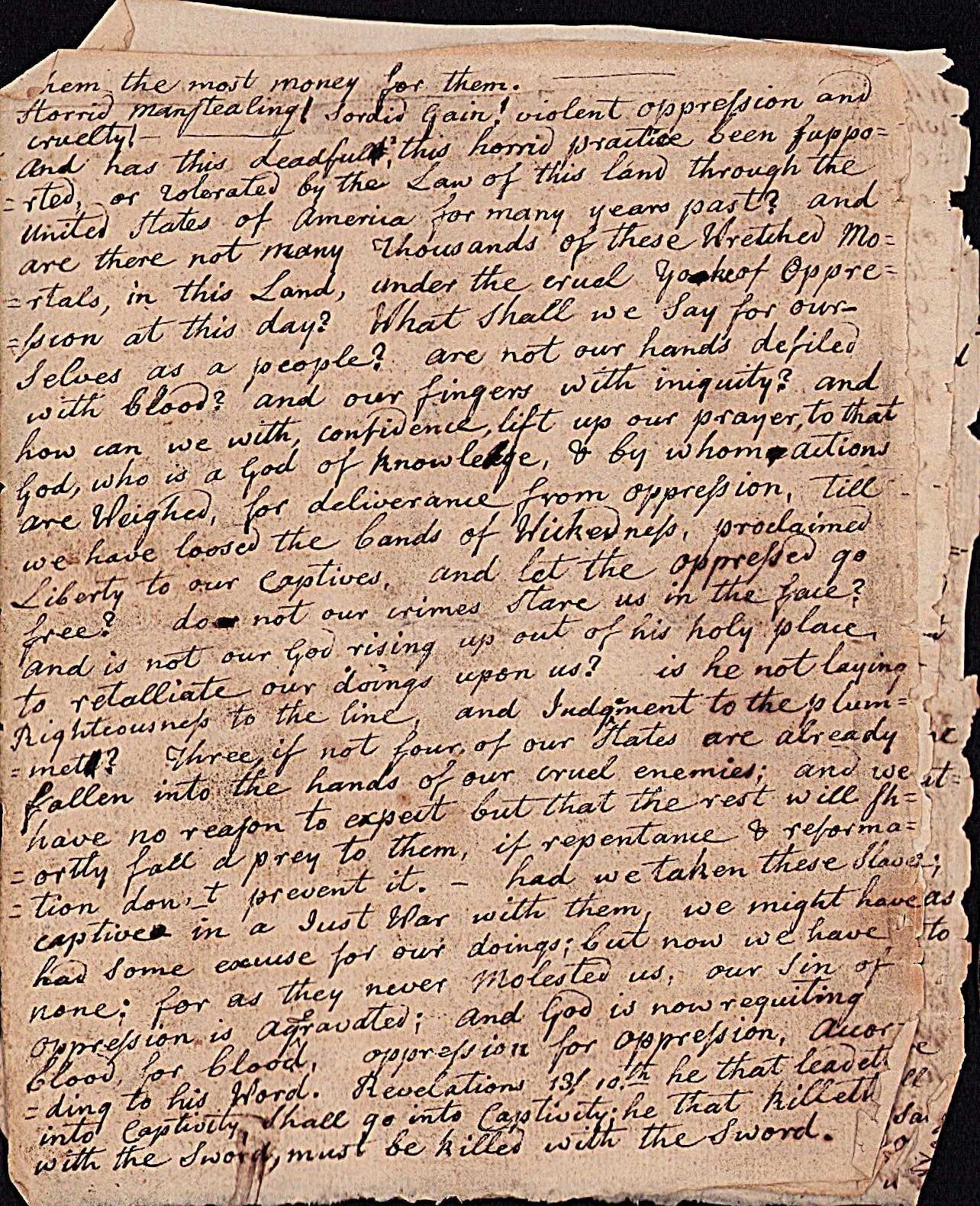
But this is not all; there is What they call Seasoning, to fit these Wretched Mortals for Severe Slavery, to be done to them yet; and their Method is to feed them with coarse & mean food, a Scant allowance to try & prove their Constitutions; in this experiment many of them die; So that the Merchants that import them lay their Accounts, thus, viz. if Six in Ten live through their Transportation & Seasoning they make a Saving voyage and now they Sell these poor people to any one that will give them the most money for them.
Horrid manstealing! Sordid Gain! violent oppression and cruelty! And has this dreadfull, this horrid practice been Supported, or Tolerated by the Law of this Land through the United States of America for many years past? and are there not many Thousands of these Wretched Mortals, in this Land, under the cruel Yook of Oppression at this day? What Shall we Say for our Selves as a people? are not our hands defiled with blood? and our fingers with iniquity? and how can we with confidence lift up our prayer, to that God, who is a God of knowledge, & by whom actions are Weighed, for deliverance from oppression, Till we have loosed the bands of Wickedness, proclaimed Liberty to our Captives, and let the oppressed go free? do not our crimes Stare us in the face? and is not our God rising up out of his holy place, to retaliate our doings upon us? is he not laying Righteousness to the line, and Judgment to the plummet? Three if not four of our States are already fallen into the hands of our cruel enemies; and we have no reason to expect but that the rest will Shortly fall a prey to them, if repentance & reformation don't prevent it. had we taken these Slaves Captives in a Just War with them, we might have had Some excuse for our doings; but now we have none; for as they never molested us, our Sin of Oppression is aggravated; and God is now requiting blood for blood, oppression for oppression, According to his Word. Revelations 13. 10th. he that leadeth into Captivity Shall go into Captivity; he that killeth with the Sword, must be killed with the Sword.
And now, Rev'd Sir, I Intreat your Candid Attention to What I have to offer to you, at this time, by way of Complaint; the Substance of which I have offered to you as my grievous Complaint for many years in private. And as these grievances increase upon my mind, and our iniquities of this kind Stare us in the face, and as the Lord, by his Severe Corrections, Seems to point directly to this our Sin of unrighteousness, oppression and violence upon our brethren; I think I may be allow'd to Speak my mind without giving Just cause of offence, to plead the cause of the oppressed, to bear my Testimony against Sin, and to take God's part in visiting this Land with Judgements, as at this day.
And as I have Said before, I look upon this oppression as the Capital Sin of these States, as it has been Supported by the Law of the Land. and although I am Sensible our Transgressions are multiplied, I think that this Sin of oppression & violence, is more peculiarly pointed at than any other, in the dispensations of providence. But here I would first Observe, that in applying the Judgements of God to a person or people, it becomes us to be Modest, & cautious; but it may Sometimes happen to Wicked men according to the Work of the Righteous. But, on the other hand, it is a Sure truth that God is known by the Judgements he executes; and in every age he doth point out Sin to the World, by Some remarkable Strokes; Some great examples of Judgements wherein men may read their Sin in their punishment; as in the case of Adoni-bezek Judges 1st. 7th. and Ahab 1 Kings 21. & others.
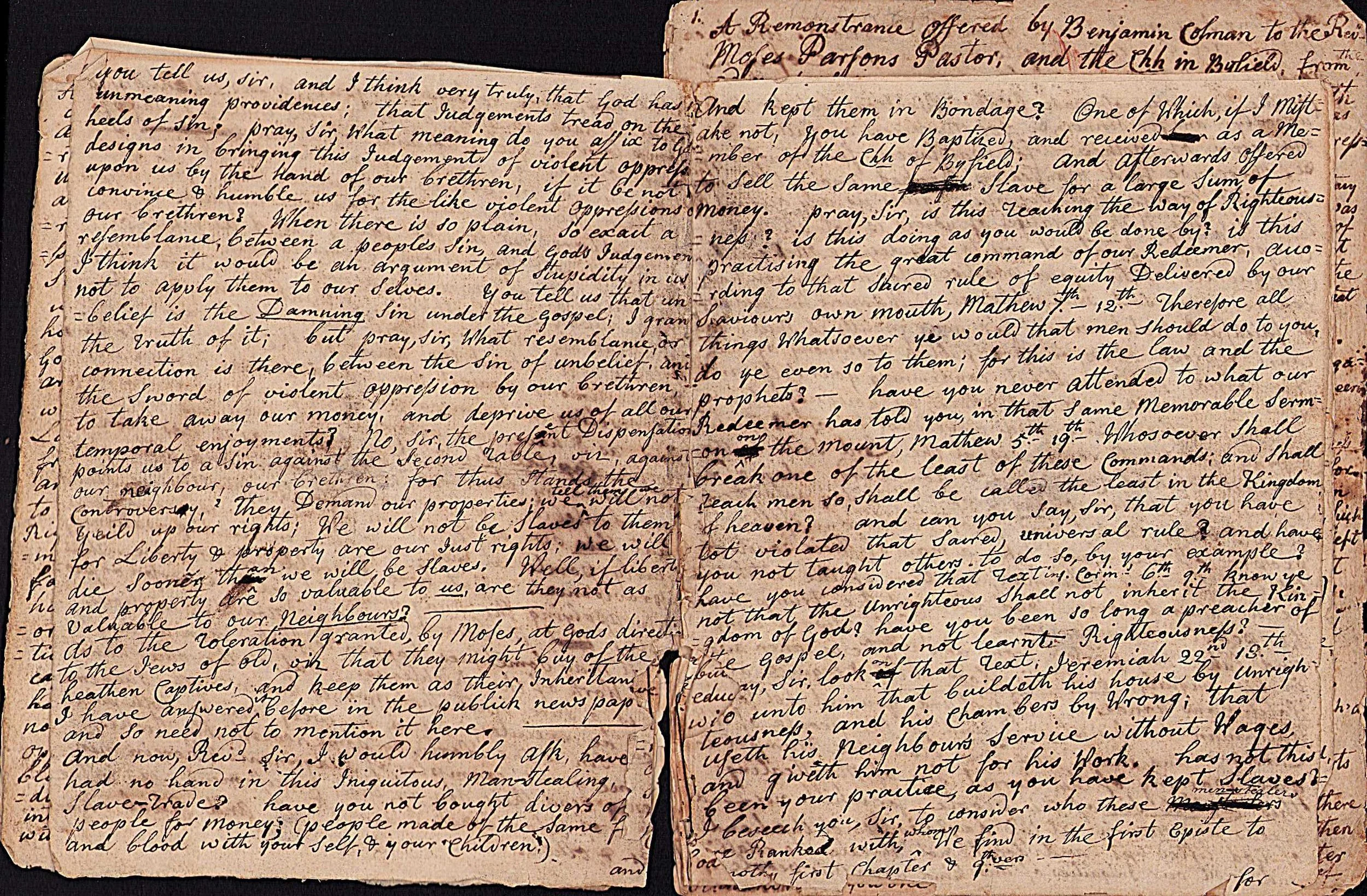
You tell us, Sir, and I think very truly, that God has [no] unmeaning providences; that Judgements tread on the heels of Sin; pray, Sir, What meaning do you affix to God's designs in bringing this Judgement of violent oppression upon us by the hand of our brethren, if it be not to convince & humble us for the like violent oppressions of our brethren? When there is So plain, So exact a resemblance, between a people's Sin, and God's Judgements, I think it would be an argument of Stupidity, in us not to apply them to our Selves. You tell us that unbelief is the Damning Sin under the gospel; I grant the truth of it; but pray, Sir, What resemblance, or connection is there, between the Sin of unbelief, and the Sword of violent oppression by our brethren, to take away our money, and deprive us of all our temporal enjoyments? No, Sir, the present Dispensation points us to a Sin against the Second Table, viz. against our neighbour, our brethren; for thus Stands the Controversy; They Demand our properties; we will not yield up our rights; We will not be Slaves to them; for Liberty & property are our Just rights; we will die Sooner than we will be Slaves. Well, if liberty and property are So valuable to us, are they not as valuable to our Neighbours?
As to the Toleration granted by Moses, at Gods direction to the Jews of Old, viz. that they might buy of the heathen Captives, and keep them as their Inheritance; I have answered before in the publick news paper, and So need not to mention it here.
And now, Rev'd Sir, I would humbly Ask, have [you] had no hand in this Iniquitous Man-Stealing, Slave-Trade? have you not bought divers of people for money; (people made of the Same flesh and blood with your Self, & your Children;) and kept them in Bondage? One of Which, if I Mistake not, you have Baptized, and received [him] as a Member of the Chh of Byfield; and Afterwards Offered to Sell the Same Slave for a large Sum of money. pray, Sir, is this Teaching the Way of Righteousness? is this doing as you would be done by? is this practising the great command of our Redeemer, according to that Sacred rule of equity Delivered by our Saviour's own mouth, Matthew 7th. 12th. Therefore all things Whatsoever ye would that men Should do to you, do ye even So to them; for this is the Law and the prophets?
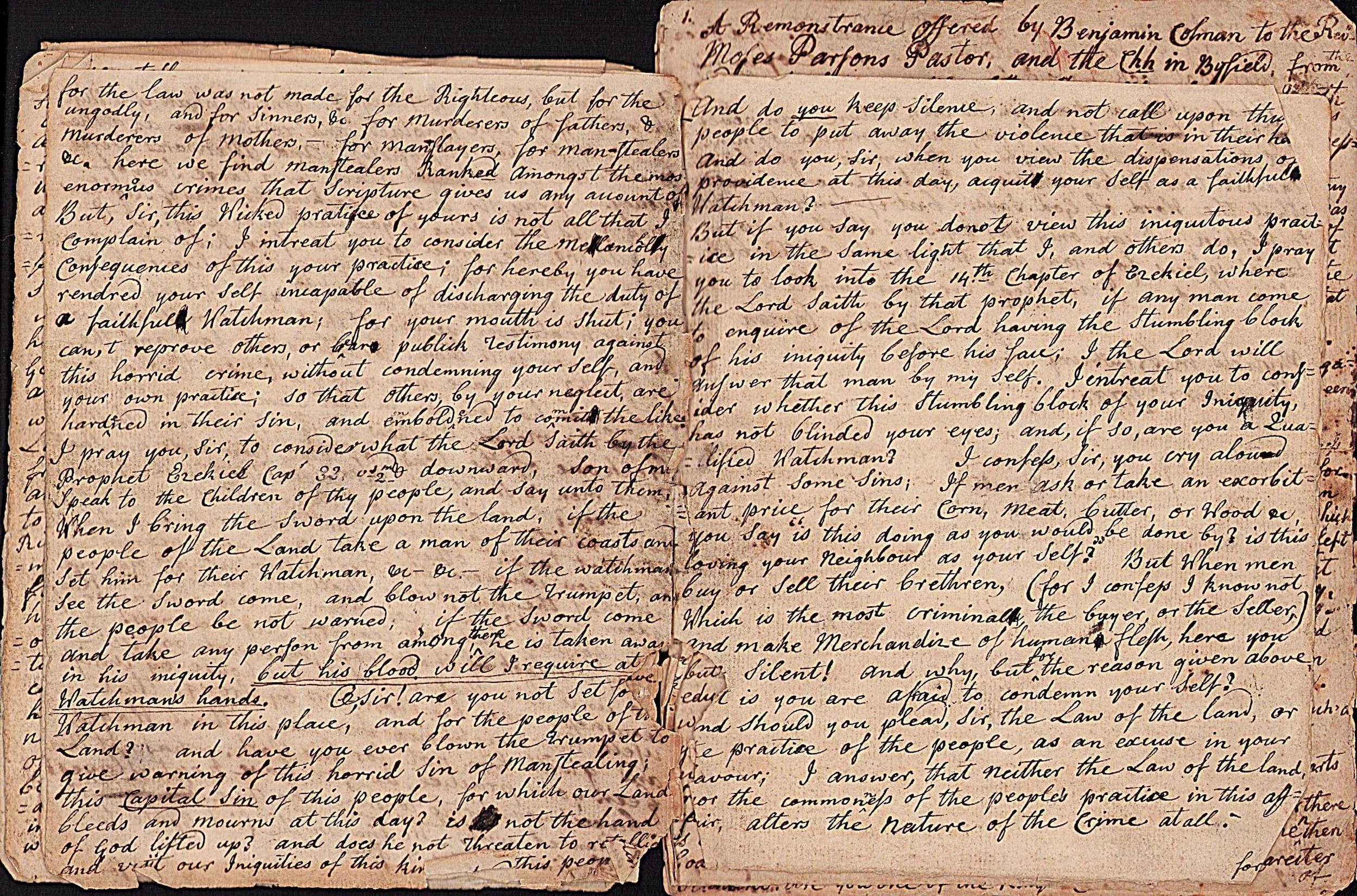
Have you never attended to what our Redeemer has told you in that Same Memorable Sermon on the mount, Matthew 5th. 19th. Whosoever Shall break one of the least of these Commands; and Shall teach men So, Shall be called the least in the Kingdom of heaven? and can you Say, Sir, that you have not violated that Sacred, universal rule? and have you not taught others to do So, by your example? have you considered that Text in Cor'n. 6th. 9th. Know ye not that the Unrighteous Shall not inherit the Kingdom of God? have you been So long a preacher of the gospel, and not learnt Righteousness? pray, Sir, look on that Text, Jeremiah 22nd. 13th. Woe unto him that buildeth his house by Unrighteousness, and his Chambers by Wrong; that useth his Neighbour's Service without Wages, and giveth him not for his Work. has not this been your practise, as you have kept Slaves? I beseech you, Sir, to consider who these manstealers are Ranked with; whereof We find in the first Epistle to Timothy first Chapter & 9th verse. For the law was not made for the Righteous, but for the ungodly, and for Sinners, &c. for murderers of fathers, & murderers of Mothers, for manslayers, for man-stealers &c. here we find manstealers Ranked amongst the most enormous crimes that Scripture gives us any account of.
But, Sir, this Wicked practise of yours is not all that I Complain of; I intreat you to consider the melancholy Consequences of this your practise; for hereby you have rendered your Self incapable of discharging the duty of a faithfull Watchman; for your mouth is Shut; you can't reprove others, or bear publick Testimony against this horrid crime, without condemning your Self, and your own practise; So that others, by your neglect, are hardened in their Sin, and emboldened to commit the like.
I pray you, Sir, to consider what the Lord Saith by the Prophet Ezekiel Cap. 33. vs. 2d. downward, Son of man Speak to the Children of thy people; and Say unto them, When I bring the Sword upon the Land; if the people of the Land take a man of their coasts and Set him for their Watchman, &c. &c. if the watchman See the Sword come, and blow not the Trumpet, and the people be not warned; if the Sword come and take any person from among them he is taken away in his iniquity; but his blood will I require at the Watchmans hands. O Sir! are you not Set for a Watchman in this place, and for the people of this Land? and have you ever blown the Trumpet to give warning of this horrid Sin of ManStealing; this Capital Sin of this people, for which our Land bleeds and mourns at this day? is not the hand of God lifted up? and does he not threaten to retaliate and visit our Iniquities of this kind upon this people?
And do you keep Silence; and not call upon this people to put away the violence that is in their hands? And do you, Sir, when you view the dispensations of providence at this day, acquit your Self as a faithfull Watchman? But if you Say you don't view this iniquitous practise in the Same light that I, and others do, I pray you to look into the 14th Chapter of Ezekiel, where the Lord Saith by that prophet, if any man come to enquire of the Lord having the Stumbling block of his iniquity before his face; I the Lord will Answer that man by my Self. I intreat you to consider whether this Stumbling block of your Iniquity, has not blinded your eyes; and, if So, are you a Qualified Watchman?
I confess, Sir, you cry aloud against Some Sins; If men ask or take an exorbitant price for their Corn, meat, butter, or Wood &c, you Say is this doing as you would be done by? is this loving your Neighbour as your Self? But When men buy or Sell their brethren, (for I confess I know not Which is the most criminal, the buyer, or the Seller,) and make Merchandise of humane flesh, here you are Silent! and why, but the reason given above, is you are afraid to condemn your Self? and Should you plead, Sir, the Law of the Land, or the practise of the people, as an excuse in your favour; I answer, that neither the Law of the Land, nor the commonness of the peoples practise in this affair, alters the nature of the Crime at all.
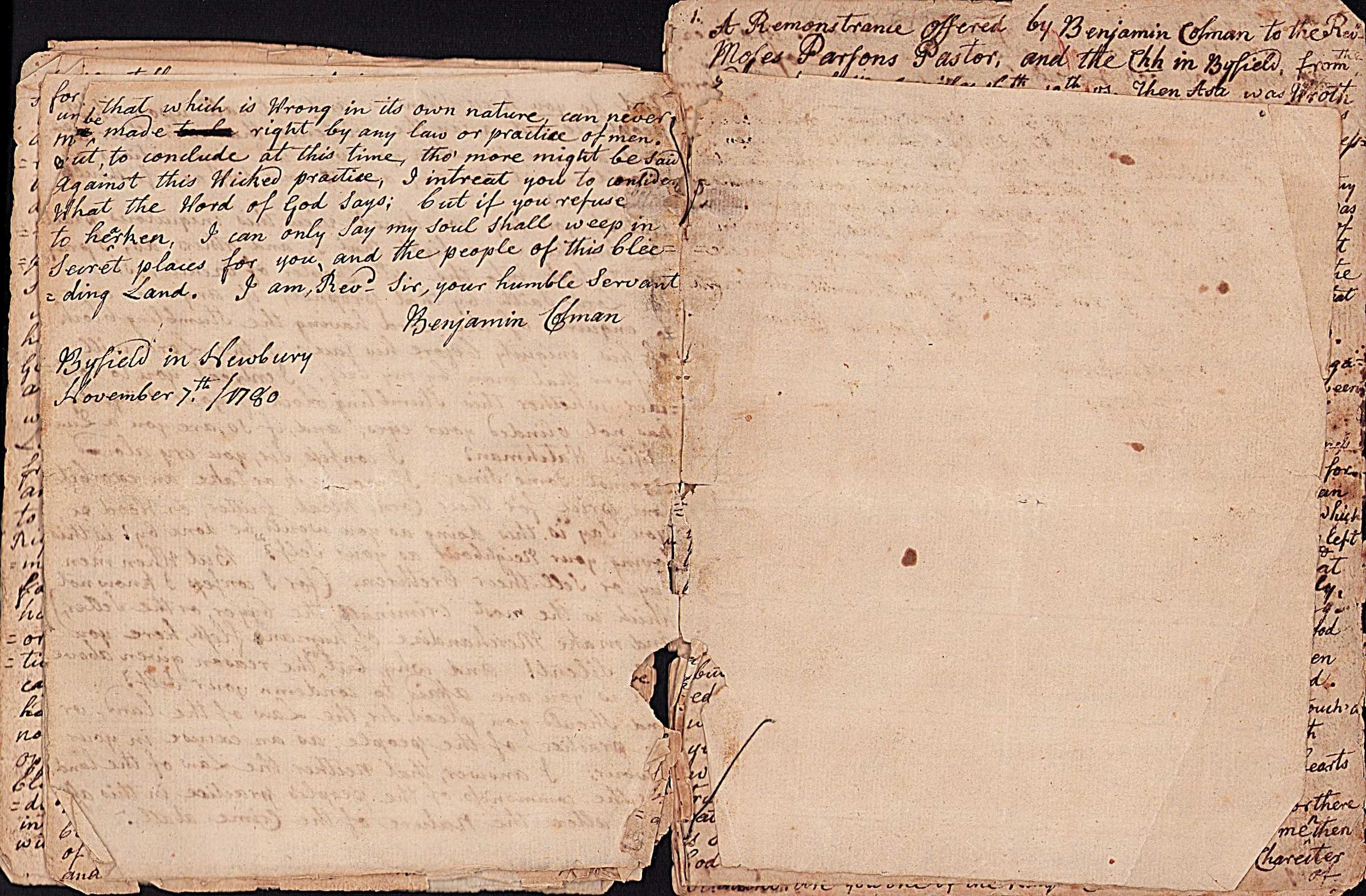
For that which is Wrong in its own nature, can never be made right by any Law or practise of men. But, to conclude at this time, tho' more might be Said against this Wicked practise, I intreat you to consider What the Word of God Says; but if you refuse to hearken, I can only Say my Soul Shall weep in Secret places for you, and the people of this bleeding Land. I am, Rev'd Sir, your humble Servant,
Benjamin Colman
Byfield in Newbury
November 7th 1780
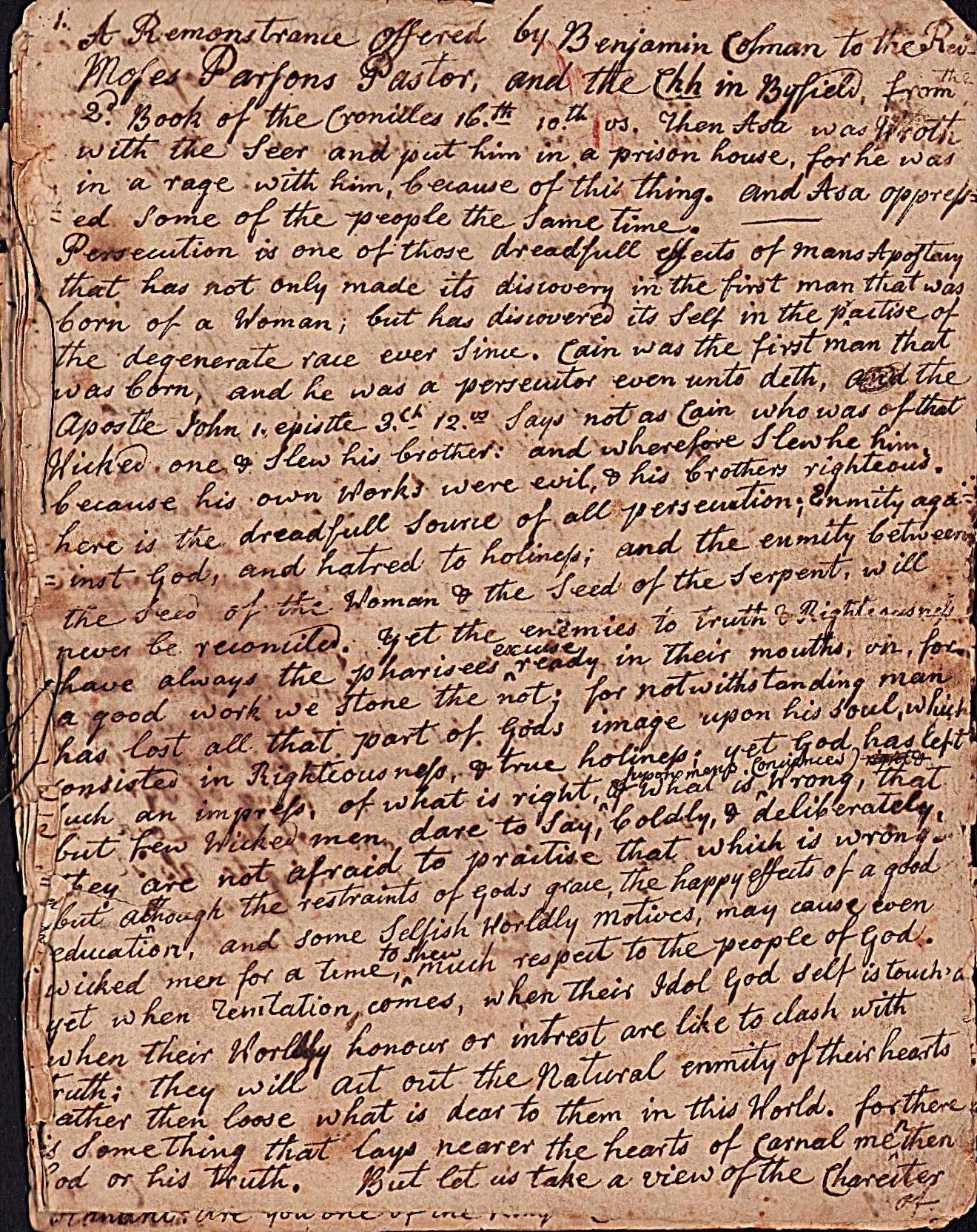
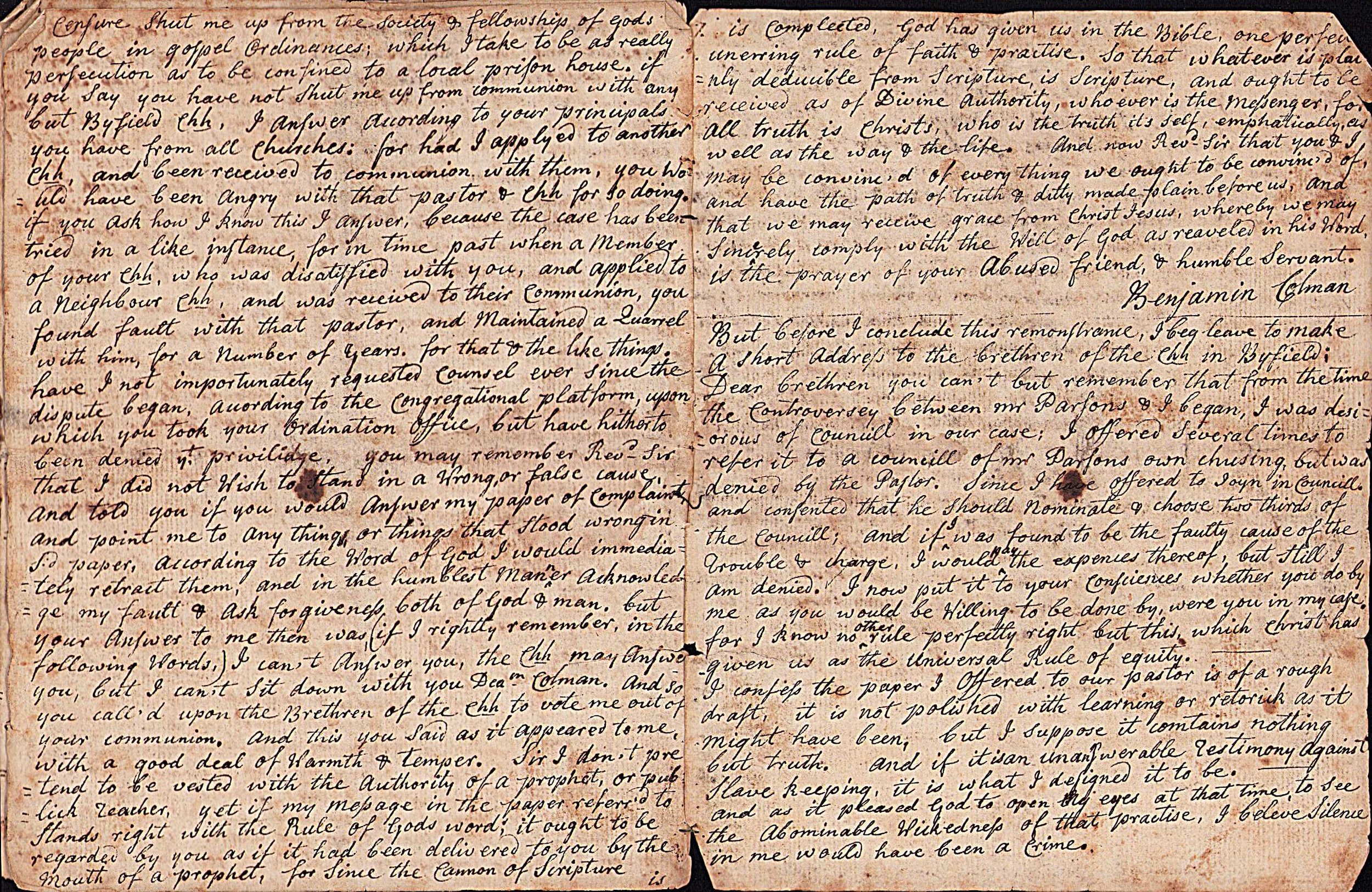
A Remonstrance Offered by Benjamin Colman, November 3, 1783
A Remonstrance Offered by Benjamin Colman to the Rev'd Moses Parsons Pastor, and the Chh in Byfield, from 2d Book of the Cronicles 16th. 10th. vs. Then Asa was wroth with the Seer and put him in a prison house, for he was in a rage with him; because of this thing, and Asa oppressed Some of the people the Same time.
Persecution is one of those dreadfull effects of mens Apostasy that has not only made its discovery in the first man that was born of a Woman; but has discovered its Self in the relatives of the degenerate race ever Since. Cain was the first man that was born, and he was a persecutor even unto death, and the Apostle John 1. epistle 3d. Ch. 12. vs. Says not as Cain who was of that Wicked one & Slew his brother: and wherefore Slew he him, because his own works were evil, & his brothers righteous. here is the dreadfull Source of all persecution; Enmity against God; and hatred to holiness; and the enmity between the Seed of the Woman & the Seed of the Serpent; will never be reconciled. Yet the enemies to truth & Righteousness have always the Pharisees excuse ready in their mouths, viz. for a good work we Stone thee not; for notwithstanding man has lost all that part of Gods image upon his Soul, which consisted in Righteousness & true holiness; yet God had left such an impress of what is right, & what is wrong, upon his Conscience; that but few Wicked men, dare to Say, boldly, & deliberately, they are not afraid to practise that which is wrong; but although the restraints of Gods grace, the happy effects of a good education, and some Selfish Worldly motives, may cause even Wicked men for a time, to Shew much respect to the people of God. Yet when temptation comes, when their Idol God Self is touch'd, when their Worldly honour or interest are like to clash with truth; they will act out the Natural enmity of their hearts rather then lose what is dear to them in this World. for there is Something that lays nearer the hearts of carnal men then God or his truth. But let us take a view of the Character of King Asa as it stands upon Sacred record.
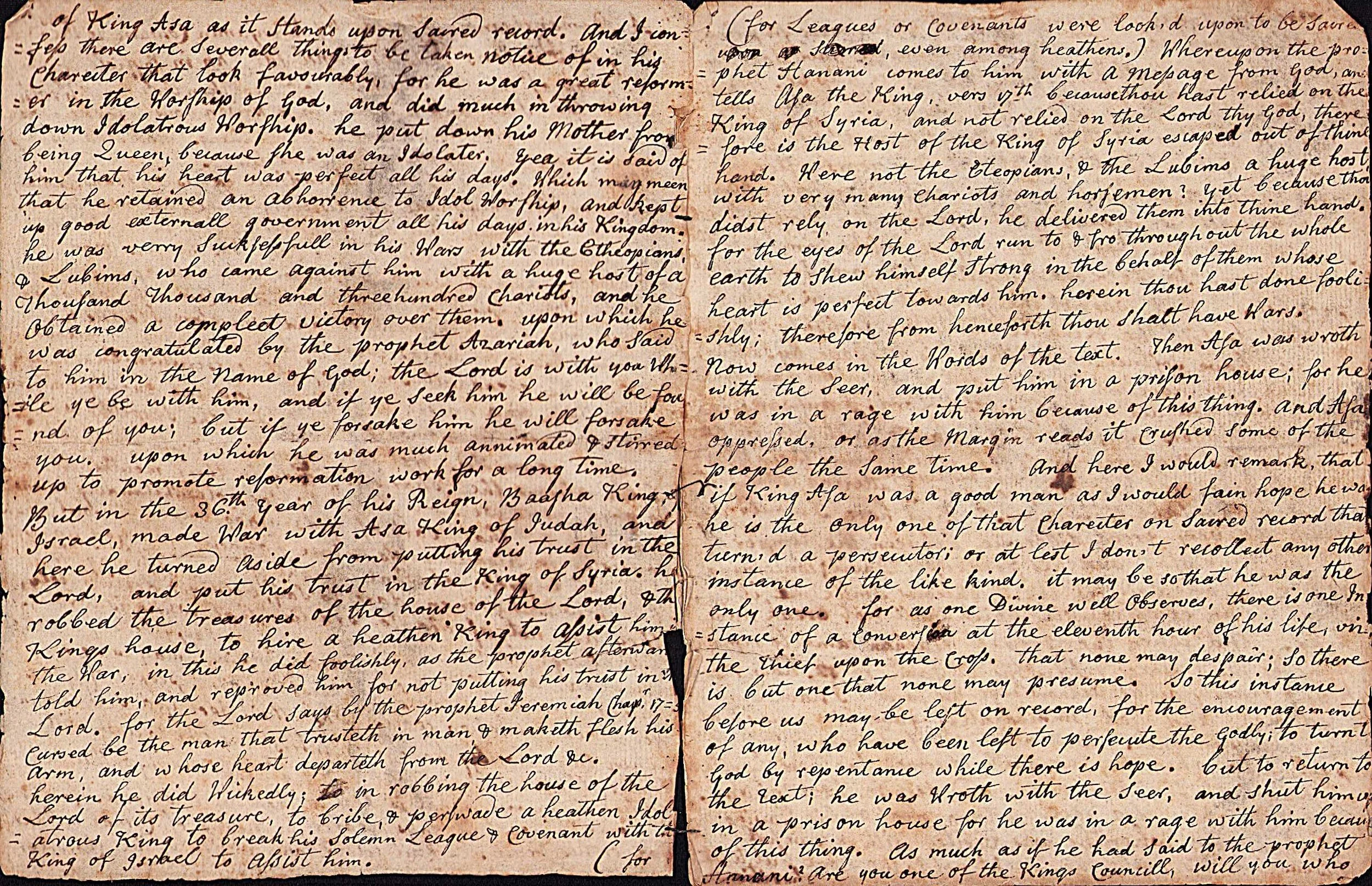
And I confess there are Severall things to be taken notice of in his Character that look favourably, for he was a great reformer in the Worship of God, and did much in throwing down Idolatrous Worship. he put down his Mother from being Queen, because She was an Idolater. yea it is Said of him that his heart was perfect all his days. Which may meen that he retained an abhorrence to Idol Worship, and kept up good externall government all his days in his Kingdom. he was very Successfull in his Wars with the Ethiopians & Lubims, who came against him with a huge host of a Thousand Thousand and three hundred chariots, and he obtained a compleat victory over them. upon which he was congratulated by the prophet Azariah, who Said to him in the Name of God; the Lord is with you While ye be with him, and if ye Seek him he will be found of you; but if ye forsake him he will forsake you. upon which he was much animated & Stirred up to promote reformation work for a long time.
But in the 36th year of his Reign, Baasha King of Israel made War with Asa King of Judah, and here he turned Aside from putting his trust in the Lord, and put his trust in the King of Syria. he robbed the treasures of the house of the Lord, & the Kings house, to hire a heathen King to assist him in the War, in this he did foolishly, as the prophet afterwards told him, and reproved him for not putting his trust in ye Lord. for the Lord Says by the prophet Jeremiah chap. 17. Cursed be the man that trusteth in man & maketh flesh his Arm, and whose heart departeth from the Lord &c. herein he did Wickedly; in robbing the house of the Lord of its treasure, to bribe, & persuade a heathen Idolatrous King to break his Solemn League & Covenant with the King of Israel to Assist him. (for Leagues or Covenants were look'd upon to be Sacred even among heathens.)
Whereupon the prophet Hanani comes to him with a Message from God, and tells Asa the King, ver. 7th. because thou hast relied on the King of Syria, and not relied on the Lord thy God, therefore is the Host of the King of Syria escaped out of thine hand. Were not the Ethiopians, & the Lubims a huge host with very many chariots and horsemen? yet because thou didst rely on the Lord, he delivered them into thine hand. for the eyes of the Lord run to & fro throughout the whole earth to Shew himself Strong in the behalf of them whose heart is perfect towards him. herein thou hast done foolishly; therefore from henceforth thou shalt have Wars.
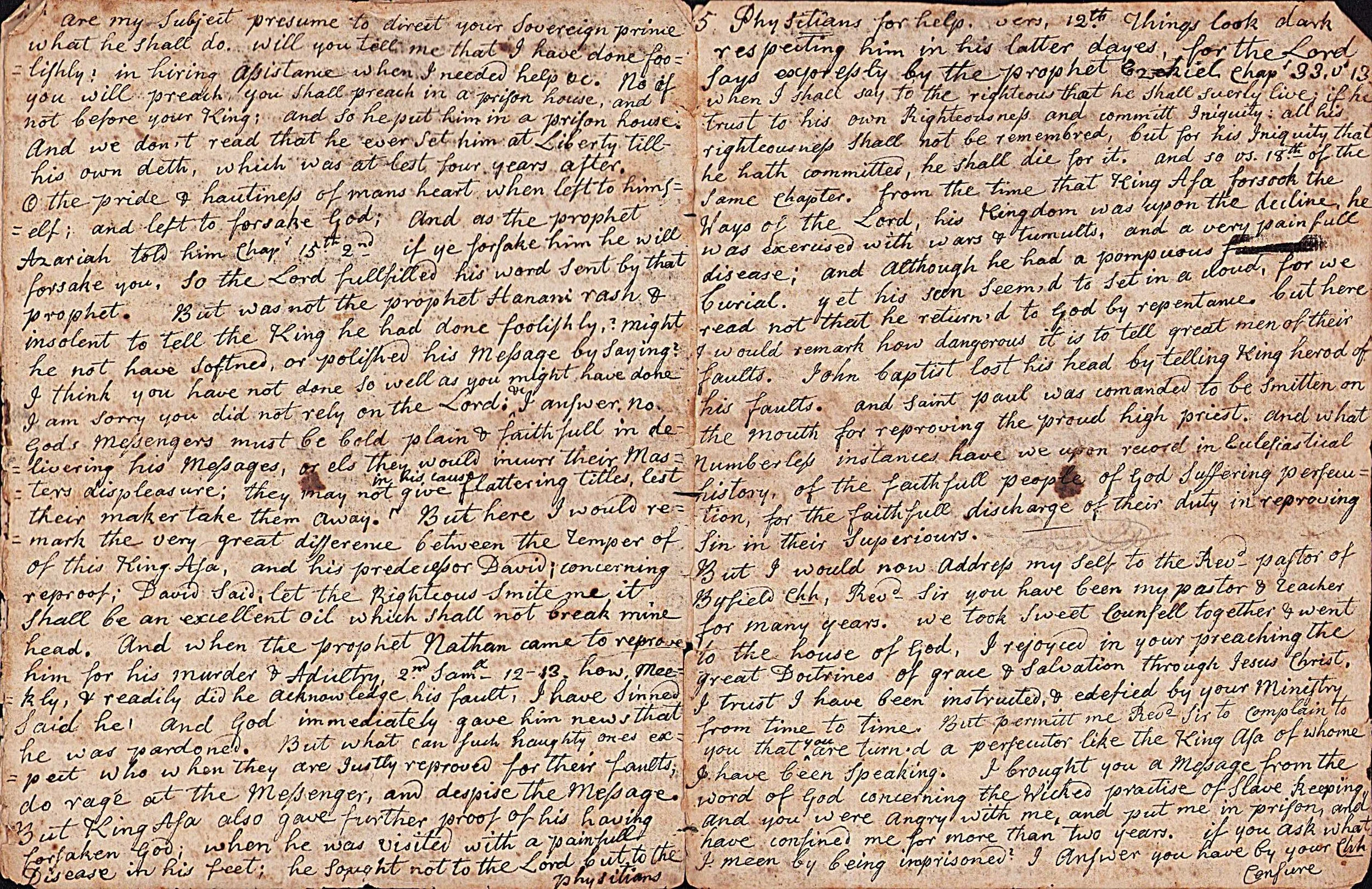
Now comes in the Words of the Text. Then Asa was wroth with the Seer, and put him in a prison house; for he was in a rage with him because of this thing. And Asa oppressed, or as the Margin reads it crushed some of the people the Same time. And here I would remark, that if King Asa was a good man as I would fain hope he was, he is the only one of that Character on Sacred record that turn'd a persecutor; or at least I don't recollect any other instance of the like kind. it may be So that he was the only one. for as one Divine well Observes, there is one instance of a conversion at the eleventh hour of his life, viz. the thief upon the Cross, that none may despair; So there is but one that none may presume. So this instance before us may be left on record, for the encouragement of any, who have been left to persecute the Godly; to turn to God by repentance while there is hope. but to return to the Text; he was Wroth with the Seer, and Shut him up in a prison house for he was in a rage with him because of this thing. As much as if he had Said to the prophet Hanani; are you one of the Kings Councill, will you who are my Subject presume to direct your Sovereign prince what he Shall do. will you tell me that I have done foolishly? in hiring Assistance when I needed help &c. If you will preach, you Shall preach in a prison house, and not before your King: and So he put him in a prison house. And we don't read that he ever Set him at Liberty till his own death, which was at least four years after.
O the pride & haughtiness of mans heart when left to himself; and left to forsake God; And as the prophet Azariah told him Chap. 15th. 2d. if ye forsake him he will forsake you. So the Lord fulfilled his word Sent by that prophet. But was not the prophet Hanani rash & insolent to tell the King he had done foolishly? might he not have Softned, or polished his Message by Saying? I think you have not done So well as you might have done, I am Sorry you did not rely on the Lord. No, I answer, no Gods Messengers must be bold plain & faithfull in delivering his Messages, or els they would incur their Masters displeasure; they may not give in his cause flattering titles, lest their maker take them away.
But here I would remark the very great difference between the Temper of this King Asa, and his predecessor David; concerning reproof. David Said, let the Righteous Smite me, it Shall be an excellent Oil which Shall not break mine head. And when the prophet Nathan came to reprove him for his murder & Adultery, 2d. Sam. 12-13 how, meekly, & readily did he acknowledge his fault, I have Sinned Said he! and God immediately gave him news that he was pardoned. But what can such haughty ones expect who when they are Justly reproved for their faults, do rage at the Messenger, and despise the Message. But King Asa also gave further proof of his having forsaken God; when he was visited with a painfull disease in his feet; he Sought not to the Lord but to the Physitians for help. ver. 12th.
Things look dark respecting him in his latter days, for the Lord Says expressly by the prophet Ezekiel Chap. 33. v. 13 when I Shall Say to the righteous that he Shall Surely live; if he trust to his own Righteousness and commit Iniquity; all his righteousness Shall not be remembered, but for his Iniquity that he hath committed, he Shall die for it. and So vs. 18th. of the Same Chapter. from the time that King Asa forsook the Ways of the Lord, his Kingdom was upon the decline, he was exercised with wars & tumults, and a very painfull disease; and although he had a pompous burial, yet his Sun Seem'd to Set in a cloud, for we read not that he return'd to God by repentance.
But here I would remark how dangerous it is to tell great men of their faults. John baptist lost his head by telling King herod of his faults. and Saint paul was commanded to be Smitten on the mouth for reproving the proud high priest. and what Numberless instances have we upon record in Ecclesiastical history, of the faithfull people of God Suffering persecution, for the faithfull discharge of their duty in reproving Sin in their Superiours.
But I would now Address my Self to the Rev'd pastor of Byfield Chh, Rev'd Sir you have been my pastor & Teacher for many years. we took Sweet Counsell together; & went to the house of God, I rejoiced in your preaching the great Doctrines of grace & Salvation through Jesus Christ, I trust I have been instructed, & edefied by your Ministry from time to time. But permit me Rev'd Sir to Complain to you that you are turn'd a persecutor like the King Asa of whome I have been Speaking. I brought you a Message from the word of God concerning the Wicked practise of Slave Keeping, and you were Angry with me, and put me in prison, and have confined me for more than two years. if you ask what I meen by being imprisoned? I Answer you have by your Chh Censure, Shut me up from the Society & fellowship of Gods people in gospel Ordinances; which I take to be as really persecution as to be confined to a local prison house.
If you Say you have not Shut me up from communion with any but Byfield Chh, I Answer According to your principles, you have from all Churches. for had I applyed to another Chh, and been received to communion with them, you would also have been Angry with that pastor & Chh for So doing. if you ask how I know this I Answer, because the case has been tried in a like instance, for in time past when a Member of your Chh, who was dissatisfied with you, and applyed to a Neighbour Chh, and was received to their Communion, you found fault with that pastor, and Maintained a Quarrel with him, for a Number of years. for that & the like things.
Have I not importunately requested Counsel ever Since the dispute began, According to the Congregational platform, upon which you took your Ordination Office, but have hitherto been denied ye privilege. you may remember Rev'd Sir that I did not Wish to Stand in a Wrong, or false cause; and told you if you would Answer my paper of Complaint, and point me to any thing, or things that Stood wrong in Said paper, According to the Word of God I would immediately retract them, and in the humblest Manner Acknowledge my fault & ask forgiveness both of God & man. but your Answer to me then was (if I rightly remember, in the following Words,) I can't Answer you, the Chh may Answer you, but I can't Sit down with you Dea'n Colman. And So you call'd upon the Brethren of the Chh to vote me out of your communion. And this you Said as it appeared to me, with a good deal of Warmth & Temper.
Sir I don't pretend to be vested with the Authority of a prophet, or publick Teacher, yet if my message in the paper refer'd to Stands right with the Rule of Gods word; it ought to be regarded by you as if it had been delivered to you by the Mouth of a prophet, for Since the Cannon of Scripture is compleated God has given us in the Bible, one perfect unerring rule of Faith & practise; So that whatever is plainly deducible from Scripture, is Scripture, and ought to be received as of Divine Authority, whoever is the Messenger, for all truth is Christ's, who is the truth its Self, emphatically, as well as the way & the life.
And now Rev'd Sir that you & I may be convinc'd of every thing we ought to be convinc'd of, and have the path of truth & duty made plain before us, and that we may receive grace from Christ Jesus, whereby we may Sincerely comply with the Will of God as revealed in his Word, is the prayer of your Abused friend, & humble Servant.
Benjamin Colman
But before I conclude this remonstrance, I beg leave to make a Short Address to the brethren of the Chh in Byfield;
Dear brethren you can't but remember, that from the time the Controversy between Mr Parsons & I began, I was desirous of Councill in our case; I offered Several times to refer it to a Councill of Mr Parsons own choosing, but was denied by the Pastor. Since I have offered to Join in Councill and consented that he Should nominate & choose two thirds of the Councill; and if I was found to be the faulty cause of the Trouble & charge, I would pay the expences thereof; but Still I am denied. I now put it to your Consciences whether you do by me as you would be Willing to be done by, were you in my case, for I know no other rule perfectly right but this, which Christ has given us as the Universal Rule of equity.
I confess the paper I offered to our pastor is of a rough draft, it is not polished with Learning or rhetorick as it might have been, but I Suppose it contains nothing but truth. and if it is an unanswerable Testimony against Slave keeping, it is what I designed it to be. and as it pleased God to open my eyes at that time, to See the abominable Wickedness of that practise, I believe Silence in me would have been a Crime.
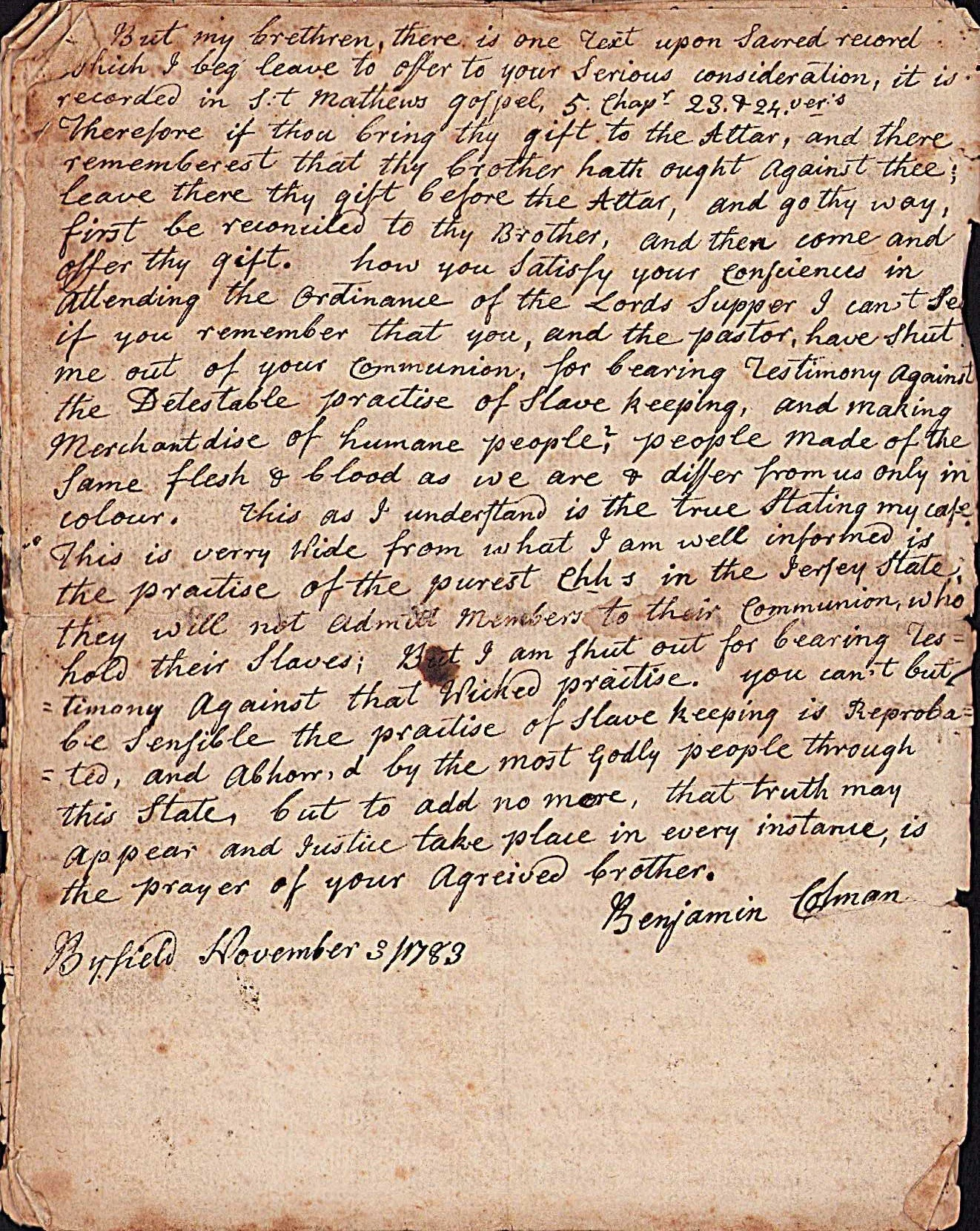
But my brethren, there is one Text upon Sacred record which I beg leave to offer to your Serious consideration, it is recorded in St. Matthews gospel, 5th. Chapr. 23 & 24. vers. Therefore if thou bring thy gift to the Altar, and there rememberest that thy brother hath ought against thee; Leave there thy gift before the Altar, and go thy way; first be reconciled to thy Brother, and then come and Offer thy gift. how you Satisfy your Consciences in Attending the Ordinance of the Lords Supper I can't See, if you remember that you, and the pastor, have Shut me out of your communion, for bearing Testimony against the Detestable practise of Slave keeping, and making Merchandise of humane people; people made of the Same flesh & blood as we are & differ from us only in colour. this as I understand is the true Stating my case.
This is very Wide from what I am well informed is the practise of the purest Chh's in the Jersey State; they will not admit Members to their Communion who hold their Slaves; Yet I am Shut out for bearing Testimony Against that Wicked practise. you can't but be Sensible the practise of Slave keeping is Reprobated, and Abhorr'd by the most Godly people through this State, but to add no more, that truth may Appear and Justice take place in every instance, is the prayer of your Agrieved brother.
Benjamin Colman
Byfield November 3 1783