
Adventures in the Archives: Voting in Newburyport Through the Centuries
by Susan Squires, PARC Volunteer
Ripping out an old built-in bookcase at my house, a local bit of history slipped from behind a shelf. It was a campaign card for George E. Twomey of 193 High Street in Newburyport. Twomey was running for the state legislature with the slogan, “For Conscientious Leadership.” With a bit of sleuthing, I discovered that Twomey was a state representative in Massachusetts from 1964 to1972. If you are wondering if this is the same George Twomey who established the Twomey, LeBlanc, & Conte Funeral Home in Newburyport, you would be right. (2)
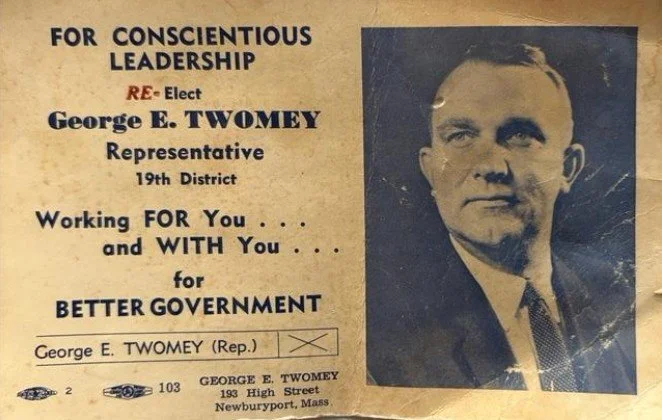
Push Card for George E. Twomey, Perkins Art & Research Center, Museum of Old Newbury.
Although it has been almost 60 years since Twomey ran for office, the card has a familiar look. I wondered how different the first United States election of 1788 was. I started a little digging only to find the first election in Essex County was all about digging out.
On December 18, 1788 a late December snowstorm had made the roads almost impassable. Despite, “a thin turnout” in Essex County (2), 265 men trudged through the snow to the Courthouse on Lower State Street near the waterfront in Newburyport to cast their vote in the first ever presidential election. Most of you will not be surprised that voting was restricted to men. Women would not get the vote until 1920. There were other restrictions. The idea of citizenship was not fully developed but wealth was an important criterion. Voting was limited in the Massachusetts Constitution of 1780 to any free adult man who owned land or had a substantial annual income (3, 4).
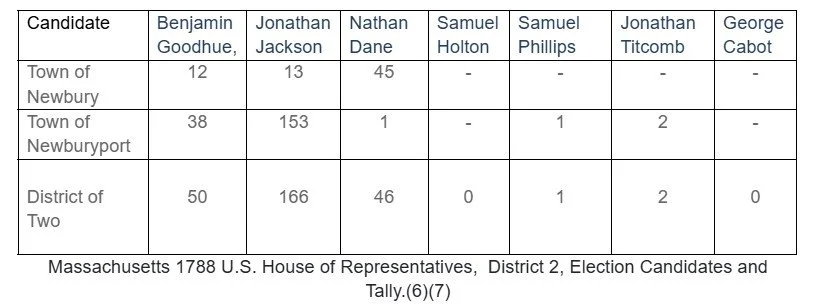
I can picture all those wealthy merchants, ship captains, and maybe a few landowners, who had managed to get through the snow drifts, shaking off the snow, slapping each other on the back and passing around a bottle of rum before loudly declaring their vote for George Washington. All knew how everyone voted. There were no secret ballots in those days— that would take another 100 years. The men were also there to select someone for the House of Representatives for their district – District 2. Jonathan Jackson was the local favorite. Although born in Boston, he had moved to Newburyport after graduating from Harvard in 1761 and built an impressive house at 201 High Street in 1771 – the same house that Timothy Dexter would later buy in 1798 (5).
Jackson’s main competitor was Benjamin Goodhue, a Salem merchant. Jackson won the local vote at the courthouse in Newburyport.
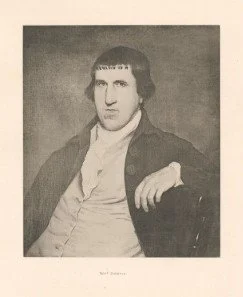
Benjamin Goodhue by unknown artist, Courtesy of the NYPL Digital Gallery, The New York Public Library
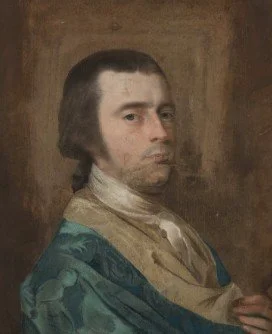
Portrait of Jonathan Jackson by John Singleton Copley
But, to the disappointment of all the men who had braved the storm, Benjamin Goodhue of Salem won district wide. It appears to have been a personality contest. Politically both men held similar views, they were Federalists and part of a coalition of bankers and businessmen who supported a fiscally sound national government and improved ties with Great Britain (8).
Eventually both men would go on to have distinguished political careers. Benjamin Goodhue would serve in Congress from March 4, 1789, until his resignation in June 1796 (9). Jonathan Jackson would be elected to the Massachusetts state senate in 1789 and then was appointed the United States Marshal for the District of Massachusetts from 1789-179. Later he became the 3rd Treasurer and Receiver-General of Massachusetts 1802-1806 (10). Politics runs in the family; Jackson’s descendants include great-grandson Oliver Wendell Holmes Jr. who served on the U.S. Supreme Court (11), and fifth great-grandson Patrick G. Jackson, a surgeon, who is married to Supreme Court Justice Ketanji Brown Jackson (12).
Sources:
The Boston Globe, 2002, Obituary for George E. Twomey, Feb 13. Online at https://www.newspapers.com/article/the-boston-globe-obituary-for-george-e/37497068/
The Massachusetts Centinel (Boston, MA). December 20, 1788.
Felt Collection Massachusetts Archives, Secretary of the Commonwealth, online at https://www.sec.state.ma.us/divisions/archives/collections/mass-archives-collection.htm
Voting Rights (and Wrongs) after the American Revolution, nd, in Elections in Massachusetts, The Commonwealth Museum, online at https://www.sec.state.ma.us/divisions/commonwealth-museum/exhibits/online/Massachusetts-votes/elections-in-ma_3.htm
Labaree, Benjamin W., 1962 Patriots and Partisans: the Merchants of Newburyport 1764-1815, Harvard University Press: Cambridge.
Lampi Collection of American Electoral Returns, 1788-1825. -- American Antiquarian Society, 2007 Online at A New Nation Votes: American Elections Returns 1787-1825 https://elections.lib.tufts.edu/catalog/sx61dn60v
Jensen, Merrill and Robert A. Becker, ed. The Documentary History of the First Federal Elections: 1788-1790. Vol. I. Madison, WI: University of Wisconsin Press, 1976. 585-599.
Lind, Michael (1997). Hamilton's Republic. Free Press, Simon & Schuster.
Benjamin Goodhue 1748 – 1814, Biographical Directory of the United State Congress in History, Art and Archive online at https://en.wikipedia.org/wiki/Benjamin_Goodhue#cite_note-FOOTNOTEGoodhue189134-4
Jonathan Jakson 1743-1810, Biographical Directory of the United State Congress in History, Art and Archives online at https://history.house.gov/People/Detail/15718#external-research-collections
Gates, Merrill E., ed. (1905). Men of Mark in America. Vol. 1. Washington, DC: Men of Mark Publishing Company
American Ancestor, 2022, Ancestry of Dr. Patrick Graves Jackson, New England Historic Genealogical Society July 8.